15 mins Pilates on your terms – anytime, anywhere.
Get your plan
15 mins Pilates on your terms – anytime, anywhere.
Get your plan
Wall Pilates is a low-impact exercise method that combines traditional Pilates principles with wall support to provide stability, proper alignment, and joint-friendly resistance training. For women over 40, Wall Pilates delivers measurable strength gains, improved posture, and enhanced muscle tone in 15-20 minute sessions without equipment or gym membership.
This guide provides 50+ exercises organized by body part and difficulty level, complete with progression strategies, safety protocols, and evidence-based timelines for visible results.
What Is Wall Pilates and Why It Works After 40
Pilates Principles Meet Wall Support: The Perfect Combination
Wall Pilates is a form of Pilates exercise performed using a wall as the primary support surface and resistance tool. The wall provides tactile feedback for body positioning, making it easier to maintain proper spinal alignment, shoulder placement, and hip stability throughout each movement.
The method combines five core Pilates principles breath control, controlled movement, precision, flow, and mind-body engagement with the stability benefits of vertical wall contact. This combination reduces the learning curve compared to mat Pilates while providing more accessible resistance than reformer machines.
The wall acts as a constant reference point for posture correction. When your back touches the wall, you immediately feel whether your pelvis tilts forward, your lower back arches excessively, or your shoulders round forward. This real-time feedback system allows you to correct alignment errors during movement rather than after injury occurs.
How Wall Pilates Differs from Mat and Reformer Pilates
Wall Pilates differs from mat Pilates by providing external support that eliminates the need for advanced body awareness to maintain proper form. On a mat, you rely entirely on proprioception and core strength to stay aligned. Against a wall, the vertical surface guides your positioning and prevents compensation patterns that lead to injury.
Reformer Pilates uses springs and sliding platforms to create variable resistance, requiring gym access and equipment investment ranging from $300 to $3,000. Wall Pilates requires only a clear wall space and delivers comparable resistance through isometric holds, eccentric loading, and bodyweight leverage at zero cost.
The simplicity of Wall Pilates makes it more sustainable for beginners and those managing joint limitations. There are no moving parts to coordinate, no springs to adjust, and no machine learning curve to overcome before seeing results.
Why Women Over 40 See Better Results with Wall Support
Women over 40 experience accelerated muscle loss (sarcopenia), decreased bone density, reduced joint mobility, and hormonal changes that affect muscle recovery and fat distribution. Wall Pilates addresses these specific age-related challenges through four mechanisms:
First, the wall provides joint protection during strength training. Impact-free movements preserve cartilage and connective tissue while still challenging muscles through isometric holds and controlled eccentric phases. This allows higher training frequency without overuse injury.
Second, wall support enables deeper core muscle activation. The stable surface lets you focus on engaging the transverse abdominis, pelvic floor, and hip stabilizers without worrying about balance. Research shows that Pilates training increases core strength by over 30% in middle-aged women during 12-week programs.
Third, the wall assists with movements that would otherwise be impossible due to strength limitations. Wall push-ups, for example, allow you to build upper body strength progressively by adjusting foot distance from the wall creating a scalable resistance system that adapts to your current capacity.
Fourth, wall-based exercises improve proprioception and balance through single-leg work performed with hand support. This reduces fall risk, which increases dramatically after age 40 and represents a major cause of disability and fractures in older women.
Benefits Specific to Women Over 40
Joint-Friendly Strength Building: No Impact, Full Support
Wall Pilates is a zero-impact training method that builds muscle strength without joint compression or repetitive stress on cartilage. Every exercise maintains continuous contact with either the wall or floor, eliminating the impact forces present in running, jumping, or high-intensity interval training.
The wall absorbs stabilization demands, allowing your muscles to work through full ranges of motion without requiring your joints to provide stability simultaneously. This dual-tasking reduction protects joints while maximizing muscle fiber recruitment.
A systematic review of Pilates training in older adults found significant improvements in balance, posture, and flexibility with no reported joint injuries across multiple studies. The low-impact nature makes it safe for women with osteoarthritis, previous joint injuries, or osteoporosis who cannot perform traditional strength training.
Core Strengthening for Better Posture and Back Health
Core strength is the foundation for spinal stability, upright posture, and pain-free movement in daily activities. The core includes the transverse abdominis, multifidus, pelvic floor, diaphragm, and deep hip stabilizers all of which activate during properly performed Wall Pilates exercises.
A 12-week Pilates study in middle-aged women measured core strength increases exceeding 30% using functional movement assessments. Participants showed improved ability to maintain neutral spine position during bending, lifting, and reaching tasks.
Wall-based core work offers advantages over floor exercises for Women Over 40. Wall roll-downs articulate each vertebra sequentially against the wall surface, providing instant feedback when segments stick or fail to move independently. Wall planks reduce wrist strain while maintaining the same core activation as floor planks.
Stronger core muscles reduce lower back pain by distributing loads evenly across the spine and pelvis. This prevents compensatory movement patterns that overload individual vertebrae and lead to chronic pain conditions.
Balance Improvement and Fall Prevention
Balance decline begins in the 40s and accelerates through the 50s and 60s, driven by reduced muscle mass, slower reaction times, and decreased sensory input from foot receptors. Falls are the leading cause of injury-related death in women over 65, making balance training a critical health priority.
Wall Pilates improves balance through progressive single-leg exercises performed with hand support on the wall. This allows you to challenge your balance system safely, gradually reducing wall contact as stability improves. Wall-supported single-leg work activates the glute medius, ankle stabilizers, and core muscles responsible for maintaining upright posture on one foot.
A meta-analysis of Pilates training in older adults found significant improvements in both static balance (standing still) and dynamic balance (walking, turning) compared to control groups. The effect sizes were large enough to translate into meaningful fall risk reduction.
The wall provides psychological safety that encourages trying more challenging balance variations. You can lean away from the wall, lift your leg higher, or close your eyes knowing the wall is there if you wobble. This confidence-building approach leads to faster balance improvements than unsupported exercises that limit challenge due to fear of falling.
Muscle Tone Without Bulk or Joint Stress
Wall Pilates builds lean muscle tone through controlled eccentric movements and isometric holds rather than heavy lifting. This training style creates defined muscles without the bulk associated with traditional weightlifting, which many women over 40 prefer aesthetically.
Eccentric training (lengthening under tension) and isometric holds (static positions) both stimulate muscle growth and strength without requiring heavy loads. Wall squats held at 90 degrees for 30-45 seconds create intense muscle activation in the quadriceps, glutes, and core despite using only bodyweight.
This approach also protects joints from excessive loading. Heavy weights increase compression forces on knees, hips, and spine forces that can damage already-thinning cartilage in women over 40. Wall Pilates achieves similar muscle activation through time under tension and movement precision rather than weight progression.
Research confirms that Pilates improves muscle tone and functional strength without increasing muscle bulk. The focus on muscle endurance (longer holds, more repetitions) rather than maximal force production creates the toned appearance most women over 40 seek.
Improved Flexibility and Mobility
Flexibility and mobility naturally decline after age 40 due to increased collagen cross-linking in fascia, reduced joint fluid production, and decreased regular movement through full ranges of motion. This stiffness affects daily function, making it harder to reach overhead, bend to tie shoes, or turn to check blind spots while driving.
Wall Pilates addresses flexibility through dynamic stretching integrated with strength work. Wall roll-downs lengthen the hamstrings and spine simultaneously. Wall calf stretches done between exercises maintain lower leg mobility. Wall-supported hip flexor stretches relieve tightness from prolonged sitting.
A systematic review found that Pilates practitioners performing 1-3 sessions weekly showed significant flexibility and mobility improvements across multiple studies of older adults. The improvements were maintained as long as practice continued, suggesting sustainable long-term benefits.
The wall enables deeper stretches by providing stable support. In a wall-supported hamstring stretch with one foot elevated on the wall, you can relax into the stretch without tensing muscles to maintain balance. This allows greater length gains compared to unsupported stretching positions.
Time-Efficient: Effective in 15-20 Minutes
Wall Pilates delivers complete workouts in 15-20 minutes through high exercise density and minimal transition time. The wall's versatility means you can perform lower body, upper body, and core exercises without changing equipment or location.
Time efficiency makes consistency achievable. Women over 40 juggle careers, family responsibilities, and personal health needs making hour-long gym sessions difficult to sustain. Fifteen-minute Wall Pilates sessions fit into lunch breaks, morning routines, or evening wind-downs without requiring travel time or gym access.
The brevity also supports recovery. Shorter sessions allow for 3-4 weekly workouts without overtraining, which is critical for women over 40 whose recovery capacity decreases with age. Research shows that moderate-duration, higher-frequency training produces better results in older adults than long, exhausting sessions.
Because the wall is always available, you eliminate common barriers to exercise: bad weather, gym closures, crowded facilities, or equipment unavailability. This consistency advantage compounds over months and years, creating sustainable fitness habits that deliver lasting results.
The 5 Core Principles of Wall Pilates Practice

Breath: Coordinating Movement with Controlled Breathing
Breath coordination is the deliberate synchronization of inhalation and exhalation patterns with specific phases of exercise movement. In Wall Pilates, you inhale during the preparation phase and exhale during the exertion phase, creating a rhythmic pattern that enhances muscle activation and core stability.
The breathing pattern follows this structure: inhale through the nose to prepare and expand the ribcage, then exhale through the mouth as you initiate movement or effort. During a wall squat, you inhale at the top position, then exhale steadily as you lower into the squat. This exhale-on-effort pattern activates the deep core muscles through increased intra-abdominal pressure.
Against the wall, you can feel your ribcage expand laterally during inhalation and your abdomen draw inward during exhalation. This tactile feedback teaches proper diaphragmatic breathing rather than shallow chest breathing, which limits oxygen delivery and reduces core engagement.
Controlled breathing also regulates nervous system activation. Slow, deliberate exhales stimulate the parasympathetic nervous system, reducing stress hormones and allowing deeper muscle relaxation between repetitions. This creates the calm, focused state characteristic of effective Pilates practice.
Control: Quality Over Quantity in Every Movement
Control refers to deliberate, conscious regulation of movement speed, muscle activation, and position throughout each exercise. In Wall Pilates, control means moving slowly enough to feel every muscle working and stopping immediately if form breaks down.
The principle prioritizes perfect repetitions over high repetition counts. Five wall squats performed with precise form, full depth, and controlled tempo produce better results than 20 rushed repetitions with partial range and momentum. This approach prevents injury and ensures target muscles not compensatory muscles perform the work.
Wall contact provides instant feedback about control quality. If your shoulders pull away from the wall during a wall roll-down, you moved too quickly and lost control. If your lower back arches during a wall plank, you failed to control pelvic position through core engagement.
Control develops through practice and attention. Beginners should perform exercises at half-speed, pausing at the most challenging position for 2-3 seconds before continuing. This deliberate pacing builds the neuromuscular coordination necessary for maintaining form as difficulty increases.
Precision: Exact Positioning and Alignment
Precision is the practice of achieving exact body positioning and joint alignment according to specific cues for each exercise. In Wall Pilates, precision determines whether exercises strengthen the intended muscles or reinforce dysfunctional movement patterns.
Precise positioning includes: feet hip-width apart with toes forward, knees aligned over ankles, pelvis neutral with sacrum touching the wall, ribcage stacked over pelvis, shoulder blades gently contacting the wall, and head in line with spine. These reference points create optimal force distribution and prevent compensatory patterns.
The wall serves as an alignment guide. During wall squats, your back maintains continuous contact with the wall as you lower, preventing the forward lean that loads the knees excessively. During wall push-ups, hand placement directly under shoulders ensures proper shoulder mechanics and prevents impingement.
Precision requires focused attention. Before each exercise, establish proper positioning by checking foot placement, pelvic tilt, shoulder position, and head alignment. Make micro-adjustments until position feels balanced and comfortable. This pre-movement preparation prevents injury and maximizes exercise effectiveness.
Flow: Smooth Transitions Between Exercises
Flow is the quality of continuous, smooth movement both within individual exercises and between different exercises in a sequence. In Wall Pilates, flow connects movements into a cohesive practice rather than isolated, disconnected exercises.
Within a single exercise, flow appears as smooth transitions between phases. In wall roll-downs, you articulate one vertebra at a time in a continuous flowing motion rather than jerky, segment-by-segment movement. This fluidity indicates proper muscle recruitment and nervous system coordination.
Between exercises, flow minimizes rest periods and maintains elevated heart rate for cardiovascular benefit. After completing wall squats, you transition directly into wall leg lifts without leaving the wall. This continuous movement pattern transforms strength exercises into moderate-intensity cardiovascular training.
Flow develops through practice and sequencing. Beginners should plan exercise order so transitions feel natural: wall squats followed by wall bridges (both lower body), then wall planks followed by wall push-ups (both upper body). This grouping creates logical flow and reduces setup time.
Engagement: Mind-Body Connection Throughout
Engagement is the conscious awareness of muscle activation, body position, and movement quality maintained throughout every exercise. In Wall Pilates, engagement means continuously monitoring which muscles are working, how movement feels, and whether form remains precise.
The mind-body connection distinguishes Pilates from mindless repetition. During a wall plank, you actively think about pulling the navel toward the spine, squeezing the glutes, pressing forearms into the wall, and maintaining a straight line from head to heels. This conscious direction produces deeper muscle activation than simply holding the position.
Wall contact enhances engagement by providing sensory feedback. You feel pressure distribution across your back during wall squats, noticing if one shoulder blade loses contact or if your lower back arches away. This information allows real-time form corrections that prevent injury and improve effectiveness.
Engagement develops through internal focus. During each exercise, mentally scan your body from head to feet, noting areas of tension, muscles working, and any pain or discomfort. Use this information to adjust position, reduce intensity, or identify which muscles need strengthening. This awareness prevents injury and accelerates progress.
Getting Started: Essential Setup and Safety

What You Need: Clear Wall Space and Comfortable Clothing
Wall Pilates requires a firm, flat wall surface free of obstructions such as light switches, outlets, decorations, or furniture within three feet. The wall should be sturdy enough to support your body weight when pressing or leaning against it. Most interior walls meet this requirement, including drywall, concrete, and plaster surfaces.
A non-slip exercise mat provides cushioning for floor exercises and prevents sliding during movements like wall bridges where feet press against the wall. Standard yoga mats (4-6mm thickness) work well. If exercising on carpet, the mat is optional but still recommended for hygiene and defined exercise space.
Clothing should allow unrestricted movement in all directions. Fitted athletic wear (leggings and tank tops or fitted t-shirts) works better than loose clothing that bunches between your body and the wall. Avoid clothing with thick seams, buttons, or zippers along the spine that create uncomfortable pressure points against the wall.
Bare feet or grip socks provide the best foot-to-wall contact during exercises like wall bridges. Running shoes are unnecessary and can reduce ankle mobility. Remove jewelry that might scratch the wall or catch during movement.
Proper Body Positioning Against the Wall
Proper starting position establishes neutral alignment before movement begins. Stand with your back to the wall and position your heels 2-4 inches away from the wall base. Your feet should be hip-width apart with toes pointing forward.
Lean back until three points of contact touch the wall: your head (or upper back if forward head posture exists), your shoulder blade area (thoracic spine), and your sacrum (the bony triangle at the base of your spine). Your lower back will have a small natural gap between your spine and the wall this is normal and correct.
Maintain a neutral pelvis by imagining your pelvis is a bucket of water that you're keeping level. If you tilt the bucket forward, water spills out the front (anterior pelvic tilt with excessive lower back arch). If you tilt backward, water spills out the back (posterior pelvic tilt with flat lower back). Neutral pelvis keeps the bucket level.
Relax your shoulders down and slightly back, allowing shoulder blades to gently contact the wall without forcing them together or elevating them toward your ears. Your arms hang naturally by your sides or rest on the wall at shoulder height, depending on the exercise.
Engage your core lightly by drawing your navel toward your spine without holding your breath or creating tension. This engagement should feel like gently hugging your midsection, not sucking in your stomach forcefully.
Warming Up: 5-Minute Preparation Routine
Warming up prepares muscles, joints, and the nervous system for exercise by increasing blood flow, elevating body temperature, and rehearsing movement patterns. A proper warm-up reduces injury risk and improves exercise performance.
Begin with 60 seconds of gentle marching in place, lifting knees toward hip height while swinging arms naturally. This elevates heart rate and increases circulation to working muscles.
Next, perform 10 shoulder rolls: lift shoulders toward ears, roll them back and down in a circular motion. This mobilizes the shoulder joints and releases upper body tension common from desk work and computer use.
Perform 10 arm circles with arms extended at shoulder height. Make small circles forward for 5 repetitions, then reverse direction for 5 repetitions. Gradually increase circle size to expand shoulder range of motion.
Stand with your back against the wall and perform 5 wall roll-downs at slow, controlled pace. Tuck your chin, peel your spine away from the wall one vertebra at a time, and lower your hands toward your feet. Reverse the movement, stacking one vertebra at a time back against the wall. This mobilizes the spine and rehearses the movement pattern used in many Wall Pilates exercises.
Finish with 10 alternating knee lifts against the wall: balance on one leg while lifting the opposite knee toward your chest, lightly touching the wall with one hand for support. This activates hip flexors, glutes, and core muscles while practicing single-leg balance.
Safety Considerations and Modifications
Women with osteoporosis should avoid exercises involving spinal flexion (rounding forward), such as wall roll-downs, due to increased fracture risk. Substitute spine extension exercises or maintain neutral spine position throughout all movements.
Those with shoulder impingement, rotator cuff injuries, or frozen shoulder should modify wall push-ups and overhead arm positions. Keep arms below shoulder height and reduce range of motion until pain-free movement returns. Consult a physical therapist for specific shoulder rehabilitation exercises before advancing.
Uncontrolled high blood pressure requires medical clearance before starting exercise programs. Avoid exercises involving sustained breath-holding or straining, which spike blood pressure. Maintain steady breathing throughout all movements.
Women recovering from abdominal or pelvic surgery (hysterectomy, c-section, hernia repair) should wait for full medical clearance, typically 6-12 weeks post-surgery. Begin with gentle core engagement exercises and progress gradually as healing permits.
Dizziness during wall exercises may indicate blood pressure changes, dehydration, or inner ear problems. Slow the pace, ensure adequate hydration, and avoid rapid position changes from lying to standing. If dizziness persists, consult your physician before continuing.
Stop immediately if you experience sharp pain, not to be confused with muscle burning from exertion. Sharp, stabbing, or shooting pain indicates potential injury and requires assessment before continuing. Muscle fatigue and mild discomfort are normal; pain is not.
When to Progress and When to Modify
Progress to more advanced variations when you complete the current exercise with perfect form for the prescribed duration or repetitions without excessive fatigue. Perfect form means maintaining all alignment cues, breathing steadily, and showing no compensatory movements.
Specific progression indicators include: completing 10-12 repetitions with full range of motion, holding positions for 45-60 seconds without shaking or form breakdown, and recovering quickly (within 30 seconds) between sets. If these standards are met consistently across three consecutive sessions, progress to the next level.
Modify exercises by increasing wall contact, reducing range of motion, or decreasing hold time when current variations feel too challenging. More wall contact provides additional support standing closer to the wall during wall push-ups reduces resistance. Reduced range of motion squatting only to 45 degrees instead of 90 degrees decreases difficulty while maintaining muscle activation.
Never sacrifice form quality to achieve progression targets. Performing 15 wall squats with knees collapsing inward is worse than performing 8 squats with perfect alignment. Quality always supersedes quantity in Wall Pilates practice.
Foundational Wall Pilates Exercises

Wall Squats: Perfect Form Guide and Variations
Wall squats are a lower body strengthening exercise performed with the back in continuous contact with a wall throughout the movement. The exercise primarily targets the quadriceps, glutes, and hamstrings while the wall support protects the lower back and helps maintain proper knee alignment.
Stand with your back against the wall and position your feet hip-width apart. Walk your feet forward 1-2 feet from the wall base while maintaining back contact with the wall. This foot position creates approximately 90-degree hip and knee angles at the bottom of the squat.
Initiate the movement by sliding down the wall as if sitting into a chair. Lower until your thighs reach parallel to the floor (90-degree knee bend) or as close as comfortable. Your knees should align directly over your ankles, not extending past your toes. Maintain back contact with the wall throughout the lowering phase.
Hold the bottom position for 2-3 seconds while maintaining steady breathing. Press through your heels to slide back up the wall to the starting position. Complete 8-10 repetitions for beginners, 12-15 for intermediate practitioners.
Beginner modification: Lower only to 45 degrees (quarter squat) and reduce hold time to 1 second. Place feet closer to the wall for additional support.
Advanced variation: Hold the bottom position (90-degree squat) for 30-45 seconds as an isometric wall sit. Or, walk feet further forward, creating a deeper squat angle at the bottom.
Common mistakes to avoid: knees collapsing inward (maintain hip-width position throughout), lifting heels off the floor (indicates tight calves or improper foot position), and losing lower back contact with the wall (suggests core engagement failure).
Wall Planks: Core Engagement and Progression
Wall planks are a core strengthening exercise performed facing the wall with forearms placed against the wall surface while the body maintains a straight line from head to heels. The exercise activates the transverse abdominis, rectus abdominis, and obliques while reducing wrist strain compared to floor planks.
Face the wall and place your forearms flat against the wall at shoulder height, with elbows bent at 90 degrees. Walk your feet backward until your body creates a diagonal line from head to heels. Your body weight shifts onto your forearms and toes.
Engage your core by pulling your navel toward your spine. Squeeze your glutes to prevent your lower back from sagging. Press your forearms firmly into the wall. Maintain this position while breathing steadily avoid holding your breath.
Hold for 20-30 seconds for beginners, 45-60 seconds for intermediate, and 60-90 seconds for advanced practitioners. Rest 30 seconds between sets and complete 2-3 sets.
The closer your feet are to the wall, the easier the exercise. For beginners, start with feet only 2-3 feet from the wall. For progression, walk feet further back, increasing the diagonal angle and resistance.
Proper form indicators: straight line from head to heels (no hip sagging or pike position), steady breathing (no breath-holding), and shoulders directly above elbows (not above or below).
Common mistakes: allowing hips to sag toward the floor (indicates weak core engagement), hiking hips up (compensating for lack of core strength), and holding breath (creates excessive tension and reduces endurance).
Advanced progressions: perform wall plank with one arm extended forward for 20 seconds, alternating arms. Or, lift one leg off the floor for 15 seconds while maintaining level hips, then switch legs.
Wall Push-Ups: Upper Body Strength Safely
Wall push-ups are an upper body pressing exercise performed facing the wall with hands placed flat against the wall surface while bending and straightening the elbows. The exercise strengthens the chest (pectorals), shoulders (anterior deltoids), and triceps while eliminating wrist strain and floor impact.
Stand facing the wall and place your palms flat against the wall at shoulder height and shoulder-width apart. Walk your feet backward 2-3 feet from the wall base. Your body forms a diagonal line from head to heels.
Engage your core and glutes to maintain body alignment. Inhale as you bend your elbows, lowering your chest toward the wall in a controlled manner. Keep elbows at approximately 45 degrees from your torso not flared wide to 90 degrees.
Lower until your nose nearly touches the wall or until you reach your comfortable range of motion. Exhale as you press through your palms, straightening your elbows and returning to the starting position.
Complete 10-12 repetitions for beginners, 15-20 for intermediate practitioners. Rest 45 seconds between sets and perform 2-3 sets.
The further your feet are from the wall, the more resistance the exercise provides. Beginners should start with feet 2 feet from the wall. Advanced practitioners can position feet 3-4 feet away, creating a more horizontal body angle.
Proper form requires: neutral spine throughout the movement (no sagging or piking), elbows traveling close to the body (45-degree angle), and controlled tempo (2 seconds down, 1 second up).
Common errors include: flaring elbows out to 90 degrees (increases shoulder impingement risk), letting the head jut forward (misaligns the spine), and bouncing off the wall at the bottom (uses momentum instead of muscle control).
Progressive variation: perform wall push-ups with a narrow hand position (hands touching) to increase tricep activation, or with one hand elevated higher than the other to challenge stability and create asymmetric loading.
Wall Leg Lifts: Lower Body Sculpting
Wall leg lifts are a lower body exercise performed standing perpendicular to the wall while lifting one leg to the side, forward, or back with light wall support for balance. The exercise targets the glute medius, hip abductors, and hip flexors while improving single-leg balance and pelvic stability.
Stand with your right side facing the wall, approximately 6-12 inches away. Rest your right hand lightly on the wall at shoulder height for balance support only not for weight bearing. Shift your weight fully onto your right leg.
For lateral leg lifts (abduction): Keeping your left leg straight with toes pointing forward, lift your left leg directly out to the side 6-12 inches from the floor. Avoid leaning toward the wall or tilting your torso maintain upright posture throughout. Hold the lifted position for 1-2 seconds, then lower with control. Complete 12-15 repetitions, then switch sides.
For forward leg lifts (flexion): Lift your left leg forward with a straight knee until your thigh reaches parallel to the floor or as high as comfortable. Maintain neutral pelvis without arching your lower back. Lower with control and repeat 12-15 times before switching sides.
For back leg lifts (extension): Lift your left leg straight back 6-12 inches, squeezing your glute at the top of the movement. Avoid arching your lower back by engaging your core. Lower with control and complete 12-15 repetitions per side.
Progression methods: increase lift height gradually, add a 2-3 second hold at the top of each lift, or reduce wall contact by using only fingertip support instead of full palm contact.
Common mistakes: leaning the torso excessively (indicates weak hip stabilizers), swinging the leg with momentum (reduces muscle activation), and rotating the hips or pelvis (suggests using hip flexors instead of target muscles).
Wall Roll-Downs: Spinal Articulation and Core
Wall roll-downs are a spinal mobility and core strengthening exercise performed standing with the back against the wall while sequentially articulating each vertebra as the spine flexes forward. The exercise improves spinal flexibility, hamstring length, and core control while providing proprioceptive feedback through wall contact.
Stand with your back against the wall, feet hip-width apart and positioned 4-6 inches from the wall base. Establish neutral spine with three contact points: head (or upper back), shoulder blades, and sacrum touching the wall.
Inhale to prepare. Exhale as you tuck your chin toward your chest and begin rolling forward, peeling one vertebra at a time away from the wall. Your hands slide down the wall as your spine flexes forward.
Continue rolling down vertebra by vertebra until your hands reach mid-shin level or as far as comfortable without straining. Your hamstrings may limit how far you can reach never force the stretch. Hold the bottom position for 2-3 seconds while breathing normally.
To return, inhale and begin stacking your spine back onto the wall from the bottom up. Imagine placing one vertebra at a time back onto the wall surface, starting with your low back and ending with your head or upper back. Your head should be the last part to touch the wall.
Complete 5-8 repetitions, moving slowly and mindfully throughout each roll-down and roll-up. The entire movement should take 15-20 seconds per repetition.
Benefits include: improved spinal articulation and awareness, lengthened hamstrings and back muscles, enhanced core control during flexion movements, and reduced back tightness from prolonged sitting.
This exercise should be avoided by individuals with osteoporosis due to the spinal flexion position, which increases fracture risk in weakened vertebrae. These individuals should substitute spinal extension exercises or maintain neutral spine positions.
Common errors: rolling too quickly (prevents sequential articulation), holding breath during movement (creates tension), and bouncing at the bottom position (increases injury risk).
Wall Bridges: Glute Activation and Hip Strength
Wall bridges are a lower body and core exercise performed lying on your back with feet elevated on the wall while pressing hips toward the ceiling. The exercise primarily targets the glutes, hamstrings, and lower back extensors while engaging core muscles for stability.
Lie on your back on an exercise mat with your body perpendicular to the wall. Position yourself close enough to the wall so that when you place both feet flat on the wall surface, your knees bend at approximately 90 degrees. Your arms rest alongside your body, palms facing down.
Engage your core and press your feet firmly into the wall. Exhale as you lift your hips off the floor, pressing upward until your body forms a straight diagonal line from shoulders to knees. Squeeze your glutes maximally at the top position.
Hold the lifted position for 2-3 seconds while maintaining even pressure through both feet on the wall. Avoid letting your hips rotate or drop to one side. Inhale as you lower your hips back to the floor with control.
Complete 12-15 repetitions for beginners, 15-20 for intermediate practitioners. Rest 30-45 seconds between sets and perform 2-3 sets.
Proper form cues: Press through heels rather than toes on the wall (increases glute activation), keep knees aligned with hips throughout the movement (prevents inward knee collapse), maintain level hips (no rotation or tilting), and avoid arching the lower back excessively at the top position.
Beginner modification: Reduce the range of motion by lifting hips only halfway up. Or, keep one foot on the floor for additional stability while the other foot presses against the wall.
Advanced variation: Single-leg wall bridge perform the exercise with one foot on the wall while extending the other leg straight toward the ceiling. Hold for 1-2 seconds at the top, then lower. Complete 8-10 repetitions per leg.
Common mistakes: pushing through toes instead of heels (reduces glute activation and increases quad dominance), letting knees fall inward or outward (indicates weak hip stabilizers), and not fully extending hips at the top (limits glute engagement).
Complete Exercise Library by Body Part: 50+ Moves
Core-Focused Exercises: 12 Variations
- Wall Roll-Down - Sequential spinal flexion while sliding hands down the wall, returning vertebra by vertebra. Improves spinal articulation and core control. Perform 5-8 slow repetitions.
- Wall Hundred - Lean back against the wall with arms extended forward, pulsing arms up and down rapidly while maintaining core engagement. Builds core endurance. Complete 100 arm pulses.
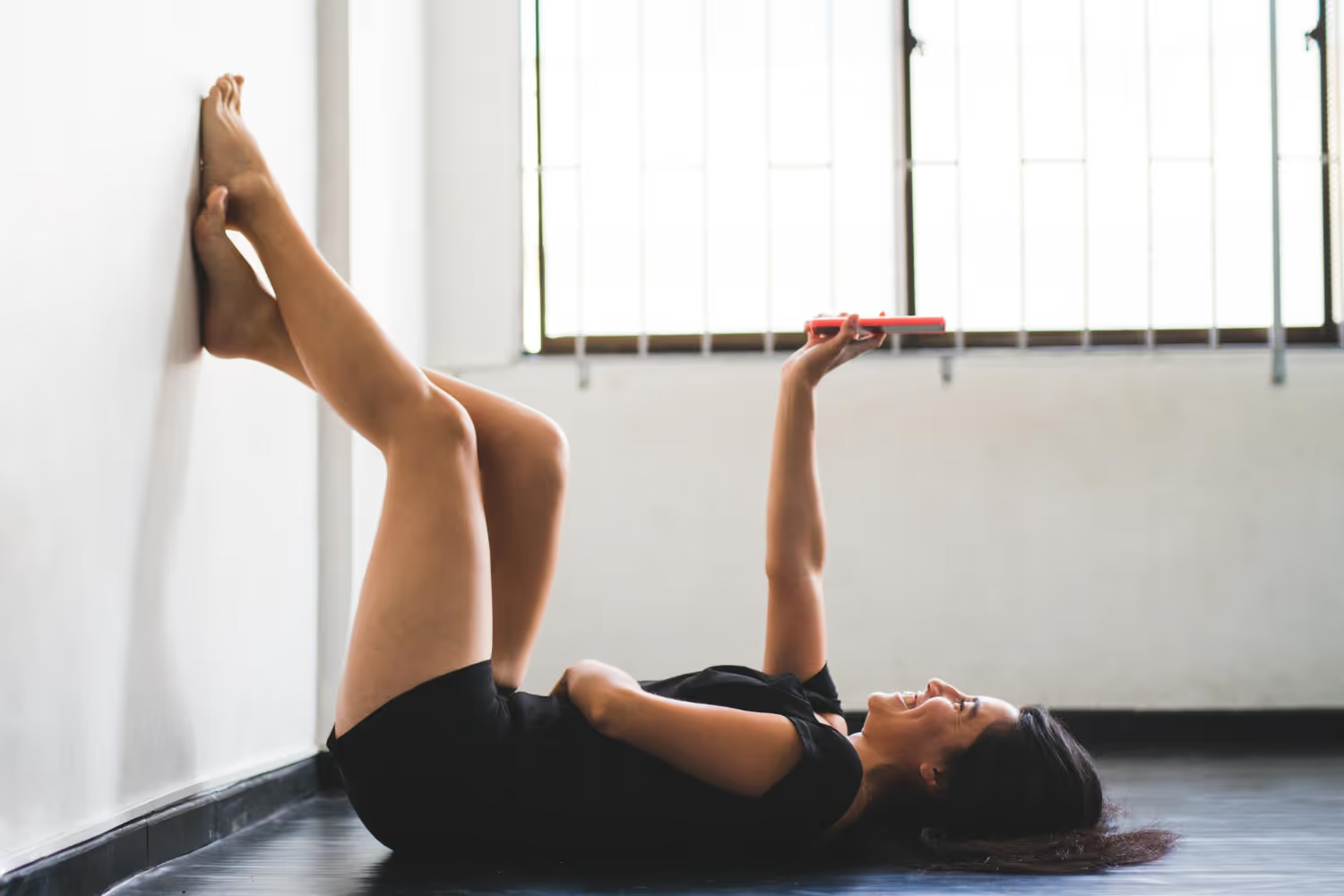
- Wall Leg Circles - Lie on back with one leg extended up the wall, drawing small circles with the foot. Challenges core stability while mobilizing hips. Perform 10 circles each direction per leg.
- Criss-Cross on Wall - Lie on back near the wall with knees bent and feet on the wall. Perform alternating elbow-to-opposite-knee rotations while maintaining stable pelvis. Targets obliques. Complete 20 total repetitions (10 per side).
- Side Wall Plank - Stand perpendicular to the wall with one forearm pressed against it, body forming a diagonal line. Hold for 30-45 seconds per side. Strengthens obliques and lateral core stabilizers.
- Wall Plank - Face the wall with forearms pressed against it at shoulder height, body in straight line. Hold for 30-60 seconds. Primary core stability exercise.
- Wall Hollow Hold - Lean back against the wall with arms extended overhead and core maximally engaged, maintaining lower back contact with the wall. Hold for 20-30 seconds. Advanced core endurance exercise.
- Wall Single-Leg Kickback - Face the wall in plank position with forearms on the wall. Alternate kicking one leg back while maintaining level hips. Perform 10-12 repetitions per leg.
- Wall Roll-Up Variation - Stand with back to wall, roll down to forward fold, walk hands forward into plank position against wall, then reverse. Combines core control with dynamic movement. Complete 5-6 repetitions.
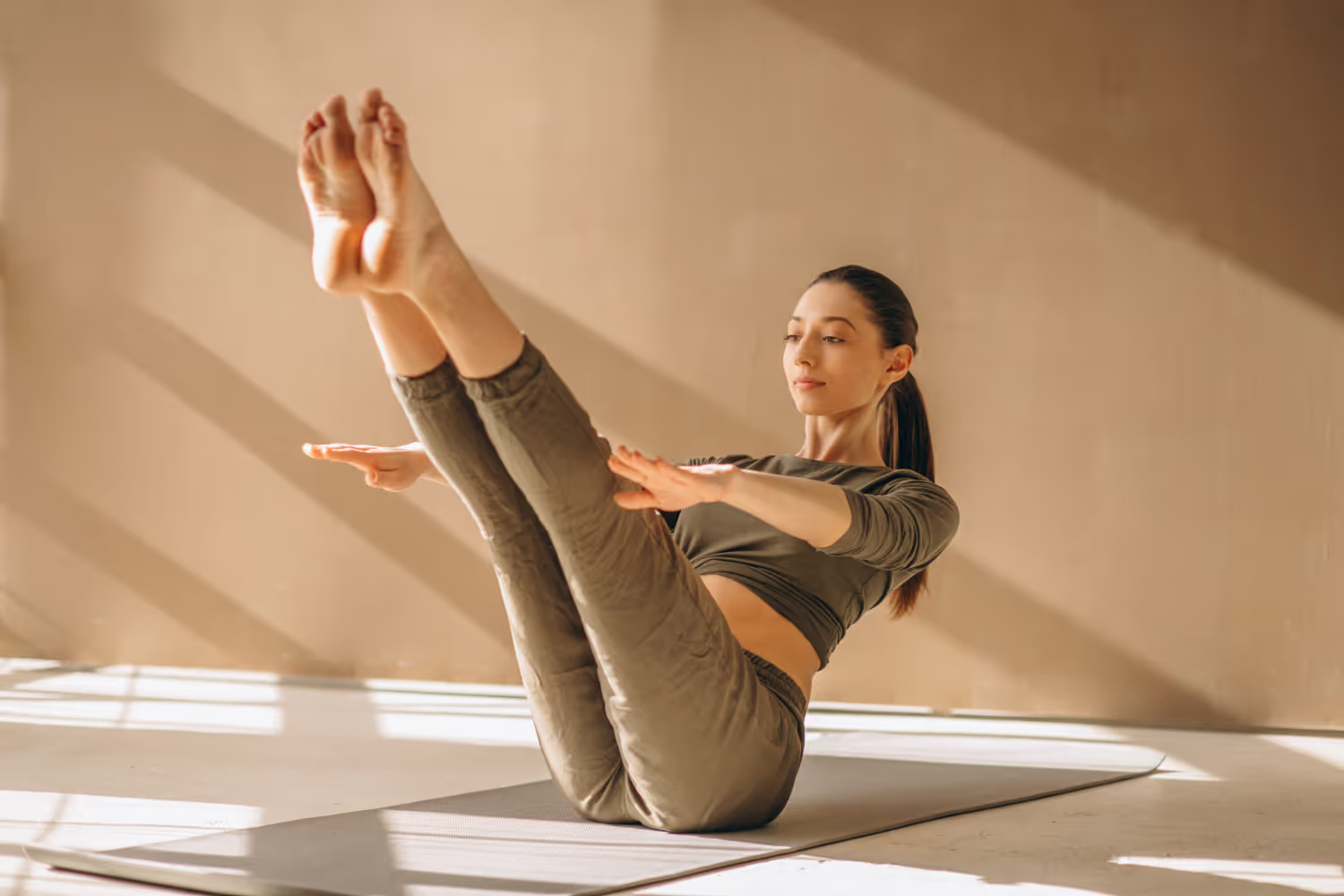
- Wall Teaser Variation - Sit facing the wall with feet elevated on the wall surface, knees bent. Lean back slightly and extend arms forward, balancing on sitting bones. Hold for 15-30 seconds. Advanced core balance exercise.
- Wall Side Bend - Stand with right side against the wall, right arm extended overhead along the wall. Slide the arm up the wall while laterally flexing the spine. Perform 8-10 repetitions per side. Targets obliques and lateral spine mobility.
- Wall Oblique Reach and Return - Stand sideways to the wall, reach across your body to touch the wall with the far hand, engaging obliques during rotation. Return to neutral. Complete 10-12 repetitions per side.
Lower Body Exercises: 15 Variations
- Wall Squat - Slide back against the wall while lowering into a squat position, maintaining back contact throughout. Primary lower body strengthening exercise. Perform 8-12 repetitions.
- Wall Sit - Hold the bottom position of a wall squat (90-degree knee bend) for 30-60 seconds. Isometric quad and glute strengthener.
- Wall Split-Stance Deadlift - Stand facing away from the wall in a split stance (one foot forward), hinge at hips while sliding back toward the wall for support. Targets hamstrings and glutes. Complete 10-12 repetitions per leg.
- Wall Glute Bridge with Feet on Wall - Lie on back with feet elevated on the wall, press hips up into bridge position. Primary glute activation exercise. Perform 12-15 repetitions.
- Wall Hamstring Curl with Feet on Wall - From wall bridge position with hips lifted, bend knees to pull heels down the wall toward your glutes. Targets hamstrings. Complete 10-12 repetitions.
- Wall Single-Leg Bridge - Perform glute bridge with one foot on the wall, other leg extended straight up. Advanced glute and hamstring exercise. Do 8-10 repetitions per leg.
- Wall Leg Lift: Side, Forward, and Back - Stand perpendicular to the wall, lift the free leg in different directions while maintaining upright posture. Targets hip abductors, flexors, and extensors. Perform 12-15 repetitions in each direction per leg.
- Wall Calf Raise - Stand facing the wall with hands pressed against it for light support. Rise onto toes, hold for 2 seconds, then lower. Strengthens calves. Complete 15-20 repetitions.
- Wall Reverse Lunge to Wall - Step backward into a lunge while keeping hands lightly on the wall for balance. Return to standing. Perform 10-12 repetitions per leg.
- Wall Chair Pose with Heel Raise - Hold wall squat position and add alternating heel raises, lifting one heel at a time while maintaining the squat depth. Challenges balance and calf strength. Complete 20 total lifts (10 per heel).
- Wall Curtsy Lunge - Stand facing away from the wall, step one leg behind and across the body into a curtsy position, lightly touching the wall for balance. Targets glutes and inner thighs. Do 10-12 repetitions per leg.
- Wall Side Lunge - Stand sideways to the wall, step the outside leg laterally into a side lunge while maintaining hand contact with the wall. Strengthens inner and outer thighs. Perform 10-12 repetitions per side.
- Wall Sumo Squat - Stand with back to the wall, feet wider than shoulders and toes turned out 45 degrees. Slide down into a wide squat. Targets inner thighs and glutes. Complete 10-12 repetitions.
- Wall Elevated Single-Leg Squat - Stand on one leg with the opposite foot resting on the wall behind you. Lower into a single-leg squat while maintaining balance with hand on the wall. Advanced exercise. Perform 6-8 repetitions per leg.
- Wall Bridge March - Hold wall bridge position and alternate lifting one foot off the wall into a marching motion. Challenges glute endurance and stability. Complete 20 total marches (10 per leg).
Upper Body Exercises: 10 Variations
- Wall Push-Up - Face the wall with hands pressed against it at shoulder height, perform push-ups by bending and straightening elbows. Primary upper body pressing exercise. Complete 10-15 repetitions.
- Wall Tricep Dips - Stand facing away from the wall, place hands behind you on the wall at hip height, bend and straighten elbows. Targets triceps. Perform 8-12 repetitions.
- Wall Shoulder Press (Bodyweight) - Face the wall in plank position with forearms on the wall, press body up so arms straighten overhead, then lower. Advanced shoulder exercise. Do 6-10 repetitions.
- Wall Angels - Stand with back against the wall, arms in goalpost position (elbows bent 90 degrees). Slide arms up and down the wall in a snow-angel pattern. Improves shoulder mobility and posture. Perform 10-12 repetitions.
- Wall Scapular Slides - Stand facing the wall with forearms pressed against it. Slide forearms up the wall while maintaining elbow contact. Strengthens serratus anterior and shoulder stabilizers. Complete 10-12 repetitions.
- Wall Narrow Push-Up - Perform wall push-ups with hands close together (touching or 6 inches apart). Increases tricep activation. Do 8-12 repetitions.
- Wall One-Arm Push-Up - Perform wall push-ups with one hand on the wall, the other hand behind your back or on your hip. Advanced unilateral exercise. Complete 6-8 repetitions per arm.
- Wall T-Raises - Stand sideways to the wall with one arm extended along the wall at shoulder height. Slide the arm up and back to create a "T" shape with your body. Strengthens posterior shoulder and upper back. Perform 10-12 repetitions per side.
- Wall Bicep Curl Variation - Face the wall in plank position with palms flat on the wall. Bend elbows to lower body toward the wall while keeping upper arms stationary. Targets biceps with bodyweight. Do 10-12 repetitions.
- Wall Plank to Push-Up - Start in wall plank position on forearms. Press up onto hands one arm at a time, then lower back to forearms. Combines core stability with arm strength. Complete 8-10 repetitions.
Full-Body Integration Exercises: 8 Variations
- Wall Squat to Press - Perform a wall squat, then as you stand, press arms overhead along the wall. Combines lower body and shoulder work. Complete 10-12 repetitions.
- Wall Mountain Climber - Hold wall plank position and alternate bringing knees toward chest in a running motion. Cardiovascular and core exercise. Perform 30-40 total knee drives.
- Wall Ski Jumps Side-to-Side - Stand facing the wall with hands pressed against it. Jump feet side to side in a controlled manner while maintaining hand contact. Cardiovascular and leg exercise. Do 20-30 total jumps.
- Wall Lunge with Overhead Reach - Perform reverse lunge while simultaneously reaching arms overhead along the wall. Full-body integration. Complete 10-12 repetitions per leg.
- Wall Plank with Alternating Leg Lift - Hold wall plank and lift one leg off the ground, holding for 5 seconds before switching. Challenges balance and core stability. Perform 10-12 lifts per leg.
- Wall Bear Crawl Variation - Start in wall plank with hands on the wall. Alternate lifting opposite hand and foot off the wall (right hand and left foot together). Advanced coordination exercise. Complete 20 total movements (10 per side).
- Wall Reverse Lunge with Twist - Step back into a lunge while simultaneously rotating your torso toward the front leg. Light hand contact with the wall for balance. Combines lower body strength with core rotation. Do 10-12 repetitions per side.
- Wall Up-Down Plank Walk - Start in wall plank on forearms. Walk one hand up to plank on hands, then the other. Walk back down to forearms. Continuous movement pattern. Complete 8-10 cycles.
Flexibility and Mobility Exercises: 10 Variations
- Wall Hip Flexor Slide/Stretch - Stand facing away from the wall, extend one leg back and place the top of the foot against the wall. Lean forward to stretch the hip flexor. Hold 30-45 seconds per side.
- Wall Calf Stretch - Stand facing the wall with hands pressed against it. Step one foot back, keeping the heel down and leg straight. Lean into the wall to stretch the calf. Hold 30-45 seconds per side.
- Wall Thoracic Rotation - Stand perpendicular to the wall with one forearm pressed against it. Rotate your chest away from the wall, opening through the thoracic spine. Hold 20-30 seconds per side.
- Wall Glute Release and Hold - Sit on the floor near the wall with one ankle crossed over the opposite knee. Place the foot of the standing leg on the wall and gently press to deepen the glute stretch. Hold 30-45 seconds per side.
- Wall Doorway Pec Stretch - Stand in a doorway or at a corner wall with one forearm pressed against the wall at shoulder height. Rotate your body away from the wall to stretch the chest. Hold 30-45 seconds per side.
- Wall Shoulder Flexion Slide - Stand facing the wall with arms extended overhead, palms flat on the wall. Walk hands up the wall as high as comfortable, feeling a shoulder stretch. Hold 20-30 seconds.
- Wall Spine Extension Slide - Stand with back to the wall and hands reaching up the wall overhead. Gently arch the upper back away from the wall while sliding hands higher. Stretches the front body and extends the thoracic spine. Hold 20-30 seconds.
- Wall Glute-Hamstring Anchor Stretch - Lie on your back with one leg extended up the wall, keeping the leg straight. Gently pull the toes toward you to deepen the hamstring stretch. Hold 30-45 seconds per leg.
- Wall Side Leg Swing - Stand perpendicular to the wall with one hand resting on it. Swing the outside leg forward and back in a controlled pendulum motion. Mobilizes hip joint. Perform 15-20 swings per leg.
- Wall Ankle Mobility Slide - Face the wall with hands pressed against it. Step one foot forward and bend the knee, driving it toward the wall while keeping the heel down. Improves ankle dorsiflexion. Perform 10-12 repetitions per side.
Progression Strategy: Beginner to Advanced

Beginner Phase - Weeks 1-4: Building Foundation
The beginner phase establishes proper movement patterns, breathing coordination, and baseline strength before advancing to more challenging variations. This foundation prevents injury and ensures long-term progression.
During weeks 1-4, perform Wall Pilates 2-3 times per week with at least one rest day between sessions. Each session lasts 15-20 minutes including warm-up and cool-down.
Choose 5-6 foundational exercises per session: 2 lower body exercises (wall squats, wall bridges), 2 core exercises (wall planks, wall roll-downs), 1 upper body exercise (wall push-ups), and 1 flexibility exercise (wall calf stretch or wall roll-down for mobility).
Perform 8-10 repetitions per exercise or hold positions for 20-30 seconds. Rest 45-60 seconds between exercises. Focus on perfect form rather than completing more repetitions or longer holds.
Key focuses for beginners: maintain continuous wall contact during exercises, coordinate breathing with movement (exhale on effort), keep movements slow and controlled (no momentum), and establish neutral spine position before initiating movement.
Progression indicators for advancing from beginner to intermediate: you complete all exercises with perfect form, you can perform 10 repetitions or hold for 30 seconds without excessive fatigue, your breathing remains steady throughout exercises (no breathlessness or breath-holding), and you experience no joint pain during or after exercise.
Intermediate Phase - Weeks 5-8: Adding Complexity
The intermediate phase increases training volume, introduces more challenging exercise variations, and reduces rest periods to build strength endurance.
During weeks 5-8, increase session frequency to 3-4 times per week. Each session extends to 20-25 minutes.
Expand your exercise selection to 8-10 exercises per session, covering all major muscle groups. Include variations such as single-leg wall bridges, side wall planks, and wall squats with extended holds (30-45 second wall sits).
Perform 12-15 repetitions per exercise or hold positions for 30-45 seconds. Reduce rest periods to 30-45 seconds between exercises to maintain elevated heart rate.
Introduce progressive overload through: longer hold times for isometric exercises (wall sits, wall planks), reduced wall contact for balance exercises (using fingertips instead of full palm), increased range of motion (deeper squats, fuller roll-downs), and added tempo variations (3-second lowering phases on wall squats).
Key focuses for intermediate practitioners: maintain form quality as volume increases, incorporate single-leg variations to challenge balance, reduce wall dependency gradually where appropriate, and add rotation and lateral movements for functional strength.
Progression indicators for advancing to advanced level: you complete intermediate variations with excellent form, you can perform 15 repetitions or hold for 45 seconds while maintaining steady breathing, you recover quickly between exercises (within 30 seconds), and you feel challenged but not exhausted at session end.
Advanced Phase - Weeks 9-12: Challenging Variations
The advanced phase incorporates complex movement patterns, minimal wall support, and dynamic transitions to maximize strength, stability, and cardiovascular benefit.
During weeks 9-12, maintain 3-4 sessions per week with sessions lasting 25-30 minutes. Some sessions may focus on strength (longer holds, slower tempo) while others emphasize cardiovascular endurance (shorter rest, flowing transitions).
Select 10-12 exercises per session, prioritizing advanced variations: single-leg wall squats with elevated back foot, one-arm wall push-ups, wall plank with alternating leg lifts, and wall bridge marches.
Perform 15-20 repetitions or hold positions for 45-60 seconds. Reduce rest to 15-30 seconds between exercises to create continuous movement flow.
Advanced techniques include: minimal wall contact variations (using only fingertips or single-hand support), added instability (closing eyes during balance exercises), tempo contrasts (explosive press on wall push-ups followed by slow 5-second lowering), and combination movements (wall squat to overhead press, wall lunge with rotation).
Key focuses for advanced practitioners: maintain perfect form despite fatigue, incorporate plyometric elements where appropriate (wall ski jumps), create fluid transitions between exercises with minimal rest, and challenge stability systems through single-limb and reduced-support variations.
At the completion of 12 weeks, you will have developed: significant core strength for daily function and injury prevention, improved muscle tone and definition throughout the body, enhanced balance and coordination that reduces fall risk, greater flexibility and mobility for pain-free movement, and sustainable exercise habits that support long-term health.
How to Tell When You're Ready to Progress
Progress to the next phase when you meet all of the following criteria for the current level, demonstrated consistently across at least three consecutive sessions:
Form quality: You execute every exercise with perfect alignment, controlled tempo, and no compensatory movements. Your body maintains proper position throughout the full range of motion without breaking form as fatigue sets in.
Performance standards: You complete the prescribed repetitions or hold times for all exercises in the session. For beginner phase, this means 10 repetitions or 30-second holds. For intermediate, 15 repetitions or 45-second holds. For advanced, 20 repetitions or 60-second holds.
Recovery capacity: You recover quickly between exercises, with breathing returning to near-baseline within the prescribed rest period. You do not feel exhausted at the end of the session but rather energized and accomplished.
Absence of pain: You experience normal muscle fatigue and mild burning during exertion but no sharp pain, joint discomfort, or lingering soreness that lasts more than 48 hours post-exercise.
Confidence and control: You feel stable and confident during exercises, particularly single-leg variations and reduced-support movements. You can focus on muscle engagement rather than just maintaining balance.
If you meet some but not all criteria, remain at the current level and continue building consistency. There is no timeline requirement for progression some practitioners spend 6-8 weeks in the beginner phase, and this extended foundation period leads to better long-term results than rushing progression.
If you cannot meet the criteria after 6-8 weeks at a given level, consider: reducing session frequency to allow more recovery time, selecting easier exercise variations within the same phase, consulting a fitness professional to assess form and identify limiting factors, or addressing underlying issues such as inadequate nutrition, poor sleep, or excessive life stress that impair recovery.
Creating Your Wall Pilates Routine
Session Structure: Warm-Up, Work, Cool-Down
Every Wall Pilates session follows a three-part structure that prepares the body for exercise, executes the main training stimulus, and facilitates recovery.
The warm-up phase lasts 5 minutes and serves to increase body temperature, elevate heart rate, mobilize joints, and activate the nervous system for movement. Begin with 60 seconds of marching in place, followed by shoulder rolls, arm circles, wall roll-downs, and alternating knee lifts. The warm-up should feel easy and comfortable, bringing your body from rest state to ready state without creating fatigue.
The work phase lasts 10-20 minutes depending on session length and contains the primary exercises targeting strength, core stability, and muscle endurance. Organize exercises in a logical sequence: lower body exercises together (wall squats, wall bridges), upper body exercises together (wall push-ups, wall planks), and core exercises distributed throughout. This grouping minimizes transition time and maintains exercise flow.
The cool-down phase lasts 3-5 minutes and includes gentle stretching and controlled breathing to facilitate recovery, reduce muscle tension, and transition from exercise state back to rest state. Include wall-supported stretches: wall calf stretch, wall hip flexor stretch, wall chest stretch in doorway position, and wall-supported forward fold. Hold each stretch for 30-45 seconds without bouncing or forcing range of motion.
Session structure benefits: proper warm-up reduces injury risk by preparing muscles and joints for loading, organized work phase maximizes efficiency and exercise quality, cool-down reduces next-day soreness and promotes flexibility gains, and consistent structure creates routine that supports habit formation.
15-Minute Express Routine
The express routine delivers effective full-body training in minimal time for days when schedule constraints limit exercise time. The routine includes warm-up, work, and cool-down compressed into 15 total minutes.
Warm-up (3 minutes): 60 seconds marching in place, 10 shoulder rolls, 5 wall roll-downs at slow tempo.
Work phase (10 minutes): Select five exercises covering all major movement patterns. Perform each exercise for 60 seconds of work followed by 30 seconds of rest. Complete 1-2 rounds depending on available time.
Exercise selection for express routine: Wall squats (lower body), wall plank (core), wall push-ups (upper body), wall leg lifts - side (lateral stability), wall roll-down (mobility and core).
Cool-down (2 minutes): Wall calf stretch 30 seconds per side, wall forward fold 30 seconds, deep breathing 30 seconds.
The express routine maintains training consistency during busy periods, prevents the "all or nothing" mentality that derails exercise habits, provides sufficient stimulus to maintain strength between longer sessions, and fits into lunch breaks, morning routines, or evening schedules without time pressure.
Perform the express routine on days when a full 20-25 minute session is not feasible. Three express sessions per week are sufficient to maintain fitness during busy periods, though they should be supplemented with longer sessions when schedule permits.
20-Minute Full-Body Routine
The full-body routine provides comprehensive training across all major muscle groups with adequate volume for strength building and muscle toning.
Warm-up (5 minutes): Follow the standard warm-up protocol described earlier marching, shoulder rolls, arm circles, wall roll-downs, and knee lifts.
Work phase (12 minutes): Select 8-10 exercises distributed across lower body, upper body, core, and mobility. Perform each exercise for 45-60 seconds or 10-15 repetitions, with 15-30 seconds rest between exercises. Complete 1-2 rounds of the circuit.
Sample full-body routine:
- Wall squats - 12 repetitions
- Wall push-ups - 12 repetitions
- Wall plank - 45 seconds
- Wall bridges - 15 repetitions
- Wall leg lifts (side) - 12 per leg
- Wall roll-down - 6 repetitions
- Wall single-leg bridge - 10 per leg
- Wall angels - 12 repetitions
Cool-down (3 minutes): Wall calf stretch 30 seconds per side, wall chest stretch 30 seconds per side, wall forward fold 45 seconds, deep breathing 30 seconds.
This routine provides sufficient training volume for strength gains and body composition changes when performed 3-4 times per week. The balance of exercises ensures no muscle group is neglected while preventing overtraining of any single area.
Adjust the routine based on personal goals: for lower body emphasis, add an extra squat or lunge variation; for core focus, include side wall plank and wall hollow holds; for upper body development, incorporate narrow push-ups and wall tricep dips.
Combining Wall Pilates with Walking or Other Exercise
Wall Pilates integrates effectively with cardiovascular exercise such as walking, cycling, or swimming to create comprehensive fitness programming that addresses both strength and aerobic capacity.
Combination option 1 - Same day: Perform cardiovascular exercise first (20-30 minutes of brisk walking or cycling), followed immediately or within 30 minutes by a 10-15 minute Wall Pilates session focusing on core and mobility. This sequence allows cardio-elevated heart rate to continue into strength work while prioritizing the higher-intensity activity first when energy is highest.
Combination option 2 - Alternating days: Perform Wall Pilates on Monday, Wednesday, and Friday, and cardiovascular exercise on Tuesday, Thursday, and Saturday, with Sunday as a complete rest day or active recovery (gentle walking or stretching). This separation allows full recovery between strength sessions while maintaining weekly exercise frequency of 6 days.
Combination option 3 - Morning-evening split: Perform Wall Pilates in the morning (15-20 minutes) and walking in the evening (20-30 minutes), or reverse the order based on schedule preferences. This split provides two exercise bouts in one day without requiring a single long session, which some women over 40 find more sustainable than consolidated workouts.
Benefits of combining modalities: cardiovascular exercise improves heart health and endurance not fully addressed by strength training alone, Wall Pilates builds muscle that cardio alone cannot develop, the variety prevents boredom and training plateaus, and the low-impact nature of both modalities protects joints while providing comprehensive fitness.
Walking recommendations to complement Wall Pilates: 150 minutes of moderate-intensity walking per week (30 minutes on 5 days), maintain a pace that elevates heart rate but still allows conversation, include hills or inclines to increase intensity gradually, and use proper footwear with cushioning and arch support.
Common Mistakes and How to Fix Them
Mistake 1: Not Engaging Core Throughout Movement
Failure to engage core muscles throughout Wall Pilates exercises leads to compensatory movement patterns, reduced exercise effectiveness, and increased injury risk. The core includes the transverse abdominis, rectus abdominis, obliques, pelvic floor, and multifidus muscles that stabilize the spine and pelvis during movement.
Signs you're not engaging your core: your lower back arches away from the wall during wall squats or wall planks, your belly balloons outward or bulges during exertion, you experience lower back discomfort during or after exercise, and you feel exercises primarily in your arms or legs rather than feeling core activation.
The fix: Before starting any exercise, establish core engagement by drawing your navel toward your spine without holding your breath. Imagine hugging your midsection with an internal corset. Maintain this engagement throughout the entire exercise it should feel like constant gentle tension, not forceful contraction that prevents breathing.
Specific technique: Exhale fully and feel your abdominal wall draw inward. Maintain 30-40% of this contraction while breathing normally. During the effort phase of exercises (lowering in a squat, pressing in a push-up), exhale and increase core engagement to 60-70% of maximum.
Practice drill: Perform wall plank and place one hand on your abdomen. Feel the muscles firm under your hand. If your belly remains soft or pushes outward, you're not engaging properly. Reset and focus on pulling the navel toward the spine before attempting the exercise again.
Mistake 2: Rushing Through Exercises
Performing exercises too quickly eliminates the control and precision that make Wall Pilates effective. Speed creates momentum that takes work away from target muscles and increases injury risk from uncontrolled movement.
Signs you're rushing: you complete exercises in less than half the recommended time, you bounce at the bottom position of movements, your breathing is rapid and shallow rather than steady and controlled, and you cannot stop the movement smoothly at any point in the range of motion.
The fix: Slow down deliberately. Use a tempo of 2-3 seconds during the lowering or difficult phase, pause for 1-2 seconds at the most challenging position, then take 2-3 seconds during the return phase. For a wall squat, this means 3 seconds lowering into the squat, 2-second hold at the bottom, and 3 seconds standing back up 8 seconds total per repetition instead of the 2-3 seconds typical of rushed movement.
Benefits of controlled tempo: increases time under tension for greater strength gains, improves neuromuscular control and body awareness, allows you to feel which muscles are working and correct form in real-time, and reduces momentum that can stress joints and connective tissues.
Practice drill: Perform 5 wall squats at your normal speed, then perform 5 wall squats while counting out loud: "Down-two-three, hold-two, up-two-three." The verbal counting forces tempo control and highlights how much faster your normal pace is than optimal.
Mistake 3: Incorrect Breathing Patterns
Improper breathing during Wall Pilates reduces core activation, increases blood pressure unnecessarily, and limits exercise performance. Two common breathing errors are breath-holding during exertion and shallow chest breathing instead of diaphragmatic breathing.
Signs of incorrect breathing: you hold your breath during the difficult phase of exercises, you feel dizzy or lightheaded during or after exercises, your shoulders elevate toward your ears during inhalation, and you can only perform a few repetitions before feeling breathless.
The fix: Implement the exhale-on-effort breathing pattern used throughout Pilates. Inhale through your nose during the easy or preparation phase, then exhale through your mouth during the difficult or exertion phase. During wall squats, inhale at the top, exhale as you lower into the squat, inhale briefly at the bottom, then exhale as you press back up.
Diaphragmatic breathing technique: Place one hand on your chest and one on your abdomen. During inhalation, your abdomen should expand while your chest remains relatively still. This indicates proper diaphragmatic breathing rather than shallow chest breathing. Practice this breathing pattern while standing against the wall before adding it to exercises.
Why proper breathing matters: exhaling during exertion naturally engages the core muscles through increased intra-abdominal pressure, steady breathing prevents blood pressure spikes and reduces cardiovascular strain, adequate oxygen delivery supports muscle performance and delays fatigue, and coordinated breathing enhances mind-body connection and movement quality.
Practice drill: Perform 5 wall planks while holding your breath (this will feel very difficult). Rest, then perform 5 wall planks with steady breathing. The difference in difficulty and duration you can hold the position demonstrates the importance of proper breathing.
Mistake 4: Poor Wall Positioning
Incorrect distance from the wall or improper body alignment relative to the wall reduces exercise effectiveness and can cause strain. Common positioning errors include standing too close or too far from the wall, failing to maintain contact with key reference points, and allowing the head to jut forward away from the wall.
Signs of poor positioning: you feel exercises primarily in your neck or shoulders rather than target muscles, you experience discomfort in your lower back during wall exercises, you cannot complete the full range of motion without losing balance or wall contact, and your head tilts forward or chin juts out during exercises.
The fix for wall squats and standing exercises: Position your heels 2-4 inches from the wall base. Lean back until three points touch the wall: head (or upper back), shoulder blade area, and sacrum. Maintain these contact points throughout the exercise. If your head does not touch due to forward head posture, allow it to remain slightly forward rather than forcing it back into an uncomfortable position.
The fix for wall planks and facing-wall exercises: Stand 2-3 feet from the wall for beginners, 3-4 feet for advanced practitioners. The further from the wall you stand, the more resistance the exercise provides. Ensure your body creates a straight diagonal line from head to heels without sagging or piking.
The fix for wall push-ups: Place hands shoulder-width apart at shoulder height. Walk feet back until your body forms a diagonal line. Check that elbows bend to approximately 45 degrees from your torso, not flared wide to 90 degrees.
Practice drill: Perform exercises in front of a mirror positioned to the side so you can see your body profile. Check whether you maintain the straight line and proper contact points. Make micro-adjustments until positioning feels balanced and comfortable.
Mistake 5: Skipping Modifications When Needed
Attempting exercises that exceed current capacity leads to form breakdown, compensation patterns, and potential injury. The ego-driven approach of doing "the full version" prevents building the foundation necessary for long-term progression.
Signs you need modifications: you cannot complete 8 repetitions with good form, you experience sharp pain (not muscle burning) during exercises, you must rest mid-exercise because muscles fail completely, your form breaks down knees collapse inward, back arches excessively, or shoulders shrug toward ears and you feel discouraged rather than challenged.
Available modifications: increase wall contact (move feet closer to the wall during wall push-ups), reduce range of motion (quarter squats instead of full-depth squats), decrease hold time (20 seconds instead of 45 seconds for wall planks), reduce repetitions (6-8 instead of 10-12), add support (place one foot on the floor during single-leg variations), and take longer rest periods (60-90 seconds instead of 30 seconds).
The fix: Choose the variation that allows you to complete the prescribed repetitions or time with proper form. There is no shame in modifications they are the stepping stones to advanced variations. A perfectly executed modified version produces better results than a poorly executed advanced version.
Progressive approach: Begin with the easiest modification and perform it consistently for 1-2 weeks. When you can complete 10-12 repetitions or 30-45 second holds with excellent form, progress to the next variation. This gradual approach builds strength safely and sustainably.
Practice mindset: View modifications as strategic choices for optimal training, not as failures or signs of weakness. Advanced practitioners still use modified versions when learning new exercises or when fatigued from previous training. Modifications are tools for success, not indicators of inadequacy.
Expected Results and Timeline

Week 1-2: Improved Posture Awareness and Balance
The first two weeks of Wall Pilates practice produce noticeable improvements in posture awareness and balance even before visible physical changes occur. These early improvements result from neuromuscular adaptations and increased body awareness rather than muscle growth.
Specific changes you'll notice: you stand taller throughout the day without consciously thinking about it, you catch yourself correcting slouched positions at your desk or while standing, you feel steadier on your feet when walking on uneven surfaces or reaching for objects, and you become more aware of your body position in space, noticing when your weight shifts off-center or when one shoulder sits higher than the other.
The mechanism behind these changes: Wall Pilates exercises provide constant tactile feedback about spinal alignment and body position. This feedback trains your proprioceptive system the sensory system that monitors body position and movement. After just a few sessions, your brain develops better awareness of neutral spine position, level shoulders, and balanced weight distribution.
Balance improvements occur because Wall Pilates includes single-leg exercises that challenge your stability system progressively. Even with wall support, standing on one leg activates the ankle stabilizers, glute medius, and core muscles responsible for maintaining upright posture. Your nervous system adapts quickly to this challenge, improving balance within days.
Research confirms these early neurological adaptations. A study on balance training in older adults found significant improvements in postural control within 2 weeks of starting practice, before any measurable muscle strength changes occurred.
Don't expect visible muscle changes during weeks 1-2. Your body is still adapting to new movement patterns and building the neuromuscular foundation for future strength gains. The posture and balance improvements you notice during this period are valuable health benefits that reduce fall risk and back pain.
Week 3-4: Noticeable Core Strength Gains
By weeks three and four of consistent Wall Pilates practice (3-4 sessions per week), you'll feel measurable core strength improvements in daily activities. Core strength is the foundation for spinal stability, upright posture, and pain-free movement.
Specific changes you'll notice: you can hold wall planks 15-20 seconds longer than when you started, everyday activities feel easier you stand from a chair without using your hands, you carry groceries up stairs without back fatigue, and you bend to pick up objects with better form and less strain, and you maintain upright posture longer while sitting at a desk or driving without lower back discomfort.
The mechanism behind these changes: Core muscles (transverse abdominis, multifidus, obliques, pelvic floor) respond quickly to targeted training. Wall Pilates exercises like wall planks, wall roll-downs, and wall bridges activate these muscles intensely and consistently, creating the stimulus for strength adaptation.
Research on Pilates core strength gains: A 12-week study in middle-aged women found core strength improvements exceeding 30% measured through functional movement tests. The largest strength gains occurred during the first 4-6 weeks as the nervous system learned to recruit core muscles more efficiently a process called neuromuscular adaptation.
Additional benefits noticed during weeks 3-4: reduced lower back pain or stiffness, particularly if you had mild chronic back discomfort before starting, better breathing capacity during exercise as your diaphragm and intercostal muscles strengthen, increased confidence during movement you feel more stable and controlled during physical activities, and improved exercise performance you can do more repetitions or hold positions longer compared to week 1.
The core strength you build during this period creates the foundation for advancing to intermediate exercises. Without adequate core strength, your body compensates with other muscles during complex movements, leading to poor form and potential injury.
Week 5-8: Visible Muscle Tone and Definition
Between weeks five and eight, consistent Wall Pilates practice (3-4 sessions weekly) produces visible changes in muscle tone and body composition. This is when friends and family may comment that you look fitter or ask if you've been working out.
Specific changes you'll notice: your legs appear more defined, particularly in the quadriceps and calves, your arms show more definition when you flex or reach overhead, your abdominal area feels firmer to the touch and may show emerging muscle definition if body fat is low enough, your glutes feel firmer and may appear more lifted in clothing, and your overall posture improvement becomes visible shoulders sit back, chest opens, and you appear taller.
The mechanism behind these changes: After 4-5 weeks of consistent training, muscle protein synthesis (the process of building new muscle tissue) accelerates. Your muscles adapt to training demands by increasing the size and number of contractile proteins within muscle fibers. This hypertrophy, combined with potential fat loss from increased activity, creates visible muscle definition.
Body composition changes: If you maintain consistent nutrition without significant calorie excess, you may lose 2-4 pounds of fat while gaining 1-2 pounds of muscle during weeks 5-8. This results in net weight staying relatively stable while appearance changes dramatically muscle is denser than fat, so even without weight loss, you appear leaner and more toned.
Research support: Studies on Pilates training show statistically significant improvements in body composition and muscle tone by week 6-8 of consistent practice. One study found that women practicing Pilates 3 times weekly for 8 weeks showed decreased body fat percentage and increased lean muscle mass, with the changes becoming visually noticeable after the 5-week mark.
Important note: Visible muscle changes depend on body fat percentage. If you carry excess body fat, you'll feel muscles strengthening and firming beneath the surface before seeing visible definition. The muscle is building regardless it simply becomes visible at lower body fat levels. Combining Wall Pilates with modest caloric deficit (200-300 calories below maintenance) accelerates visible changes.
Week 9-12: Full Body Transformation and Strength
By weeks nine through twelve of consistent Wall Pilates practice, you achieve comprehensive body transformation including significant strength gains, clearly visible muscle tone, improved functional capacity, and sustainable exercise habits.
Specific changes you'll notice: you perform 2-3 times as many repetitions as when you started wall squats that felt hard at 8 repetitions now feel manageable at 15-20, you hold isometric positions like wall sits and wall planks 2-3 times longer than your starting duration, you execute advanced variations that seemed impossible in week 1 single-leg bridges, one-arm wall push-ups, extended wall planks, your body moves with fluidity and control rather than awkwardness or stiffness, and you've lost 4-8 pounds of fat while gaining 2-4 pounds of muscle, resulting in significant changes in how clothing fits.
Functional strength improvements by week 12: you climb stairs without breathlessness or leg fatigue, you carry heavy objects (groceries, luggage, grandchildren) without back strain, you perform yard work or housework with less fatigue and better movement quality, you participate in recreational activities (hiking, dancing, sports) with greater ease and confidence, and your balance and coordination allow quick direction changes without stumbling or hesitation.
Body composition by week 12: Consistent Wall Pilates creates measurable fat loss and muscle gain. Research shows that 12 weeks of Pilates training 3-4 times weekly produces: 3-6% reduction in body fat percentage, 5-10% increase in lean muscle mass, 2-4 inch reduction in waist circumference, and improved muscle definition visible in arms, legs, core, and back.
Posture transformation: After 12 weeks, postural changes become permanent structural adaptations. Your muscles have strengthened in their proper positions, making good posture feel natural and comfortable rather than forced. Forward head posture reduces or resolves, rounded shoulders open and sit back in proper position, excessive lumbar curve (lordosis) or flat back (posterior pelvic tilt) normalize toward neutral alignment, and you appear 1-2 inches taller due to improved spinal alignment.
Most importantly, by week 12 you've established sustainable exercise habits. Wall Pilates has become part of your routine rather than a temporary intervention. This consistency ensures continued progress beyond the initial 12 weeks and creates lifelong fitness habits.
Taking It Further: Structured 28-Day Challenge
Benefits of Following a Progressive Program
A structured 28-day Wall Pilates challenge provides systematic progression, clear daily direction, and accountability that self-directed practice often lacks. Progressive programming eliminates guesswork about which exercises to do, how long to perform them, and when to advance to harder variations.
Specific benefits of structured programs: daily workout prescriptions remove decision fatigue you simply follow the day's planned routine without planning or research, progressive overload is built into the program exercises gradually become more challenging as your capacity increases, ensuring continued adaptation and avoiding plateaus, balanced programming ensures all muscle groups receive adequate attention preventing overtraining of some areas while neglecting others, and time-efficient sessions typically last 15-25 minutes, making consistency achievable despite busy schedules.
Psychological benefits: having a structured plan creates commitment and reduces the likelihood of skipping sessions, seeing progression mapped across 28 days provides motivation you can visualize the journey from current state to goal state, accountability increases when following a program, particularly if it includes tracking or community elements, and completing a structured challenge builds self-efficacy the belief in your ability to achieve fitness goals through consistent effort.
Research on structured programs: Studies comparing self-directed exercise to structured programs consistently show higher adherence rates, greater strength gains, and better long-term consistency with structured approaches. One study found that participants following structured Pilates programs showed 40% better adherence compared to those given general Pilates guidelines without specific daily prescriptions.
A 28-day timeline is ideal because: it's long enough to see meaningful results (4 weeks captures the initial strength gains and early body composition changes), it's short enough to maintain motivation the end is visible from the beginning, preventing the "endless commitment" feeling, and it establishes a daily habit research shows that behaviors performed consistently for 21-28 days begin to feel automatic.
Daily Guided Video Demonstrations
Structured Wall Pilates challenges typically include daily guided video demonstrations that show proper form, provide real-time coaching cues, and eliminate confusion about exercise execution.
Benefits of video guidance: visual demonstration shows exact body positioning where to place feet, how to align hips, where hands should contact the wall, real-time coaching cues guide breathing patterns, tempo control, and form corrections during the exercise, demonstrations show common mistakes and how to avoid them, preventing injury and ensuring effectiveness, and multiple camera angles reveal positioning details that written descriptions cannot convey.
What quality video demonstrations include: clear introduction stating the day's focus lower body emphasis, core challenge, full-body flow, warm-up sequence with modifications shown for different fitness levels, complete exercise demonstrations with form cues, breath coordination, and counting to guide tempo, real-time follow-along format where you exercise simultaneously with the instructor, cool-down and stretching sequence, and completion encouragement and preview of the next day's focus.
The learning advantage: beginners particularly benefit from video guidance because they lack experience recognizing proper positioning and movement quality. Seeing the exercise performed correctly establishes a mental model to replicate. Intermediate and advanced practitioners benefit from form refinements and advanced variations demonstrated in video format.
Video format considerations: 15-25 minute total duration including warm-up, work, and cool-down, follow-along style where you exercise in real-time with the instructor rather than watching first then doing separately, clear audio with verbal cues for form, breathing, and counting, high-quality video that shows body positioning clearly from multiple angles, and demonstrations by an instructor who embodies the target demographic (women over 40) so modifications and progressions match audience needs.
Progress Tracking and Accountability
Structured challenges include progress tracking systems that document strength gains, body composition changes, and consistency. Tracking creates accountability, provides motivation through visible progress, and identifies areas requiring adjustment.
What to track during a 28-day challenge: daily completion check off each completed session, exercise performance record repetitions completed or hold times achieved for key exercises (wall squats, wall planks, wall push-ups), body measurements take measurements at day 1, day 14, and day 28 (waist, hips, thighs, arms), energy and how-you-feel ratings subjective assessments of energy level, mood, sleep quality, and pain levels, and photos take front, side, and back photos in form-fitting clothing at days 1, 14, and 28 to capture visible changes.
Simple tracking format: Use a printed or digital log with each day listed. For each session, record: date, session completion (yes/no), key exercise performance (e.g., wall squats: 12 reps, wall plank: 40 seconds), energy level (1-10 scale), and brief notes about how the session felt.
The psychological power of tracking: seeing completed sessions accumulate creates momentum you don't want to break the streak, recording performance improvements provides tangible evidence of progress, motivating continued effort, identifying patterns you may notice lower energy on days after poor sleep or improved performance after rest days, and reviewing progress during difficult days reminds you how far you've come, preventing discouragement.
Accountability mechanisms: share your commitment with a friend or family member who asks about your progress weekly, post daily completion updates in a private social media group or online forum dedicated to the challenge, use a workout accountability app that sends reminders and tracks streaks, and schedule sessions in your calendar as non-negotiable appointments with yourself.
Community Support and Expert Coaching
The most effective structured Wall Pilates challenges include community support and expert coaching that provide motivation, answer questions, and create social accountability.
Community support benefits: shared experience with others pursuing the same challenge reduces isolation and increases motivation you're not alone in the journey, celebration of milestones community members acknowledge and congratulate progress, creating positive reinforcement, problem-solving assistance when you encounter challenges, others who have overcome similar obstacles can provide practical advice, and friendly competition seeing others' progress can inspire increased effort without creating unhealthy comparison.
Expert coaching elements: form check opportunities where you can submit videos of your exercises and receive personalized feedback on alignment and technique, modification guidance for those with injuries, limitations, or specific needs, progressive adjustments if standard progression feels too easy or too difficult, coaches adjust your plan, answer to questions about exercise execution, recovery, nutrition, and related topics, and motivational support during difficult periods when adherence falters.
What quality programs provide: private online group or forum where participants connect and share experiences, weekly live sessions or video updates from coaches providing encouragement and addressing common questions, resources library with additional content nutrition guides, recovery protocols, exercise modification documents, and direct access to coaching staff through email or messaging for urgent questions or concerns.
The social psychology of group fitness: research consistently shows that group-based exercise programs produce higher adherence rates and better outcomes than isolated individual practice. The mechanisms include: social facilitation people work harder when exercising alongside others, even virtually, accountability to the group not wanting to let others down who are tracking your participation, identity formation you begin to see yourself as someone who does Wall Pilates, reinforcing the behavior, and sustained motivation group energy carries you through periods when individual motivation wanes.
When joining a structured 28-day challenge with community and coaching, you gain access to expertise, support, and accountability that dramatically increase the likelihood of completing the challenge and achieving your transformation goals. This investment in guided programming accelerates results compared to self-directed practice.
Conclusion
Wall Pilates delivers measurable strength, improved posture, and enhanced muscle tone for women over 40 through joint-friendly, equipment-free training that fits into 15-20 minute sessions. The wall provides essential stability and alignment feedback that makes Pilates principles accessible to beginners while offering sufficient challenge for advanced practitioners.
The scientific evidence confirms Wall Pilates effectiveness. Research demonstrates that Pilates training increases core strength by over 30% in middle-aged women, improves balance and posture significantly in older adults, and enhances flexibility and mobility when practiced 1-3 times weekly. The low-impact nature protects joints while delivering strength gains comparable to traditional resistance training.
The 50+ exercises organized by body part and difficulty level in this guide provide progression from beginner to advanced variations across 12 weeks. Starting with foundational movements like wall squats and wall planks, you build the neuromuscular control and strength necessary for complex variations including single-leg bridges and one-arm push-ups.
Expected results follow a predictable timeline. Weeks 1-2 bring improved posture awareness and balance through neurological adaptations. Weeks 3-4 produce noticeable core strength gains felt in daily activities. Weeks 5-8 deliver visible muscle tone and body composition changes. Weeks 9-12 culminate in comprehensive body transformation including significant strength gains and established sustainable exercise habits.
The five core principles breath, control, precision, flow, and engagement distinguish Wall Pilates from mindless exercise repetition. These principles ensure every movement targets intended muscles, protects joints, and builds the mind-body connection that extends benefits beyond the exercise session into daily movement quality.
For women over 40 facing muscle loss, decreased bone density, reduced joint mobility, and hormonal changes, Wall Pilates addresses all these challenges simultaneously. The joint-friendly approach allows training frequency of 3-4 sessions weekly without overuse injury. The progressive nature accommodates current fitness level while providing clear advancement pathways. The time efficiency removes the barrier of lengthy gym sessions.
To get started with expert guidance, the Reverse Health Wall Pilates Program provides structured 28-day challenges with daily guided videos, progress tracking, and community support specifically designed for Women Over 40.
Success requires consistency over intensity. Three 20-minute sessions weekly, performed with proper form and progressive challenge, produce better results than sporadic intense workouts. The wall is always available no gym access, equipment purchase, or weather conditions create barriers to consistent practice.
Begin with the foundational exercises provided in this guide. Master proper positioning, breathing coordination, and controlled movement tempo before progressing to advanced variations. Track your performance repetitions completed, hold times achieved, and how exercises feel to document progress that motivates continued effort.
Consider joining a structured 28-day challenge with daily guided videos, progress tracking, and community support to accelerate your results and establish lasting exercise habits. The combination of expert programming, accountability, and social connection dramatically increases adherence and outcomes compared to self-directed practice.
Wall Pilates is not a temporary fitness trend but a sustainable strength training method backed by research and proven effective for the specific needs of women over 40. Your wall awaits begin your transformation today.
15 mins Pilates on your terms – anytime, anywhere.
Get your planSources
Silva da Rocha, Jeferson, et al. "Pilates and Improvement of Balance and Posture in Older Adults: A Meta-analysis with Focus on Potential Moderators." Health Sciences Review, vol. 5, 2022, p. 100054, https://doi.org/10.1016/j.hsr.2022.100054.
Su, Hsiao, et al. "Effects of a 12-Week Pilates Program on Functional Physical Fitness and Basal Metabolic Rate in Community-Dwelling Middle-Aged Women: A Quasi-Experimental Study." International Journal of Environmental Research and Public Health, vol. 19, no. 23, 2022, https://doi.org/10.3390/ijerph192316157.
Pucci GCMF, Neves EB, Saavedra FJF. "Effect of Pilates Method on Physical Fitness Related to Health in the Elderly: A Systematic Review." Rev Bras Med Esporte, vol. 25, no. 1, 2019, pp. 76-87, https://doi.org/10.1590/1517-869220192501193516.
Sampaio T, Encarnação S, Santos O, Narciso D, Oliveira JP, Teixeira JE, Forte P, Morais JE, Vasques C, Monteiro AM. "The Effectiveness of Pilates Training Interventions on Older Adults' Balance: A Systematic Review and Meta-Analysis of Randomized Controlled Trials." Healthcare (Basel), vol. 11, no. 23, 2023, p. 3083, doi: 10.3390/healthcare11233083.
FAQs
How Long Does It Take to See Results from Wall Pilates?
You will notice improved posture awareness and better balance within 1-2 weeks of starting Wall Pilates practice. Measurable core strength gains become apparent during weeks 3-4 as you hold positions longer and perform daily activities with less effort. Visible muscle tone and body composition changes appear between weeks 5-8 when friends may comment on your improved appearance. Full body transformation including significant strength gains, clearly visible muscle definition, and established sustainable habits occurs by weeks 9-12. These timelines assume consistent practice of 3-4 sessions per week lasting 15-25 minutes each. Results accelerate with higher training frequency and slow with inconsistent practice. Your starting fitness level also affects timeline beginners often see dramatic initial results while those with existing fitness progress more gradually. Research confirms this progression. A study on Pilates training in middle-aged women found statistically significant strength improvements by week 4, body composition changes by week 6, and comprehensive fitness improvements by week 12. The largest percentage gains occur during the first 8 weeks as the nervous system adapts and muscle protein synthesis accelerates.
Can Wall Pilates Help with Lower Back Pain?
Yes, Wall Pilates can significantly reduce lower back pain by strengthening core muscles, improving posture, and teaching proper movement patterns. The core muscles stabilize the spine and pelvis during daily activities when these muscles are weak, the spine absorbs excessive stress, leading to pain. Wall Pilates exercises target the deep core stabilizers including transverse abdominis, multifidus, and pelvic floor that support spinal health. Research supports Pilates for back pain management. A systematic review of Pilates interventions for chronic lower back pain found significant pain reduction and functional improvement compared to minimal intervention or general exercise. The improvements were maintained at 6-month and 12-month follow-ups, demonstrating lasting benefits. Wall Pilates offers specific advantages for back pain compared to other exercises. The wall provides external support that allows core strengthening without excessive spinal loading. Exercises like wall roll-downs improve spinal mobility while wall planks build endurance in core muscles that prevent pain. Wall squats strengthen legs and glutes while protecting the lower back through wall support. However, if you experience severe back pain, pain that radiates down your legs, or pain accompanied by numbness or weakness, consult a healthcare provider before starting exercise. Some back conditions require specific treatment or modified exercise approaches. For mild to moderate chronic back pain without red flags, Wall Pilates practiced 3-4 times weekly typically reduces pain within 3-4 weeks.
Do I Need Special Equipment or Clothing for Wall Pilates?
No specialized equipment is required for Wall Pilates. You need only a firm, flat wall surface free of obstructions, a non-slip exercise mat for floor exercises (optional on carpet), and comfortable athletic clothing that allows unrestricted movement. The wall should be sturdy enough to support your body weight when pressing or leaning against it. Standard interior walls (drywall, concrete, plaster) work perfectly. Avoid walls with decorations, light switches, or outlets in the area where your body will contact the wall. Ensure at least 3 feet of clear floor space in front of the wall for exercises requiring distance from the wall. A standard yoga mat (4-6mm thickness) provides adequate cushioning for floor-based exercises like wall bridges. If exercising on carpet, the mat is optional but still recommended for hygiene and to define your exercise space clearly. Do not use thick gym mats or cushioned surfaces, which create instability during balance exercises. Clothing should be fitted enough to allow you to see body alignment but not restrictive. Leggings or fitted shorts work better than loose pants that bunch between your body and the wall. Fitted tank tops or t-shirts are preferable to loose shirts. Avoid clothing with thick seams, buttons, or zippers along the spine that create uncomfortable pressure points when leaning against the wall. Footwear is unnecessary. Bare feet or grip socks provide the best contact and mobility for Wall Pilates. Athletic shoes restrict ankle mobility and are not recommended unless you have a specific foot condition requiring support. The minimal equipment requirement makes Wall Pilates ideal for home practice, travel workouts, or situations where gym access is limited. There are no expensive machines to purchase and no ongoing membership fees only your body and a wall.
How Often Should Women Over 40 Do Wall Pilates?
Women over 40 should perform Wall Pilates 3-4 times per week with at least one rest day between sessions to allow adequate recovery. This frequency provides sufficient training stimulus for strength gains and body composition changes while preventing overtraining that can occur when recovery capacity decreases with age. Three weekly sessions represent the minimum effective dose for measurable results. Research shows that Pilates practiced 3 times per week produces significant improvements in strength, balance, and body composition over 8-12 weeks. Fewer than 3 weekly sessions typically maintain existing fitness but do not create substantial improvements. Four weekly sessions accelerate results compared to three sessions, particularly during the intermediate and advanced phases (weeks 5-12). However, more than 4 sessions per week provides diminishing returns and increases injury risk from inadequate recovery. The low-impact nature of Wall Pilates allows higher frequency than high-impact exercise, but muscles and connective tissues still require recovery time to adapt and strengthen. Session duration should range from 15-25 minutes including warm-up and cool-down. Shorter express sessions (15 minutes) work well for busy days or when combined with walking or other cardiovascular exercise. Longer sessions (25 minutes) provide additional volume for strength building during dedicated Wall Pilates days. Rest days are crucial for women over 40 because recovery capacity decreases with age. Muscles repair and strengthen during rest periods, not during exercise itself. Minimum one rest day between sessions prevents cumulative fatigue. Include at least one complete rest day per week with no structured exercise gentle walking and stretching are appropriate on rest days. Consider this weekly schedule: Monday and Thursday for 20-minute full-body Wall Pilates sessions, Tuesday and Friday for 20-30 minute walks, Wednesday for 15-minute express Wall Pilates session, Saturday for 30-minute walk or recreational activity, and Sunday as complete rest or gentle stretching.
Can Wall Pilates Replace Traditional Gym Workouts?
Wall Pilates can effectively replace traditional gym workouts for general fitness, muscle toning, core strength, flexibility, and functional fitness in women over 40. The method provides sufficient resistance through bodyweight leverage, isometric holds, and eccentric loading to build strength without weights or machines. Research confirms that bodyweight training produces comparable strength gains to weighted exercises when performed with proper volume and progression. Wall Pilates advantages over gym workouts include: zero cost no gym membership or equipment purchases required, convenience practice anywhere with a wall, no travel time, time efficiency effective sessions take 15-20 minutes versus 45-60 minutes typical of gym workouts including travel, lower intimidation factor no crowded facilities or unfamiliar equipment, joint-friendly approach lower injury risk compared to heavy weightlifting, and sustainable consistency easier to maintain regular practice without external barriers. However, Wall Pilates has limitations compared to comprehensive gym training. It provides limited stimulus for maximal strength development (lifting heavy objects, extreme physical demands). Bodyweight resistance eventually plateaus adding external weight would be necessary for continued strength gains beyond 12-16 weeks. It offers less variety than gym facilities with numerous machines and equipment options. Cardiovascular intensity remains moderate Wall Pilates elevates heart rate but does not provide the same cardiovascular challenge as running, cycling, or high-intensity interval training. The ideal approach for most women over 40 combines Wall Pilates for strength, core, flexibility, and balance with walking, cycling, or swimming for cardiovascular health. This combination addresses all fitness components without requiring gym access while remaining joint-friendly and sustainable long-term. If your goals include: toning and defining muscles, improving core strength and posture, enhancing balance and preventing falls, increasing flexibility and mobility, or establishing sustainable home fitness habits, Wall Pilates alone provides sufficient stimulus without gym workouts. If your goals include: building maximum strength for athletic performance, training for competitive sports, adding significant muscle mass (hypertrophy), or performing heavy lifting tasks regularly, consider adding gym-based strength training to complement Wall Pilates practice.