Chair Yoga that meets you where you are.
Get your plan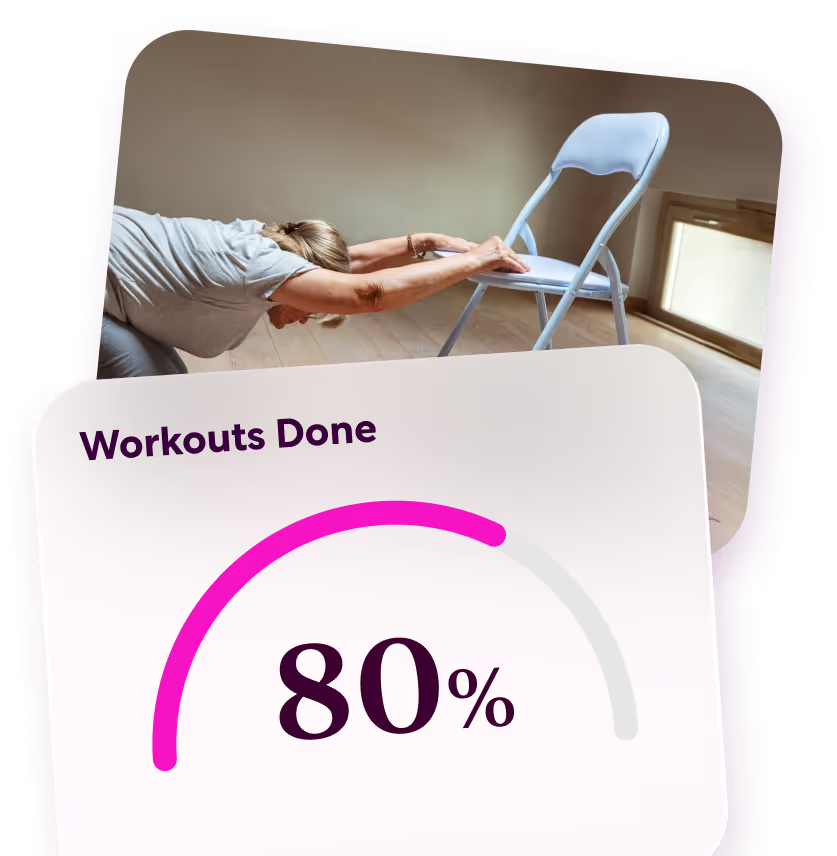
Chair Yoga that meets you where you are.
Get your plan
Yoga isn’t just for bendy, mat-loving yogis in full splits. With chair yoga, you bring gentle strength, improved flexibility, balance, and calming breath into a format tailor-made for women over 40.
In this guide you’ll learn what chair yoga is, why it works for you now, how to set it up safely, and then dive into specific poses and sequences to help you move with confidence.
Traditional yoga made accessible with chair support
Chair yoga adapts classic yoga postures so you practise while seated or standing with a chair for stability. Instead of getting up and down from the floor, you use a firm seat or chair-back to support your body and guide movement.
Perfect for women 40+ with joint concerns or balance issues
As we age, joints may become stiffer, balance may waver, and standing for long periods becomes more taxing. Research on older women with knee osteoarthritis shows that chair yoga can improve strength, mobility, and daily function.
Also ideal for: office workers, beginners, injury recovery
You don’t have to be a “yoga-expert” or extremely flexible to begin. If you spend many hours seated at a desk, are recovering from injury, or simply feel intimidated by traditional yoga classes, chair yoga is for you.
You don’t need to be flexible to start
Seated or supported formats of yoga allow participants with limited mobility or fear of falling to access movement safely without requiring much equipment or even prior experience.
Improved flexibility without forcing or pain
Working while seated or using chair support allows you to move joints such as hips, spine, and shoulders at a pace that feels safe.
Better balance and fall prevention
Practising seated or supported poses teaches your body to engage stabilising muscles and maintain posture even when you’re seated. These improvements aid stability and confidence during daily movements.
Gentle strength building (especially core and legs)
Chair yoga engages the legs, hips, and core in controlled ways that reduce impact yet increase strength over time, giving you functional power for day-to-day activities.
Reduced stress and cortisol through breathwork
Studies show that yoga in any format supports the nervous system through mindful breathing and body awareness.
Improved posture from desk work or daily life
By practicing upright seated poses, you strengthen your spinal alignment and back muscles, counteracting the slouching common from working long hours in front of a desk or sitting inside your car or public transportation for too long while stuck in traffic.
Enhanced body awareness and mind-body connection
The practice encourages noticing how your body moves, where you feel tension, and how breath and movement integrate.
Joint mobility without impact or strain
Because you’re seated or supported, there’s much less load on hips, knees, and ankles compared with floor-based yoga, making it perfect for those with sensitive joints.
Choosing the right chair (stable, no wheels, proper height)
Sit in a chair that doesn’t wobble, roll, or tilt. Feet should rest flat on the floor and your knees should be about hip-height. Chairs with arms may offer extra support but avoid a deep cushion that tilts you back.
What to wear: comfortable, breathable clothing
Wear minimally restrictive clothes that let your torso twist, your hips shift, and your arms lift freely. Choose footwear with grip or go barefoot on a non-slip surface. Avoid slippery socks or long hems that could catch under the chair.
Space requirements: minimal (just chair + small clearance)
You only need a small, clear area around your chair. A good rule of thumb is being able to move your arms enough around you and maybe both of your legs to extend fully. Aside from that, extra space is just a bonus. However, do clear away rugs, extra chairs, or other obstructions so you can move confidently without bumping anything else.
Safety considerations and when to modify
If you feel sharp pain, dizziness, or your joints feel unstable, stop and adjust. Chair yoga is safe for most older adults, but don’t push it if you’re not feeling well or your body is telling you to stop.
Warming up: gentle joint circles and breathing
Begin with two to three minutes of simple movements: shoulder rolls, ankle circles, and gentle spine twists. Combine this with slow inhales and long exhales to wake up your body and prepare it for the poses ahead.
Diaphragmatic breathing basics
Sit upright in your chair with feet flat and spine gently tall. Place one hand on your belly and inhale slowly through your nose so you feel your abdomen rise. Exhale through slightly parted lips, letting the belly soften. This posture and pace engage your diaphragm, supporting relaxed breathing and improving core stability.
Research on guided breathing exercises indicates improved lung capacity and a calmer nervous system response, even when practiced seated.
Box breathing for calming (4-4-4-4 pattern)
Adopt a steady rhythm: inhale for four counts, hold for four, exhale for four, pause for four. Keep your spine upright and shoulders softened. This method slows your breathing rate, eases tension, and helps you shift into a more centered state.
Studies of yogic breath techniques show this kind of paced pattern relaxes your body’s stress-response system.
Counted breath for stress reduction
Once you feel familiar with diaphragmatic and box breathing, you can extend your exhale. Try inhaling for five counts and exhaling for six or seven. Maintain your chair base firm and your hips anchored. Extending the outbreath signals your nervous system toward rest and recovery, which is particularly beneficial on a busy day or when your mind is racing.
Coordinating breath with movement
Match your movements to the breath every time you lift your arms, rotate your torso, or stretch to the side. For example, inhale as you lift your arms overhead, exhale as you lower them. Keep your chair planted, feet steady, and your attention on how the breath supports your motion. This coordination deepens your body awareness, strengthens the link between your inner rhythm and outer movement.
Seated mountain pose: establishing foundation
Start sitting upright near the front edge of the chair, feet flat and hip-width apart. Lift your chest gently, root through your feet, and rest your hands on your thighs. Maintain soft shoulders and a relaxed gaze ahead.
Seated cat-cow: spinal mobility
Sit with your feet on the floor and place your hands on the chair’s sides. On your inhale, arch your spine and open your chest; on the exhale, round your spine and bring your chin toward your chest. Move slowly with your breath.
Seated forward fold: hamstring stretch
From seated mountain, inhale to lift tall, then exhale, folding forward from the hips, reaching your hands toward your shins or the chair seat. Let your spine remain long, soften your head and neck. You’ll feel the stretch in the hamstrings and the lower back. Use a strap or towel if your reach is limited.
Seated twist: spinal rotation and digestion
Sit with feet grounded. Place your right hand on the back of the chair, left hand on your right thigh. Inhale tall, exhale, turning your upper body to the right, gently looking over your right shoulder. Hold for a few breaths, come back to center, switch sides.
Seated side bend: lateral flexibility
Begin in seated mountain. Inhale your arms overhead, then exhale, bringing both hands to one side of the chair as you lean your torso gently toward the opposite direction, keeping your bottom rooted. Return upright and repeat on the other side.
Seated eagle arms: shoulder and upper back
Sit tall, bend elbows at shoulder height, wrap your right arm under the left and bring palms to touch (or as close as comfortable). Lift elbows and draw shoulders down the back. Remain upright in the chair. After a few breaths, switch arm wraps.
Seated pigeon: hip opener
Edge forward in the chair. Cross your right ankle over your left knee. Flex the right foot and press the right knee gently away from you as you fold slightly forward. Keep your spine long. After a few breaths, switch sides.
Seated warrior: strength and focus
Sit sideways in your chair facing the side. Step your front foot forward outside the chair base (if space allows), and your back foot angled back. Raise arms overhead or to heart level. Sit tall and engage your legs without collapsing into the chair. Then switch sides.
Seated Side Leg Stretch: outer thigh reach
Sit tall, feet hip-width. Inhale your arms overhead, exhale, and lower one arm down the side of the chair as you extend the opposite leg out to the side, keeping both feet on the floor. Reach the upper arm overhead and feel the stretch down the side of the body and the outer thigh. Switch sides.
10. Seated Chair Boat: core challenge
Sit at the front edge of the chair, hold the sides of the seat for support. Lean back slightly, keep your spine tall, and lift one leg or both legs off the floor. Breathe smoothly and hold for several breaths, then lower.
11. Seated Chest Opener: upper-body opening
Sit tall. Interlace your fingers behind your back and straighten your arms, drawing your shoulders back and lifting your chest. Keep feet firmly planted. Slightly tilt your chin upward if comfortable. Hold a few breaths and release.
12. Seated Wrist & Finger Stretch: desk-friendly relief
Sit upright, extend your right arm forward with palm facing down. With your left hand, gently pull your right fingers down toward you. Hold 15-30 seconds, then switch. Next, extend the right arm with palm up and gently pull fingers back with the left hand.
13. Seated Heel Raises: ankle and calf activation
Sit tall and place your feet flat. On an inhale, lift both heels, so you balance on the balls of your feet, then exhale and lower slowly. Repeat 8-12 times.
14. Seated Chair Sun Salutation Variation: full-body flow
Start seated mountain. Inhale arms overhead, exhale, fold forward. Inhale to chair cat-cow arch, exhale round your spine. Inhale, lift arms overhead again, and exhale, place hands on thighs. Take 5-8 rounds at a comfortable pace.
15. Supported Seated Savasana: relaxation
Sit back in your chair with support behind you if available, feet flat, and arms resting gently in your lap or on armrests. Close your eyes, soften your face, and take slow, full breaths for 1-2 minutes. Let your internal systems settle and absorb everything you’ve done.
Chair-supported mountain pose
Stand behind your chair with both hands lightly holding the backrest. Step your feet hip-width apart, soften your knees, and lift through your chest. As you breathe smoothly, draw your shoulder blades back and down.
Chair-supported forward fold
Standing behind the chair, inhale to lift your chest, then exhale and hinge from your hips to fold forward, keeping your hands on the backrest for safety. Let your head soften and breathe into your hamstrings and spine
Chair warrior variations
Face sideways next to the chair, place one hand on the backrest for support, and step one foot forward and one foot back. Bend the front knee and keep the back leg long, arms reaching overhead or out to the sides
Chair tree pose: balance with support
Stand behind the chair, hold the backrest lightly, shift your weight onto one foot, and place the other foot on the inner calf or ankle (avoid the knee). Lengthen through your spine and lift your arms if comfortable. With the chair offering a safety net, your balance muscles engage without risk of falling.
Chair triangle pose
Position yourself sideways to the chair, front foot pointing forward, back foot slightly turned. Place the hand closest to the chair on the seat or backrest; extend the opposite arm overhead. Imagine reaching both arms in opposite directions.
Chair-supported lunges
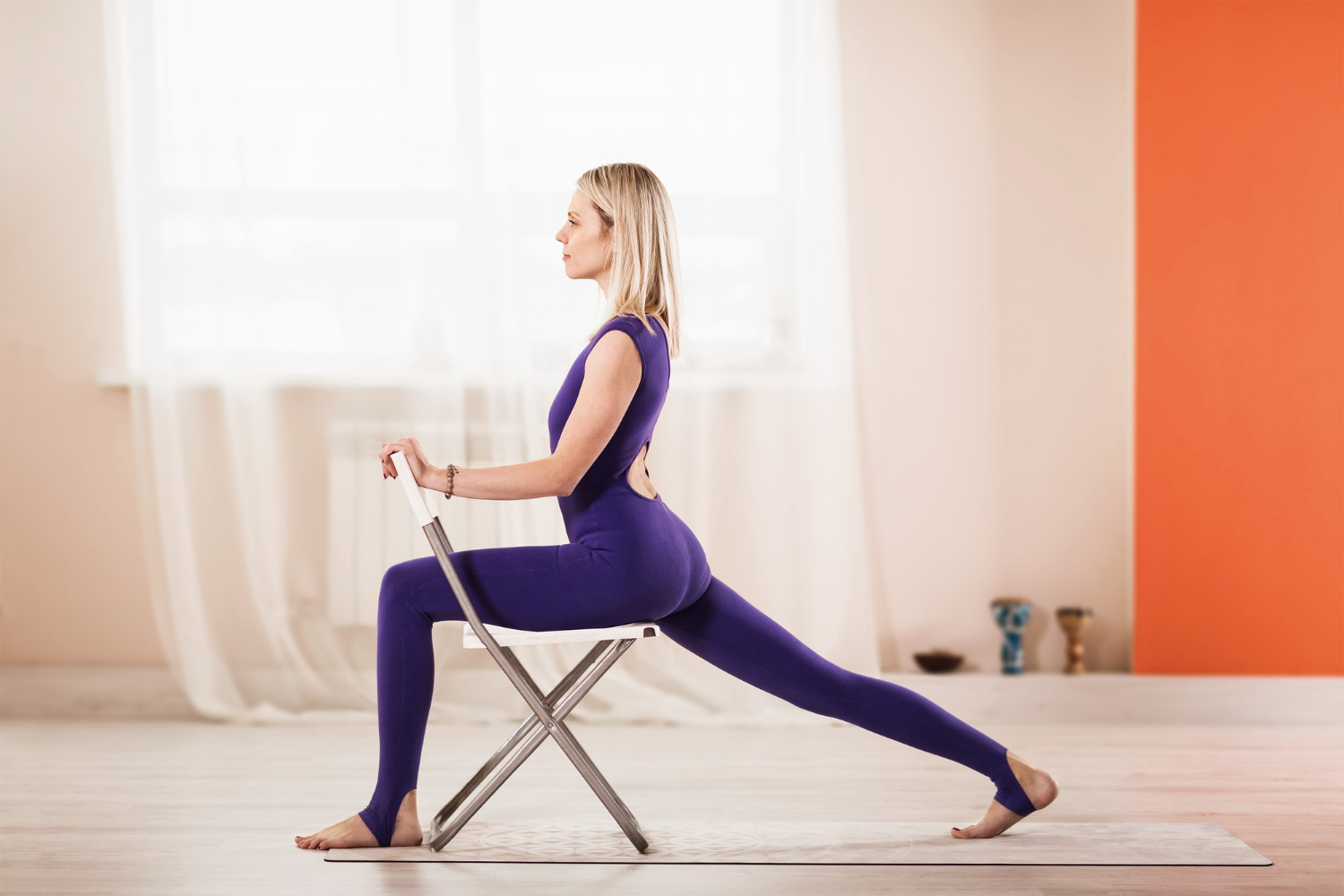
Stand behind the chair, hold the seat with both hands, and step one foot back into a gentle lunge. Keep the front knee over the ankle, remain upright, and breathe deeply. Then switch sides.
Chair-assisted squats
Stand facing the chair, feet hip-width apart, hold the backrest lightly for support. Inhale to prepare, exhale, and bend your knees, lowering your hips as though aiming to sit, but hover just above the chair. Inhale to stand back up.
Chair-supported Wide-leg Forward Bend
Stand behind the chair holding the backrest. Step your feet wide, hinge forward from the hips and let your arms hang toward the seat or floor. Keep your spine long. You’ll feel a stretch across your hamstrings, inner thighs, and lower back.
Standing Side-Bend with Chair Support
Stand to one side of the chair, one hand lightly on the backrest for support. Raise the opposite arm overhead and lean away from the chair to create a lateral stretch through the side body. Keep your feet grounded and core engaged.
Chair-supported Standing Calf Raises
Stand behind the chair, holding the backrest. Shift your weight onto the balls of your feet, raise your heels, then lower slowly. A simple but powerful way to strengthen calves and ankles for better posture and mobility.
Supported Standing Spinal Twist
Stand with the chair in front of you and one hand on the backrest. Step one foot slightly back, rotate your torso, and place the opposite hand on the chair seat or backrest for support. Turn gently to look over your shoulder.
Chair-assisted Side Leg Lift
Stand behind the chair holding the backrest. Shift weight into one leg and lift the opposite leg out to the side, keeping the foot flexed. Keep your torso upright and use the chair only for balance.
Supported Standing Pigeon Variation
Stand behind the chair and place one foot on the seat (or the outer edge) with the knee bent and the foot flexed. Hold the backrest for stability and lean slightly forward to deepen the hip opening. Repeat on the other side.
Chair-supported Warrior III Variation
Stand behind the chair with both hands on the backrest. Shift your weight into one foot, hinge forward at the hips, and lift the opposite leg straight back until your body forms a T-shape, holding the chair lightly for balance.
Chair-supported Heel-to-Toe Balance Walk
Stand behind the chair holding the backrest. Shift weight forward onto your toes, then onto your heels, then take a small step heel-to-toe while holding the chair for light support. Continue a few steps.
10-minute gentle morning routine
Begin seated in your chair, then start with 2 minutes of slow diaphragmatic breathing. Move into seated mountain pose, then transition through seated cat-cow to warm your spine. Add seated side bends and eagle arms for 30–45 seconds each. Finish with heel raises and a brief chair-supported forward fold.
15-minute stress-relief sequence
Start by holding the chair for support and practicing box breathing (4-4-4-4) for one minute. Move into seated twist and seated pigeon for five breaths each. Shift to a standing side-bend with the chair, followed by chair-supported mountain pose and triangle pose. End with three minutes of supported seated savasana, closing your eyes and observing your breath.
20-minute strength-focused practice
Warm-up with seated heel raises, wrist stretches, and diaphragm breaths. Progress into seated chair boat for core engagement, then stand for chair-assisted squats and chair-supported lunges (one minute each side). Move into chair warrior variation and supported warrior III for balance and leg strength. Conclude with a wide-leg forward bend behind the chair, followed by 2 minutes of breath coordination in the chair.
25-minute full-body flow
Begin seated with diaphragm breathing and joint circles. Flow through seated mountain into seated cat-cow, forward fold, and side bends. Move to a standing phase using chair-supported mountain, tree pose, side-leg lift, and standing pigeon. Return to the chair for seated twist and shoulder opener, then switch to standing chair-assisted squats and heel-to-toe balance walk. Close with a supported seated savasana for five minutes.
Sequencing principles: warm to active to cool
Start with gentle movement and breath, build in strength or balance focus as you warm up, and finish with relaxation or a slower flow. This structure allows your nervous system to shift into movement, then settle back into rest.
Weeks 1-2: learning foundational poses
Begin with seated poses only, focusing on ease of movement, steady breath, and gentle alignment. Rest when you feel tired, and avoid holding poses too long. At this early stage, you’re building comfort with the chair, your body, and the breath as a team.
Weeks 3-4: holding poses longer, adding breath
Once the foundations feel familiar, aim to hold poses for 20–30 seconds and deepen your breathwork (e.g., extend exhales by one count). You might begin adding standing poses supported by the chair, cultivating a mild balance and strength element.
Weeks 5-8: flowing between poses, deeper stretches
At this phase, you shift towards more movement: for example, flowing from a seated side bend into a standing forward fold using the chair for support. Add slightly longer holds in hip-openers, or engage the core more in each pose, while staying attuned to how your knees, hips, and spine feel for deeper, more engaged stretches.
Months 3+: more standing work, balance challenges
Now your practice may include standing sequences behind the chair, such as the tree variation, balance walks, and dynamic transitions (sit-to-stand slowly). Continue using the chair as a safety net, but don’t be afraid to ask more of your body.
For limited shoulder mobility
If your shoulders feel stiff or have reduced range of motion, keep your arms at chest height rather than overhead and use a strap or towel to hold between your hands. Work within the range that does not cause pain.
For hip or knee sensitivity
When knees or hips feel sensitive, stay seated more of the time. You might reduce your lunges or forward folds and instead use a chair for standing support or aim for half-depth instead of full.
For balance concerns
If standing poses feel unstable, place your chair close to a wall, keep your hand lightly on the backrest, and reduce how far you lift your arms or how narrow your stance becomes. Over time, you can gradually widen your stance or lift your hands higher as confidence grows.
For lower back issues
Keep your spine long in every pose, avoid extreme forward bends unless you know your back accommodates them, and add a cushion behind your lower back if needed. Focus on gentle core engagement and support the lumbar region by sitting nearer to the front edge of the chair.
Using props: blocks, straps, cushions
Props are allies, not gimmicks. Use a strap to reach your feet in a forward fold, blocks to raise your hands in side bends, or cushions under your feet to keep your spine upright. These adjustments help you move safely and stay aligned.
Evening relaxation sequence
Use your chair to ease into a calm state: begin seated, lift your arms overhead on an inhale, and exhale, fold forward with hands resting gently on the seat. Follow with seated side-bends and finish with a supported seated savasana (relaxation) where you close your eyes and let your breath slow.
Breath work for calming nervous system
When your respiration slows and deepens, the body shifts from “fight or flight” to “rest and repair.” A study found that 20-minute chair yoga sessions improved heart rate variability, promoting a sense of calm.
Gentle twists and forward folds for rest
Seated twists and gentle forward folds reduce muscular tension in the hips and spine—areas that often hold stress. Reducing body tension helps your system settle, making it easier to drift into sleep with less discomfort and racing thoughts.
Supported savasana (relaxation pose)
End your practice by sitting back in the chair, feet flat, hands softly in your lap or on armrests, eyes closed. Focus on softening the body and letting your breath return to its natural rhythm. Research reports participants describing better sleep and reduced fatigue after practicing yoga.
Minimum: 2x weekly for maintaining flexibility
Two sessions a week of 15-20 minutes support joint mobility, help maintain range of motion, and remind the nervous system of your “moving” baseline before advancing.
Optimal: 4-5x weekly for strength and stress benefits
If you practice four to five times a week, you reinforce the movement habit, deepen your posture and breath awareness, and build momentum in your strength, balance, and stress resilience.
Daily: short 10-minute practices add up
Even a 10-minute daily sequence can go a long way. Short, consistent sessions can compound into meaningful changes over the course of weeks without overwhelming your schedule.
Combining with Wall Pilates or walking
Chair yoga pairs well with other activities such as walking, wall Pilates, or light resistance training. Use chair yoga as a complement, not a replacement: for example, walk for 20 minutes three times a week, then finish with two chair yoga sessions to enhance your core strength, balance, and inner calm.
Week 1-2: reduced stiffness and stress
In the first two weeks, you’ll often notice less tightness in your hips, a calmer breathing rhythm, and a slightly better mood.
Week 3-4: improved flexibility and range of motion
By weeks three and four, you may reach further in forward bends, feel your spine twist more easily, and stand a little taller thanks to upright posture support.
Week 5-8: better balance and core strength
By the second month, your chair-supported standing poses build leg and core resilience. You’ll catch yourself adjusting less often and feel steadier on your feet.
Month 3+: significant posture improvement and confidence
After three months, your posture shifts, you engage your body naturally during daily tasks, and your movement feels easier, becoming more confident in your mobility and less fearful about your balance.
Joining a structured Chair Yoga program
Enrolling in a program invites you into a like-minded circle of participants. When you log in weekly or attend in-person sessions, you’re part of a learning path that gradually expands your movement, balance, and breath work in a thoughtful way. According to research, group-based movement helps older adults stick with a routine because they feel accountable to others and supported in their journey.
Video-guided daily practices
Choose programs that specifically target seated and standing chair yoga formats. Daily guided videos keep your technique fresh, your motivation high, and guarantee your safety when you self-practice. It also boosts familiarity, builds confidence, and lowers the barrier to showing up each day.
Community support and accountability
Sharing progress, challenges, and small wins enhances motivation, reduces isolation, and reinforces the habit of practice. Studies show that for older adults, the social side of fitness plays a major role in both attendance and enjoyment.
Progressive challenges designed for your level
As you become familiar with chair-supported poses, gradually increasing the difficulty now makes sense. Try holding poses 10-15 seconds longer, reduce the chair support by using one hand instead of both, or add a lightweight (1–2 kg) in your hand during seated arm lifts. After 8-12 weeks, you might shift more into standing balance sequences behind the chair, such as tree or warrior-III variations.
Source:
- Yao, Teng, et al. "Effect of Chair Yoga Therapy on Functional Fitness and Daily Life Activities among Older Female Adults with Knee Osteoarthritis in Taiwan: A Quasi-Experimental Study." Healthcare, vol. 11, no. 7, 2023, p. 1024, https://doi.org/10.3390/healthcare11071024.
- Woodyard, Catherine. "Exploring the Therapeutic Effects of Yoga and Its Ability to Increase Quality of Life." International Journal of Yoga, vol. 4, no. 2, 2011, p. 49, https://doi.org/10.4103/0973-6131.85485.
- Banstola, D. (2017). Effect of Yoga Breathing Exercises on Ventilatory Function. Journal of Gandaki Medical College-Nepal, 9(2), 17–22. https://doi.org/10.3126/jgmcn.v9i2.17861
- Epe J, Stark R, Ott U. Different Effects of Four Yogic Breathing Techniques on Mindfulness, Stress, and Well-being. OBM Integrative and Complementary Medicine 2021; 6(3): 031; doi:10.21926/obm.icm.2103031.
- Tyagi, Anupama, and Marc Cohen. "Yoga and Heart Rate Variability: A Comprehensive Review of the Literature." International Journal of Yoga, vol. 9, no. 2, 2016, p. 97, https://doi.org/10.4103/0973-6131.183712.
- Taibi, Diana M., and Michael V. Vitiello. "A PILOT STUDY OF GENTLE YOGA FOR SLEEP DISTURBANCE IN WOMEN WITH OSTEOARTHRITIS." Sleep Medicine, vol. 12, no. 5, 2011, p. 512, https://doi.org/10.1016/j.sleep.2010.09.016.
- Komatsu, H., Yagasaki, K., Saito, Y. et al. Regular group exercise contributes to balanced health in older adults in Japan: a qualitative study. BMC Geriatr 17, 190 (2017). https://doi.org/10.1186/s12877-017-0584-3
Smith, Gabrielle L., et al. "The Association between Social Support and Physical Activity in Older Adults: A Systematic Review." The International Journal of Behavioral Nutrition and Physical Activity, vol. 14, 2017, p. 56,
https://doi.org/10.1186/s12966-017-0509-8
.
Chair Yoga that meets you where you are.
Get your planSources
FAQs
What is chair yoga and how does it differ from traditional yoga?
Chair yoga adapts traditional yoga poses to be performed while seated or using a chair for support. This makes it accessible for those who may have balance issues or joint concerns, eliminating the need to get up and down from the floor.
Why is chair yoga particularly beneficial for women over 40?
Chair yoga is beneficial for women over 40 as it helps improve flexibility, strength, and balance without putting strain on sensitive joints. It offers a safe and effective way to stay active and enhance overall well-being as the body ages.
How can I set up my space for a chair yoga session?
Choose a stable chair without wheels, ensuring your feet can rest flat on the floor and your knees are at hip height. Clear a small area around the chair so you can move your arms and legs freely, and ensure the surface is non-slip if you're barefoot.
What should I wear for chair yoga?
Wear comfortable, breathable clothing that allows for free movement of your arms and legs. It's best to avoid slippery socks and long hems that could catch under the chair, and choose footwear with good grip or go barefoot.
Can beginners do chair yoga and what should they keep in mind?
Yes, chair yoga is ideal for beginners as it is gentle and supportive. Beginners should focus on moving at a comfortable pace, listen to their bodies, and modify poses if they experience any discomfort or strain.