Chair Yoga that meets you where you are.
Get your plan
Chair Yoga that meets you where you are.
Get your plan
Chair yoga is an incredible version of yoga that modifies traditional variations for accessibility and added challenge.
Often misinterpreted as less than traditional yoga due to its seated position, with many wondering, “Is this real yoga?”, “Will I get similar benefits?”, and “Can I progress?”.
The truth is, it actually provides the same benefits, including flexibility, mobility, strength, and stress relief, with the benefit of added support. This helps beginners and those with limited mobility improve their health with confidence.
In this article, we discuss chair yoga for women over 40. We cover chair yoga fundamentals, safe practices, eight essential poses for beginners, and how to create your routine.
Why Chair Yoga Works for Women Over 40
Chair yoga is an excellent form of exercise for women over 40, as the chair provides a stable surface that helps build confidence. Below, we explore why it is so effective, including its accessibility, ability to reduce joint stress, and benefit for developing confidence.
Accessibility Without Sacrificing Benefits
The use of chairs offers a stable structure, which makes it more accessible for beginners and those with functional limitations. While traditional yoga is incredible for developing strength, mobility, and function, not everyone can balance or perform floor-based poses.
Chairs can be added to existing poses for support and to lighten resistance. This makes movements more accessible, allows you to learn techniques, develop strength, and take advantage of the many other benefits.
Joint-Friendly Approach to Flexibility
Chair yoga is also excellent for supporting joints and encouraging flexibility. Yoga is famously known for lengthening muscles and mobilizing joints, however, for those with sensitive joints and limited range of motions, it can be difficult to assume the positions necessary to improve in these areas.
Using a chair provides users with the support they need to get into challenging positions, allowing them to effectively improve flexibility without aggravating joints.
Building Confidence Through Supported Practice
The support provided by the chair is amazing for developing confidence. Beginners and women with limited function tend to lack the ability to hold, balance, and move through a full range of motions.
The chair provides stability which allows them to confidently push beyond those functional limitations. This helps them develop strength, flexibility, and mobility, which in turn builds confidence.
Setting Up for Safe Chair Yoga Practice
.jpeg)
Selecting the correct chair and choosing the right space is essential for safe chair yoga practice. Below, we discuss chair selection, positioning, how to use props, and how to create an appropriate space for safe chair yoga practice.
Choosing and Positioning Your Chair
Selecting the correct chair and position within a space is a must for chair yoga. When choosing a chair, it should meet the following criteria:
- Feet should be flat on the floor when comfortably seated.
- Knees should be at a 90-degree angle with thighs parallel to the floor.
- Legs and base should be even and stable (no wobble, rubber feet).
Regarding position, we recommend placing the back of the chair against a wall with enough space on either side. Placing it against the wall will stop it from shifting, while the space around the chair will allow you to perform your poses without interference.
Optional Props that Enhance Practice
Using optional props is a great way to add support and enhance your practice. For example, if you are finding it difficult to sit down and stand up when your knees and hips are set at a 90-degree angle, place a cushion or rolled up towel on the seat. This will elevate the hip above 90 degrees, making it easier to stand up and perform certain poses.
Meanwhile, props such as blocks, bolsters, and straps can be used to deepen stretches and align the body.
Creating Appropriate Space
One of the best things you can do for your chair yoga is to create a space that removes distractions, decompresses, and focuses on your session. This can be done by making the following changes:
- Remove distraction (phone, devices, TV)
- Reduce clutter
- Choose warm colors
- Use candles or incense
- Designate it a yoga only space
Fundamental Chair Yoga Breathing and Alignment
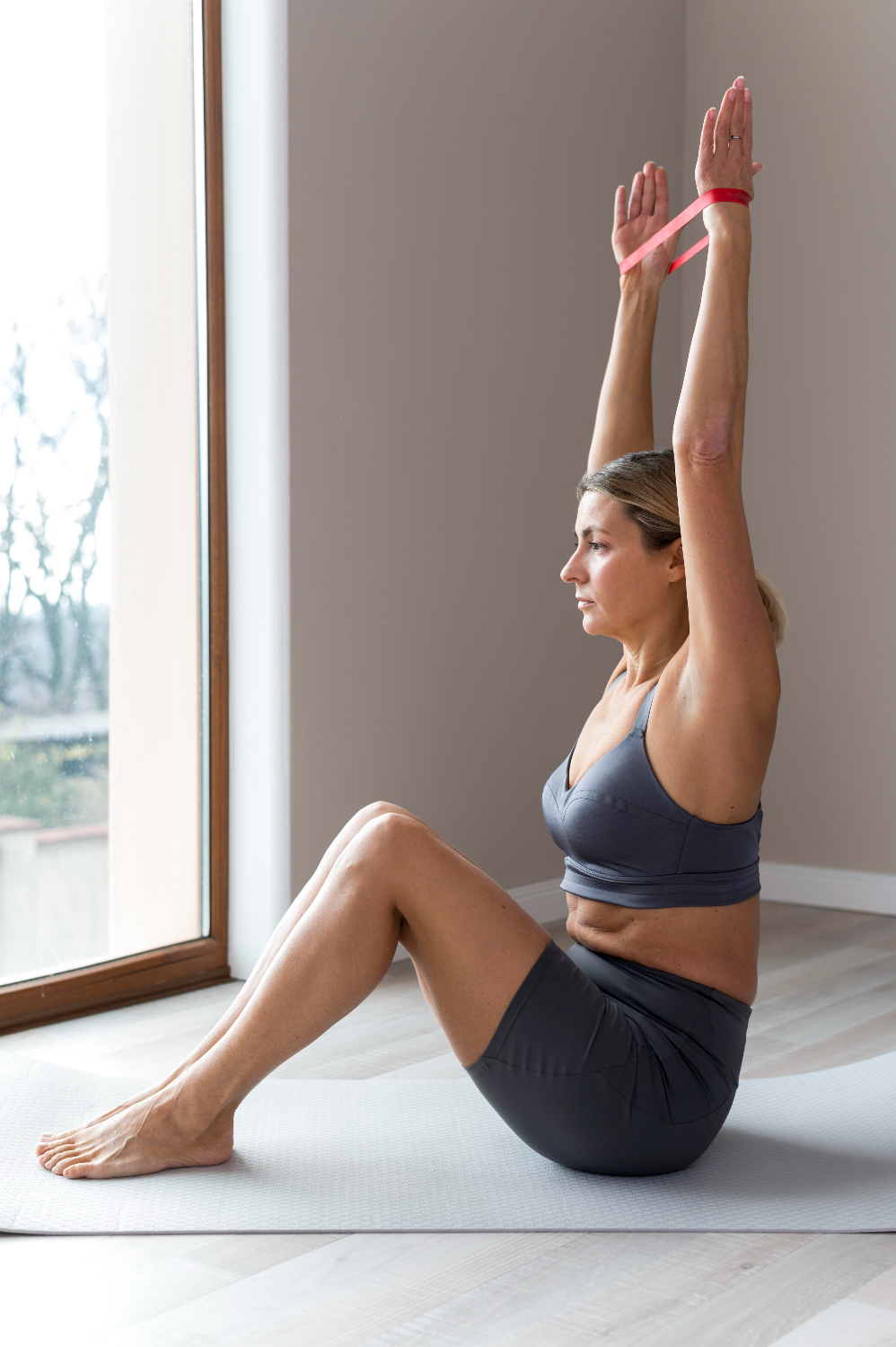
Before we begin going through the exercise, we must discuss the fundamentals of correct breathing and alignment. Below, we discuss seated posture fundamentals, breath awareness, and more engage while seated.
Seated Posture Fundamentals
Seated posture requires you to sit upright with your head, neck, and spine aligned in neutral positions. This can be achieved with the following cues:
- Spine straight and long
- Upper body relaxed with the shoulders back and down
- Abdominals gently engaged.
This can be challenging to perform in the beginning. However, like all poses, it will get easier to sustain.
Breath Awareness and Patterns
Breathing awareness and patterns are a key part of yoga. Yoga utilizes nasal breathing, which is shown to engage the parasympathetic nervous system. Correctly synchronized, it allows you to relax and flow into each movement.
Yoga uses many different breathing patterns and techniques, including:
- Victorious Breath (Ujjayi Breath): Gently constrict your throat and create a soft ocean-like sound as you inhale and exhale.
- Alternate Nostril Breathing (Nadi Shodhana): Sitting upright, bring your right hand up to your face and place your thumb and ring finger on your nose. Block your right nostril with your thumb and inhale through your left nostril, then release your thumb, press down your ring finger, and exhale. Perform in reverse.
- Bee Breath (Bhramari Breath): Inhale through the nose, then exhale while making a humming sound like a bee, while plugging the ears or covering the eyes.
- Breath of Fire (Kapalabhati): Perform forceful, quick exhales from the nose while engaging the abdominal muscles, with inhales and exhales are the same duration.
- Box Breathing: Inhale for 4 counts, hold for 4 counts, exhale for 4 counts, and hold for 4 counts.
Core Engagement While Seated
Engaging the core during your chair yoga session creates the strong foundation required to perform different movements and poses. When performed correctly, the combination of good posture, core activation, and breathing allows you to dynamically stabilize, helping you flow between movements.
Below is a list of core engagement techniques and instructions on how to perform them for maximum engagement.
- Optimal Posture: Sit upright with your head, neck, and back aligned to create a long spine.
- Breathing: Sitting upright, creating a proud chest, and inhaling deeply while engaging your core muscles.
- Core Engagement: Sitting upright with a proud chest, inhale, then exhale, and draw your belly button to the spine while engaging your core muscles. This will engage the transverse abdominis, a corset-shaped muscle that will align the spine and keep the core rigid.
8 Essential Chair Yoga Poses for Beginners
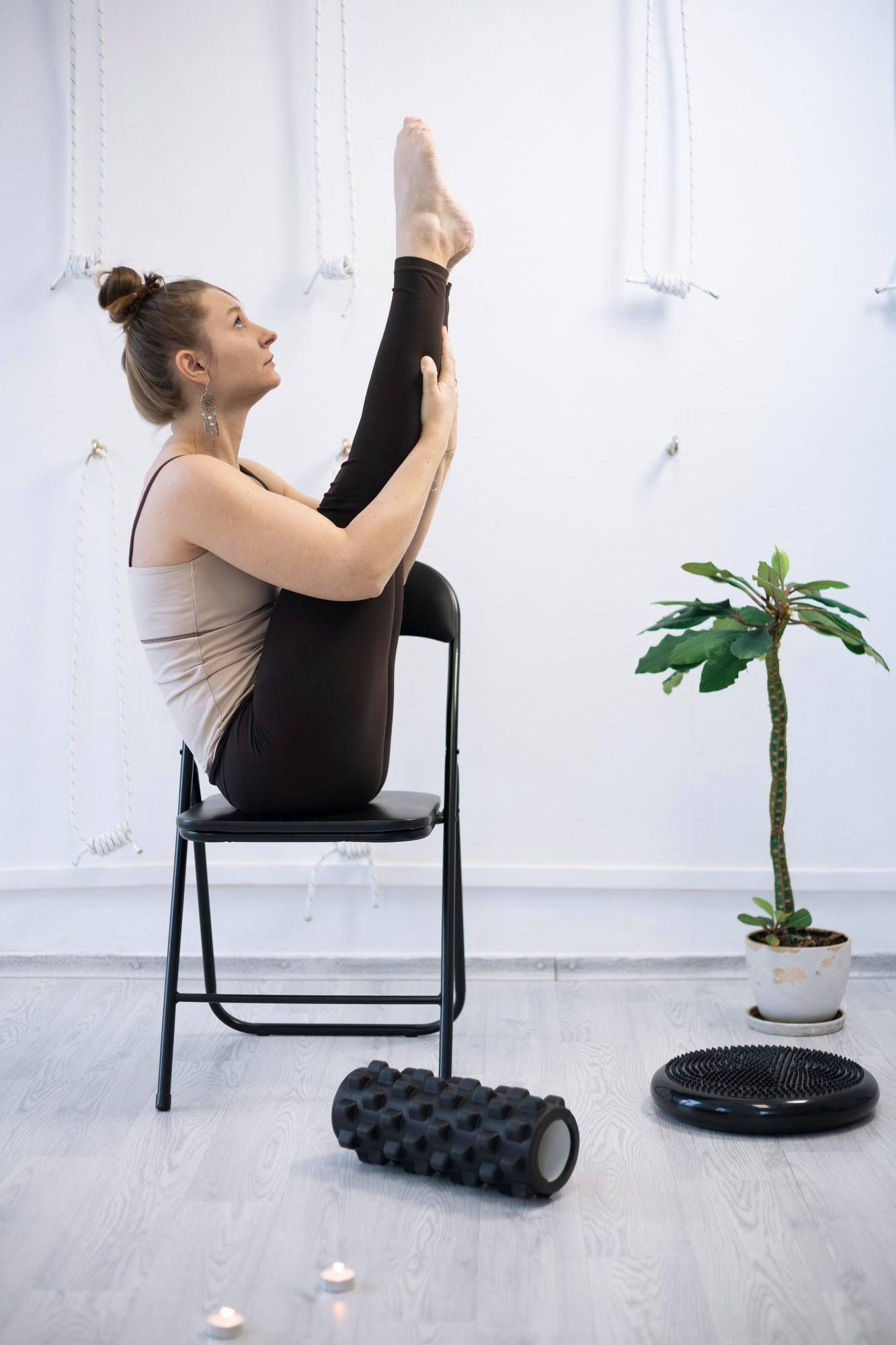
Chair yoga has several exercises that are excellent for developing strength, flexibility, and mobility. Below, we share our eight best poses for beginners, including upper body for the spine and lower body for balance. Each pose will contain a brief description, instructions, and instructor cues.
Poses 1-4: Upper Body and Spine
The following four poses target the upper body and focus on lengthening and releasing tension.
1. Chair Cat Cow
The chair cat cow is an upper-body hair yoga exercise designed to mobilize the spine. Performed by flexing and extending the spine along with correct breathing and posture, helps to lengthen paraspinal muscles, reducing restriction, while relieving back tension.
How To Do Chair Cat Cow
- Sit on your chair in the upright position, with your hands resting on your thighs.
- Position your feet hip-width apart.
- Inhale and extend your back to exaggerate the upright position.
- Then inhale, flex your spine, and round your shoulder forward.
- Exhale, and return to the upright position.
Instructors Cues
- At the end of each repetition, return to the middle and focus on aligning the head, neck, and spine. This will help you reset and maintain proper form for the entire set.
- Focus on performing the movement with correct breathing. This will help your body relax, improve movement, and result.
2. Chair Side Twists
The chair-side twist is designed to improve spinal rotation. The benefit of performing the movement on the chair is that it stops the hip from rotating, allowing you to focus on spinal rotation.
The chair can also be used to rotate the body, allowing you to gauge the exact amount of rotation and push for added rotation.
How To Do Chair Side Twists
- Sit on the chair with your legs on the right side so your right shoulder is beside the back of the chair.
- Plant your feet firmly on the floor, hip-width apart.
- Exhale and rotate to the right 90 degrees toward the back of the chair and grasp the backrest with both hands.
- Pause for a moment, inhale, and then return to the starting position.
- Perform for the designated duration or number of repetitions, then switch sides.
Instructors Cues
- Keep your feet facing forward and firmly planted on the floor. This helps you get a better stretch.
- Begin with smaller rotations to begin and gradually progress to 90 degrees.
3. Chair Arm Raised Mountain Pose
The chair arms raised mountain pose (overhead stretch) lengthens the sides, waist, and ribs, while improving circulation and breathing. This is excellent for improving posture and spinal mobility.
How To Do Chair Arms Raised Mountain Pose
- Sitting upright, position your feet firmly on the floor hip-width apart.
- Hand your arms by your sides with your palms falling away from the body.
- Inhale and lift your arms in a fanning motion until your palms come together overhead.
- Hold for a moment, then lower the arms back down in a fanning motion to the sides. Repeat.
Instructors Cues
- Focus on inhaling and reaching overhead. This will increase stretching.
- Maintain an upright posture during the stretch. This will help lengthen the spine.
4. Chair Forward Fold
The chair forward fold is a variation of a traditional yoga exercise designed to stretch the back of the body. Performed by bending forward, it lengthens the hamstrings, glutes, and back.
How To Do Seated Forward Fold
- Sitting up with your feet placed together, arms by your sides, with palms falling outward.
- Inhale and lift your arms overhead in a fanning motion until they meet in the middle overhead.
- Exhale and bend forward, reaching down until your hands touch the floor beside your feet.
- Then lift the body back up, reaching your arms overhead. Repeat from this position.
Instructors Cues
- Focus on breathing, inhaling as your rhea overhead, and exhaling as you perform the fold. This will help lengthen the spine and increase the stretch during the fold.
- At the bottom of the fold, relax into your breath, and allow your body to completely relax.
Poses 5-8: Lower Body and Balance
The next four movements target the lower body, helping improve balance and mobility.
5. Chair Knee Lifts
Chair knee lifts are a great exercise for targeting the core and hip flexors. Performed in the upright position, each leg is lifted in a slow marching motion, requiring the core to stabilize.
How To Do Chair Knee Lifts
- Sit upright and place your feet firmly on the floor hip-width apart, and your arms by your sides.
- Inhale, then exhale and tense your abdominal muscles.
- Lift your right foot off the floor until your knee is at belly button height, then lower it to the floor.
- Alternate legs for the designated duration of a number of repetitions.
Instructors Cues
- Concentrate on breathing, keeping your body upright, and more engaging for the duration of the exercises.
- Perform small, sharp breaths each repetition. This will help keep your core engaged.
6. Chair Pigeon Pose
The chair pigeon pose is a lower-body pose designed to stretch and mobilize the hips. Easy and often relaxing to perform, it is great during your chair yoga sessions and even at your desk.
How To Do Chair Pigeon Pose
- Sit upright, with your feet planted, hip-width apart.
- Lift your right foot and rotate it outward so that your ankle turns to the midline of the body.
- Place your right ankle on your left knee.
- Allow your knee to continue rotating outward until your shin is parallel with the floor.
- Breathe in, then breathe out, and gently bend forward at the hips.
- Hold for the desired duration, then return to the upright position, and switch sides.
Instructors Cues
- Keep the trunk straight for the duration of the stretch. This will help lengthen the glute and open the hips.
- To deepen the stretch, bring the heel of the lifted leg closer to the body.
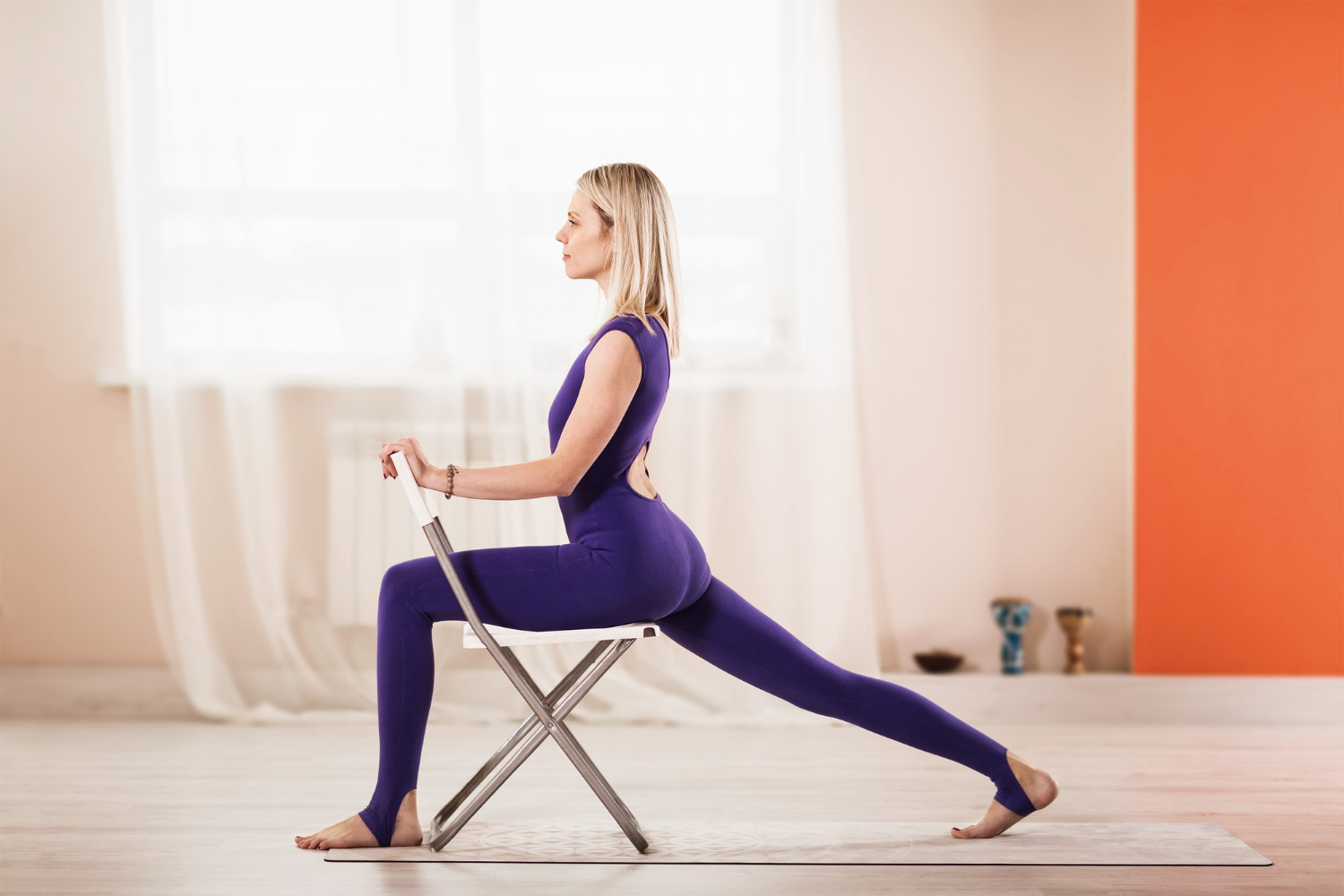
7. Chair Warrior 1 Pose
The chair warrior 1 pose is a seated version of the traditional yoga exercise which improves posture, stability, and stretches the hips.
How To Do Chair Warrior Pose
- Sit on the chair with your legs on the left side so your left shoulder is facing the back of the chair.
- Adjust your hips to the right so your right glute is off the chair.
- Extend your right leg back and drop your right knee so your thigh is vertical.
- Extend and straighten your right leg back to assume an extended lunge position.
- Put your palms together and lift your arms directly overhead.
- Hold for the designated duration, then change sides.
Instructors Cues
- Focus on correct breathing, this will improve the stretch.
- If it is your first time, limit how far you extend the back leg. This will help you balance.
8. Chair Squat
The chair squat is designed to help beginners develop lower-body strength and balance. The use of a chair allows the participant to lower themselves into the full depth squat without the risk of falling backward.
How To Do Chair Squat
- Sit on the chair with your feet spaced shoulder-width apart, firmly planted on the floor.
- Straighten your arms out in front so they are parallel with the floor.
- Exhale, and engage your core.
- Lean forward slightly and push yourself up into the standing position.
- Lead back with your hips and lower yourself back down to the seat position.
Instructors Cues
- Keep your arms straight for the duration of the set. This will act as a counterweight for your hips going backwards, helping you balance.
- Lean forward with a straight back to begin the squat. This will help you perform the upward phases of the movement.
- Perform the lowering phase with control and avoid dropping.
Creating Your Chair Yoga Practice Routine
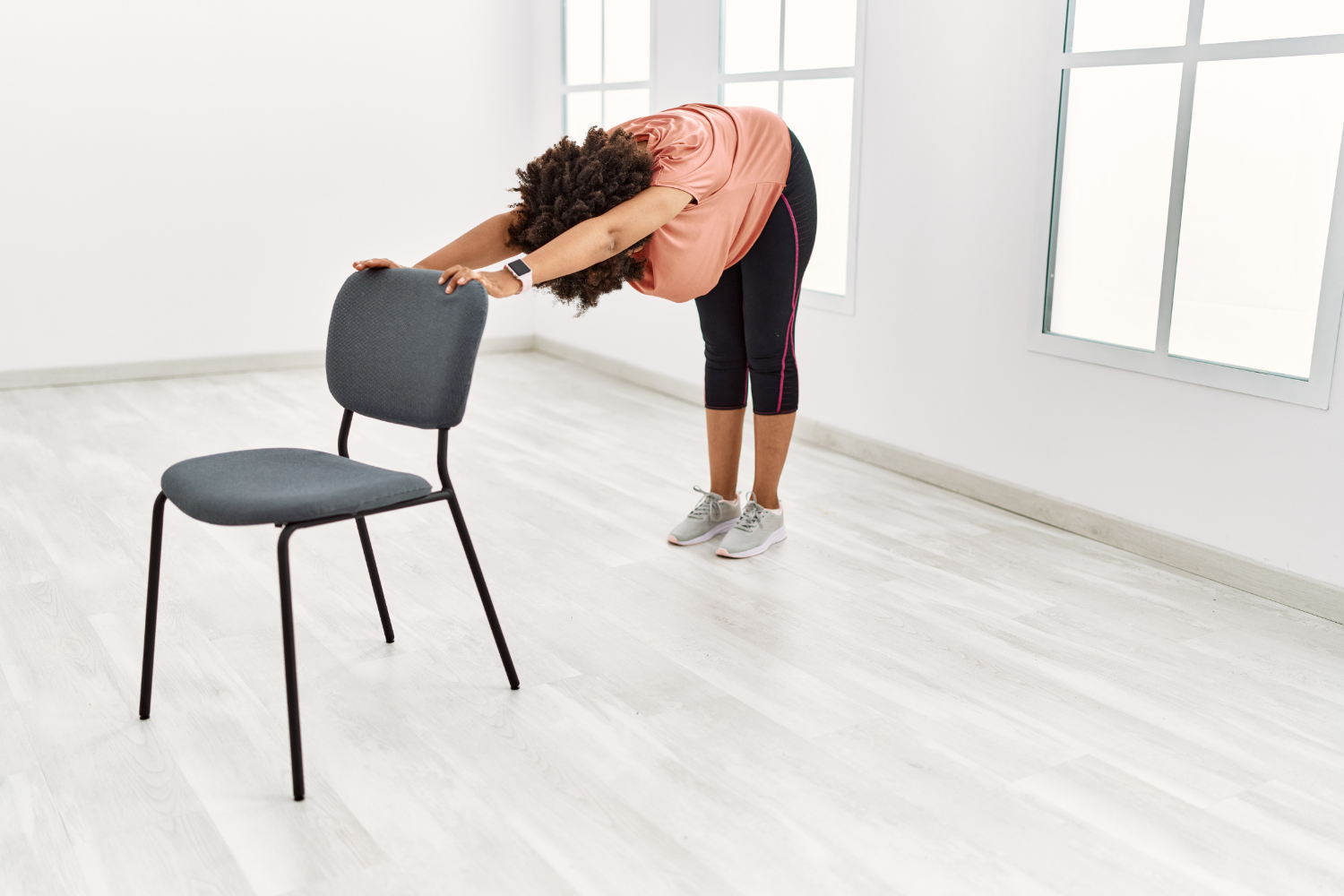
Developing a chair yoga routine requires you to understand movement patterns, allowing you to create a sequence that flows. Below, we provide a sample 20-minute routine, a training schedule, and guidelines to help you develop your future routines.
Sample 20-Minute Sequence
This beginner routine is created using the upper and lower body movements listed above. The program will highlight a general flow of chair yoga sessions, including the name of the exercises, sets, duration, and rest times.
This program focuses on lengthening, mobilizing, and releasing tension from the upper body. Followed by strengthening the lower body and core, before lengthening the hip flexors and mobilizing the hips.
How Often to Practice
Beginners should practice chair yoga 2--3 times a week. For example, many movements in the program above focus on lengthening, mobilizing, and activating key muscle groups. Not only is this not strenuous, but it also helps improve function, circulation, and reduce stress, making it essential for overall health.
Furthermore, many of these movements can be performed during daily life to get you moving. Poses such as chair pigeon pose, chair overhead stretch, chair side twists, and chair knee lifts can all be performed throughout the day. This helps develop proficiency and helps relieve tension throughout the day.
Here is an example of a weekly schedule for the routine above.
Sequencing Principles
The sequence of a chair yoga routine should focus on gently warming up and lengthening muscles and mobilizing joints before engaging in resistance training-style movements.
This can be seen in the routine above, which warms tissue and mobilizes joints with exercises such as chair cat cow, chair side twist, chair overhead stretch, and chair forward fold. These movements are performed in a similar positioning and naturally flow into one another.
Once the body is mobilized, resistance-style exercise and more intense poses such as chair squats, chair knee lifts, and chair warrior pose are performed. These places a greater demand on the body.
Performing your session in a similar order will prepare your body for the routine, helping improve the performance of more intense exercises. After this, you can also finish with similar stretch poses as a cool-down.
Modifications for Common Concerns

Exercising with health issues is a very common concern for women over 40. Below, we discuss how to adapt for arthritis and joints, and how to modify training for balance and limited range of motion.
Adapting for Arthritis and Joint Pain
One of the biggest issues women over 40 face is arthritis and joint pain, which can make it difficult to perform movements. Fortunately, yoga is effective for reducing tender and swollen joints and pain.
Chair yoga’s seated position in particular is favorable, helping those suffering to take their time, avoid pain, and safely increase strength and mobility.
Here is a list of ways you can modify your sessions to ensure you are improving without aggravation.
- Warm-up: Warming up muscles and joints can establish a mind-muscle connection, improving movement quality and decreasing pain.
- Avoid Pain: A 4/10 on the pain scale is acceptable during rehabilitation; however, anything beyond this can aggravate your condition. Working to this level allows you to safely push to new limits, which is essential for strengthening muscles and joints.
- Limit Range of Motion: Limiting and controlling your range of motion is excellent for ensuring you don’t aggravate joint issues. The seated position, in particular, allows you to take your time and gradually work to a safe range of motion and improve function without the risk of setbacks.
- Minimize Positional Changes: Changing your position during a session may aggravate your joint condition. We suggest performing exercises in a similar position to decrease the risk of increasing pain.
- Seek Assistance: Seek the advice of a healthcare professional and a qualified yoga instructor. They will answer any questions regarding your condition.
Balance Modifications
For those struggling with balance, chairs with armrests and changing positioning can provide added support.
For example, a chair with armrests provides support during chair squats. Meanwhile, blocks or cushions can be used to elevate the hips to make standing up easier.
The seated positions do address many balance-related issues. However, if you need further assistance, ask an instructor for guidance.
Working with Limited Range of Motion
For women with a limited range of motion, chair height and movements can be modified to their specific needs. For example, for women who struggle with sitting down, changing to a higher chair will make it easier to sit down and stand up.
Here is a list of modifications based on the exercises listed above.
- Chair Forward Fold: Decrease the amount of flexing and focus on breathing and spinal alignment.
- Chair Cat Cow: Perform slowly, focusing on breathing, only flexing and extending as your body allows.
- Chair Side Twist: Using the chair for support, perform smaller rotations.
- Chair Squat: Elevate the hips using a cushion or block. This will increase seat height, making it easier to sit down and stand up.
- Chair Knee Lifts: Perform small lifts. This will make it easier to balance while decreasing joint pressure.
Progressing Your Chair Yoga Practice

Progressing with Chair yoga will eventually present you with the opportunity to move to more advanced movements and even to mat yoga. Below, we discuss how to challenge yourself further, when to try mat, and how to combine chair and standing elements.
Adding Challenge While Staying Supported
Challenging yourself during your chair yoga sessions is essential for ongoing improvements to strength, flexibility, mobility, and stability.
This can be done by making the following changes:
- Increasing the number of sets and repetitions
- Extending pose duration
- Increasing intensity (decrease rest times)
- Program intermediate and advanced exercises
- Gently increasing range of motion (for those with joint pain)
- Use less support (for those using balance assistance)
When to Consider Mat Transitions
For many women, chair yoga provides them with the support to safely and comfortably perform exercises without the risk of falling or aggravating joints. However, over time, strength and mobility will improve enough that moving to the mat can be considered.
This transition should only be considered once you can comfortably get up and down off the floor without assistance. Furthermore, if you do decide to make the change, we suggest doing so within a guided session with an instructor. They will be able to guide you through new exercises and assist with movements and transitions.
Combining Chair and Standing Elements
Adhering to mat yoga doesn’t mean you have to write off your chair yoga routine. Both can be combined to maintain function, alignment, and strength.
For example, you can begin your session in the chair, allowing you to gently warm up and prepare the body for the session ahead. This will make it easier to transition to the mat.
If you are now comfortable with both forms of yoga, ew recommend experimenting with different combinations.
Chair Yoga that meets you where you are.
Get your planSources
- Sinha AN, Deepak D, Gusain VS. Assessment of the effects of pranayama/alternate nostril breathing on the parasympathetic nervous system in young adults. J Clin Diagn Res. 2013 May;7(5):821-3. doi: 10.7860/JCDR/2013/4750.2948. Epub 2013 May 1. PMID: 23814719; PMCID: PMC3681046. https://pmc.ncbi.nlm.nih.gov/articles/PMC3681046/
- Haaz S, Bartlett SJ. Yoga for arthritis: a scoping review. Rheum Dis Clin North Am. 2011 Feb;37(1):33-46. doi: 10.1016/j.rdc.2010.11.001. Epub 2010 Dec 3. PMID: 21220084; PMCID: PMC3026480. https://pmc.ncbi.nlm.nih.gov/articles/PMC3026480/
FAQs
What is chair yoga, and how is it different from traditional yoga?
Chair yoga modifies traditional yoga poses to be performed while seated or using a chair for support. This makes it more accessible for those who may have difficulty with balance or floor-based poses, while still providing benefits like improved flexibility, strength, and stress relief.
Why is chair yoga beneficial for women over 40?
Chair yoga is beneficial for women over 40 because it reduces joint stress while enhancing flexibility and mobility. The chair provides stability and support, making it easier to perform poses safely and effectively, which is especially important as the body ages.
How can I set up a safe space for chair yoga at home?
To set up a safe space for chair yoga, select a stable chair with a flat seat and legs that don't wobble. Position it against a wall for extra stability, and ensure there is enough space around you to move freely. Consider using props like cushions or straps to support your practice.
Can chair yoga help improve my flexibility and strength?
Yes, chair yoga can help improve flexibility and strength by allowing you to perform poses with support, reducing the risk of injury. It encourages muscle lengthening and joint mobility while providing a stable base to build strength gradually.
Should I use props during chair yoga, and what kind should I use?
Using props in chair yoga can enhance your practice by providing additional support and helping you achieve better alignment. Common props include cushions to elevate the hips, blocks to support hands during poses, and straps to assist in deeper stretches.