Chair Yoga that meets you where you are.
Get your plan
Chair Yoga that meets you where you are.
Get your plan
Women over 40 experience a decline in function that can almost feel like it comes out of nowhere, expressing concerns about loss of flexibility and balance.
This is due to an age and hormone-related decline of physical health and decrease in physical activity due to the busyness of everyday life.
Fortunately, there is a way to regain flexibility and balance chair yoga.
Chair yoga is a modified form of traditional yoga that uses a chair for support, making it accessible for those with limited mobility. This evidence-based practice builds strength, flexibility, and balance without the fear of falling, allowing women over 40 to gradually restore physical function through supported movements.
In this article, we discuss chair yoga for flexibility and balance. We explain how flexibility and balance change over 40, flexibility training principles, the six best chair yoga exercises for flexibility, and more.
Understanding Flexibility and Balance Changes After 40

Entering your 40s impacts flexibility and balance. Below, we discuss why this happens, including the decline of balance, the risk of falls, and how chair yoga serves as an effective intervention.
Why Flexibility Naturally Decreases
Women over 40 experience a decline of the sex hormone estrogen, which leads to many physiological changes, including changes to muscle function. Studies show that estrogen reduces stiffness of tendons and ligaments, which increases joint flexibility.
This is compounded by the natural decline that comes with age. Research shows that flexibility depends on the elasticity of muscles, ligaments, and connective tissue. This tissue stiffens with age, reducing elasticity and flexibility.
Balance Decline and Fall Risk Factors
Balance is the ability for the body to maintain its center of gravity or center of mass against a supportive ground. The ability to maintain center of gravity declines at age 30 and accelerates after 60, due to the decline in connective tissue elasticity and flexibility.
This decrease affects joint range of motion, impairing balance and resulting in an increased risk of falls.
How Chair Yoga Addresses Both Simultaneously
Research shows that yoga has a positive effect on balance and lower body flexibility. These benefits transfer to chair yoga as it consists of modified versions that use a chair for support.
This allows participants to perform modified yoga movements, helping them safely improve flexibility and balance. Many women find chair yoga particularly effective because the chair support removes the fear of falling, enabling them to focus fully on the stretching and strengthening movements. A chair yoga program provides structured guidance through these modified poses, ensuring correct form and progressive challenge.
Flexibility Training Principles with Chair Support
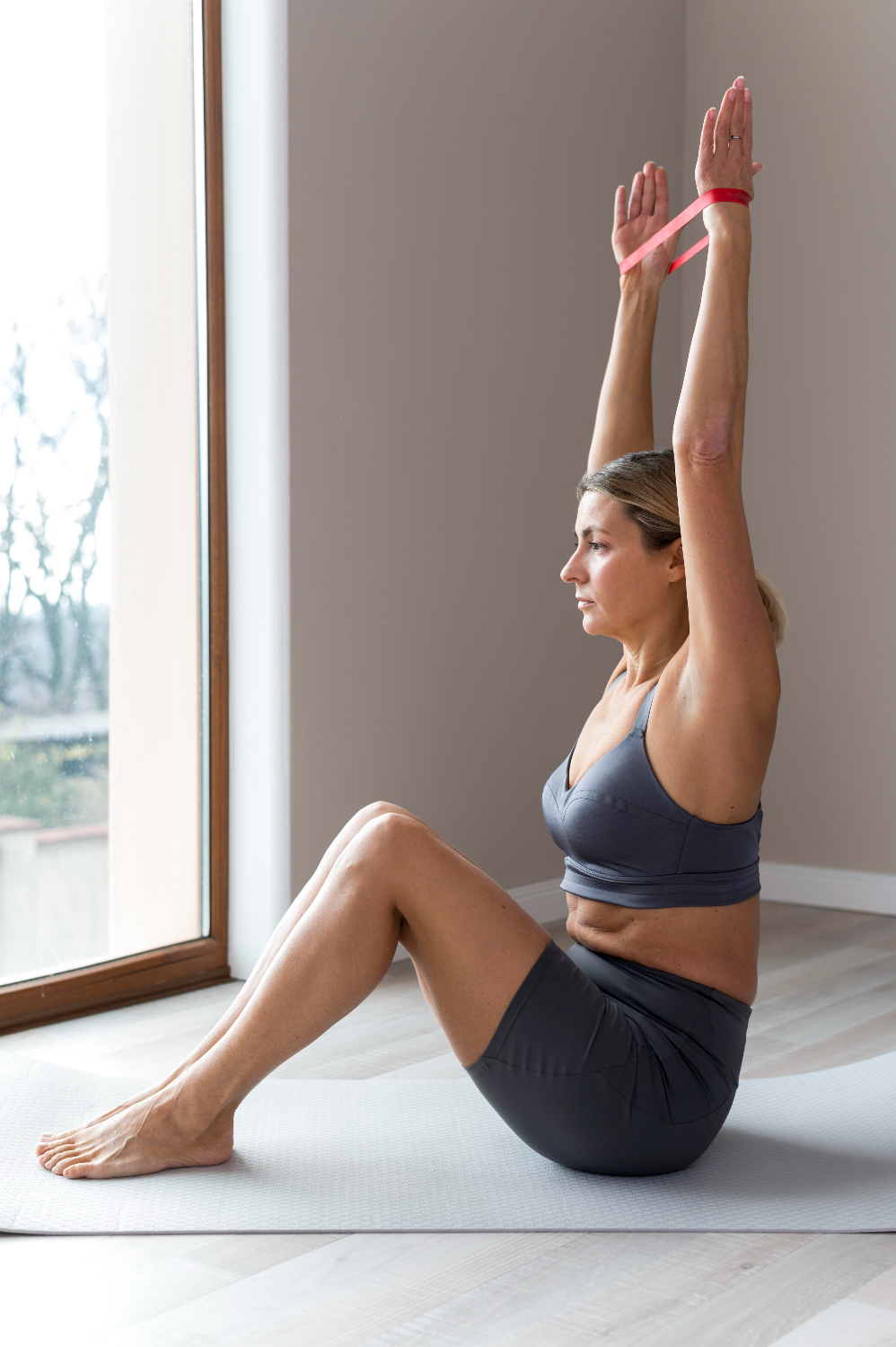
Chair yoga shares movements, poses, and principles with traditional yoga. Below, we discuss flexibility training principles, including duration over intensity, breathing, and progressive technique.
Duration Matters More Than Intensity
When it comes to developing flexibility and balance, duration matters more than intensity. Research indicates that stretches held for longer duration show greater improvements in flexibility.
This is excellent for anyone with limited flexibility, allowing them to make significant improvements by simply holding a stretch for longer.
Breathing into Stretches
Breathing during chair yoga poses and movements is a powerful mechanism for enhancing flexibility. A 2025 study explored the impact of diaphragmatic breathing on lumbar flexibility, discovering its positive effects, highlighting the benefits for musculoskeletal health and individuals with lower back issues by relieving muscular tension and improving range of motion.
Breathing during chair yoga has a similar effect, releasing muscle tension while allowing relaxation into your stretches.
Progressive Deepening Technique
Sources explain that this can be done by performing progressive muscle relaxation, a technique where you consciously activate a muscle group and hold it for a few seconds before releasing it and allowing it to relax. This allows you to progressively deepen physical, mental, and emotional relaxation.
When this technique is combined with breathing and the benefits of longer stretch durations, it allows you to relax and improve flexibility.
6 Chair Yoga Poses for Enhanced Flexibility
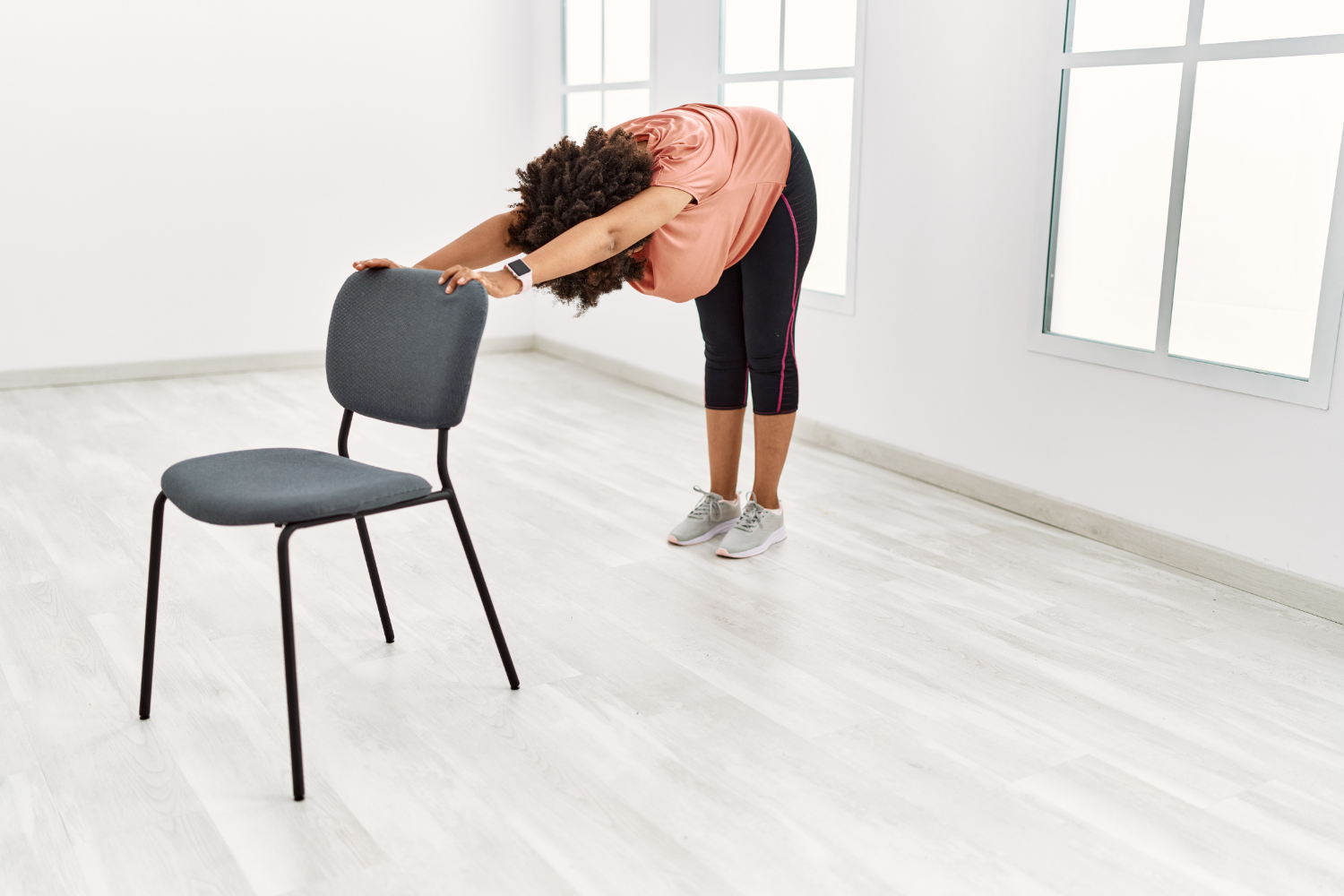
Here are the six best chair yoga poses for enhancing flexibility. Each exercise comes with a brief description, instructions, and instructor cues to help you maximize your results.
Hip Flexor and Hamstring Openers
The following exercises are excellent for safely lengthening the hip flexors and hamstrings.
1. Chair Warrior 1 Pose
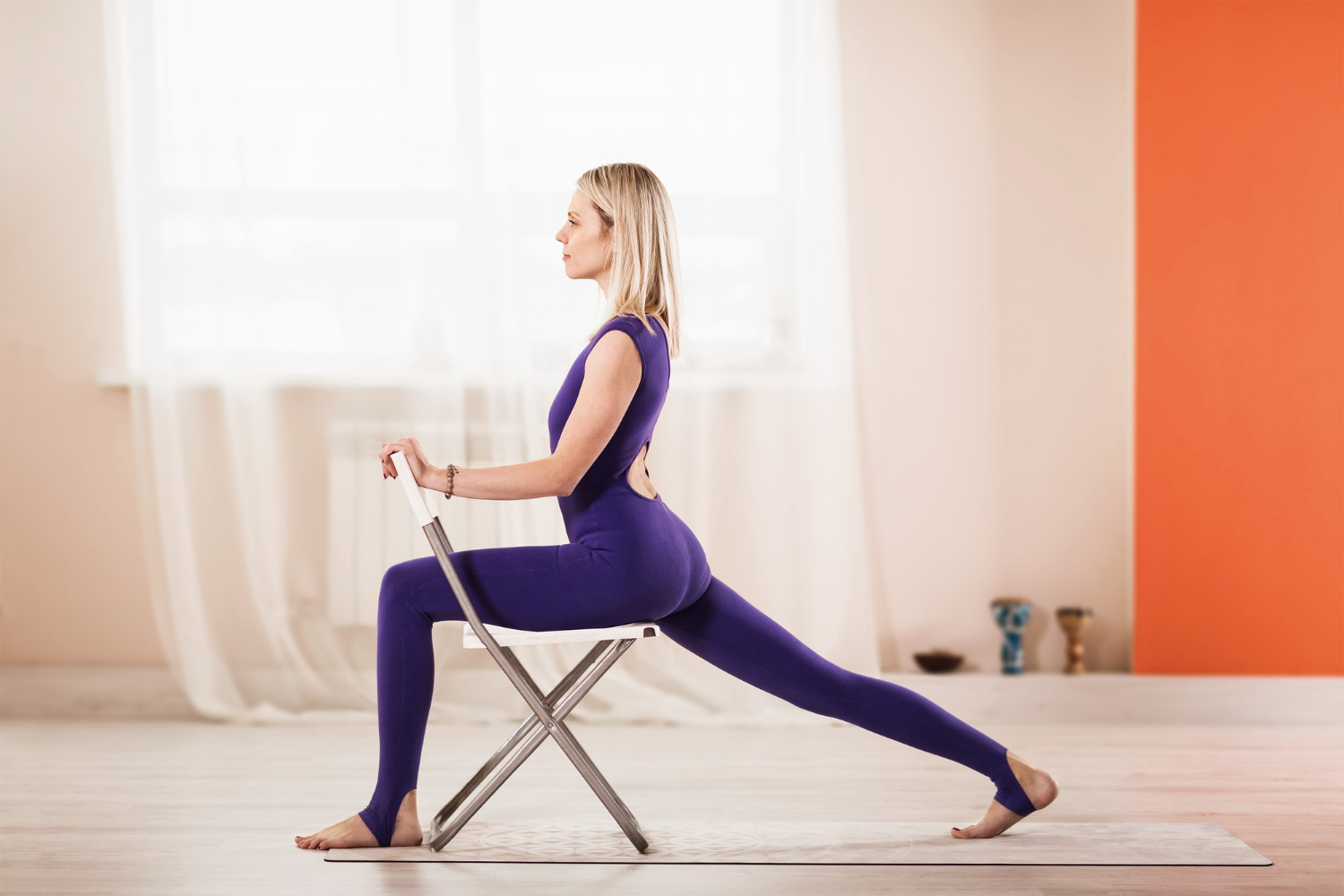
The warrior 1 pose is a variation of the traditional exercise that stretches the hip flexors and improves posture. Performing the movement in the seated position is great for those with limited mobility, allowing them to safely increase flexibility without the risk of falling.
How To Do Chair Warrior 1 Pose
- Sit on the chair with your legs to the right side of the chair so your left shoulder is beside the back of the chair.
- Shift your hips to the left so your left glute is off the chair.
- Extend your left leg back and drop your knee to the floor so your thigh is vertical.
- Straighten your left leg back to assume an extended lunge position.
- Put your palms together and lift your arms directly overhead.
- Hold position for the desired duration, then switch sides.
Instructor Cues
- Beginners should limit how far they extend the back leg. This will decrease the stretch and improve balance.
- Concentrate on breathing and relaxing with each breath. This will help you relax into the stretch.
2. Chair Hamstring Stretch
The chair hamstring stretch is an accessible version of the popular floor yoga stretch. Performed on the edge of a seat, it allows women with limited mobility to stretch the hamstrings without needing to sit on the floor.
How To Do Chair Hamstring Stretch
- Sit on the chair in the upright position, with feet planted on the floor hip-width apart.
- Shuffle forward so the hamstrings are off the chair and your weight rests on your glutes.
- Place one hand on top of the other on your right thigh.
- Brace with your left leg and straighten your right leg.
- Inhale, then exhale and with a straight spine, lean forward while running your hands down your thigh.
- Once you reach a comfortable stretch, hold for the desired duration.
- Then sit back up to the upright position and change sides.
Instructor Cues
- Focus on breathing, reaching and increasing your stretch with each exhale.
- Keep your spine straight for the duration of the stretch. This will emphasize the stretch on the hamstring.
Shoulder and Upper Back Stretches
The following shoulder and upper back stretches allow you to release tension in the upper body while in the seated position. This makes them great not only for your routine, but also during the day.
3. Chair Cross Body Shoulder Stretch
The chair cross body shoulder stretch is excellent for releasing shoulder and upper back tension. Performed in a seated upright position, it is a great addition to your chair yoga routine.
How To Do Chair Cross Body Shoulder Stretch
- Sit on the chair and place your feet shoulder-width apart.
- Lift your right arm across the body at shoulder height, holding it in place with your left arm.
- Inhale, then breathe out, and feel the stretch around the shoulders and between the shoulder blades.
- Hold for the designated duration, then switch sides.
Instructor Cues
- Hold the arm firmly in place, and focus on your breathing. This will help target the shoulder, helping to lengthen the muscle.
- Maintain an upright posture for the duration of the stretch. This will improve the stretch.
4. Chair Side Stretch
The chair side stretch is designed to lengthen the muscles of the core, back, and shoulders. Performed in the seated position with a gentle bend to the side, it is an easy way to improve upper body flexibility.
How To Do Chair Side Stretch
- Sit on the chair in the upright position and position your feet hip-width apart.
- Grasp the left side of the chair with your hand for stability.
- Lift your right arm directly overhead.
- Breathe in, then breathe out, and bend to the left side while reaching with the right hand.
- Hold for the designated duration, then switch sides.
Instructor Cues
- Bend to the side as you exhale. This will help you relax into the stretch.
- Ensure your feet are firmly planted and your hand is grasping the chair. This will create a stable base, allowing you to safely perform the stretch.
Spinal Mobility Movements
These movements help to release tension through the back, mobilize the spine, and improve posture.
5. Chair Cat Cow
The chair cat cow is an amazing exercise for mobilizing the spine and improving spinal awareness.
How To Do Chair Cat Cow
- Sit upright on the chair and place your knees hip-width apart, with hands resting on your thighs.
- Breathe in, then breathe out, and extend your back and tilt your head up to a 45 degree angle, exaggerating the upright position.
- Then breathe in, curl your spine, and round your shoulders forward.
- Exhale and return to the upright position.
Instructor Cues
- Focus on moving with your breath, exhaling and extending, inhaling and curling. This will help you relax, release tension, and improve mobility.
- Place your hands gently on the knees and avoid pushing them against your thighs.
6. Chair Side Twist
The chair side twist is a great exercise for increased rotation and stretching the back muscles. Performed in the seated position with a simple rotation, it can be programmed in almost any routine.
How To Do Chair Side Twist
- Sit on the chair with your legs on the left side so your left shoulder is beside the back of the chair.
- Position your feet shoulder-width apart, and firmly plant your feet on the floor.
- Exhale and rotate your torso 90 degrees toward the back and grasp the backrest with both hands.
- Hold for a moment, breathe in, and then return back to the starting position.
- Perform for the designated duration or number of repetitions, and then change sides.
Instructor Cues
- Keep your feet planted and facing forward. This will help you get a better stretch.
- Start with smaller rotations and gradually increase until you reach 90 degrees.
Balance Training Fundamentals with Chair
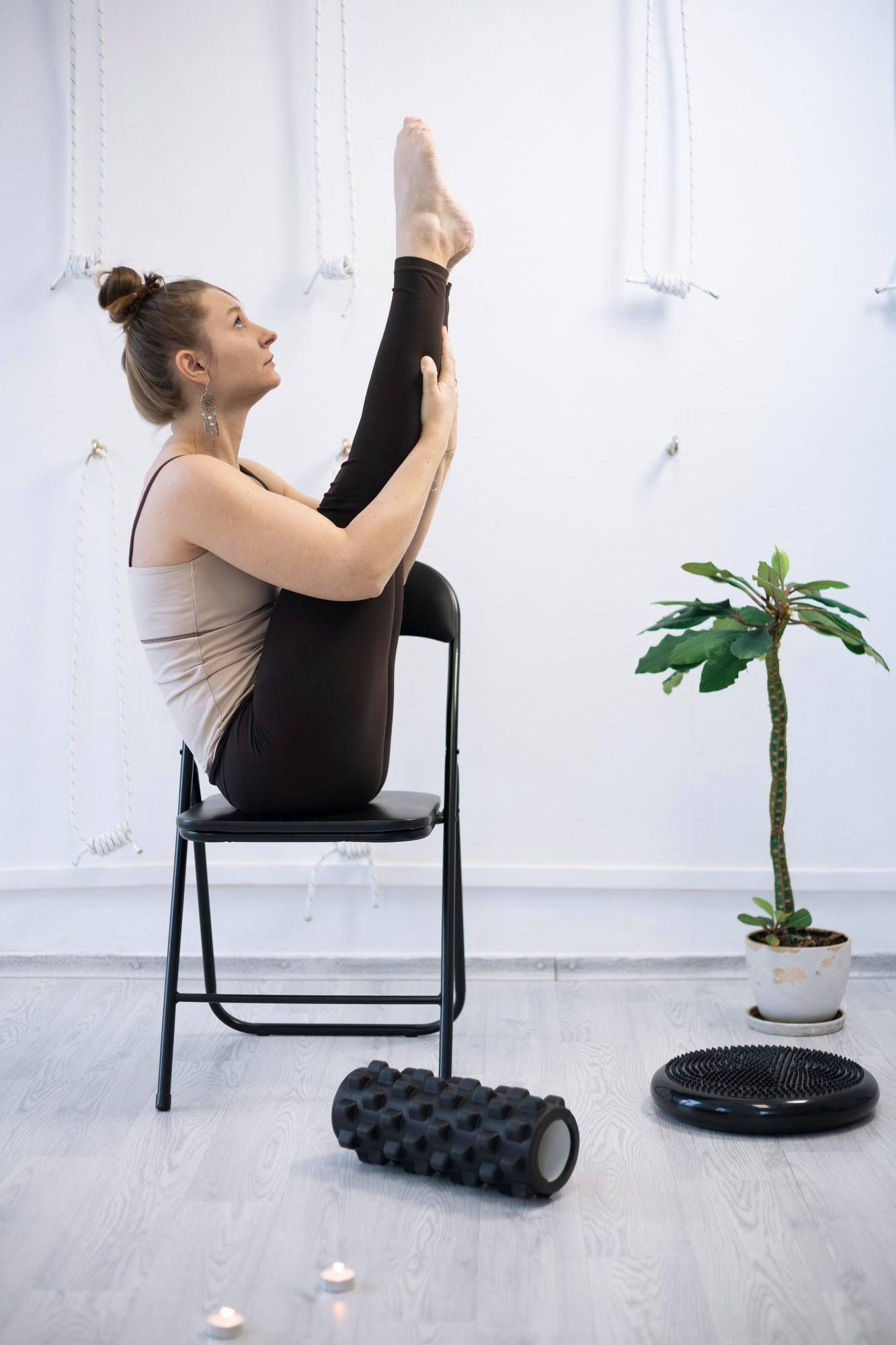
Balance training with chair yoga requires a gradual increase of instability to develop awareness. Below, we discuss balance training fundamentals, including how to build confidence, progress challenges, and develop awareness.
How Chair Support Builds Confidence
The chair is the perfect piece of equipment for developing balance as it provides a stable surface both in the seated and standing positions.
When seated, it can be used to develop single leg balance and core stability without the risk of falling. This allows you to gradually increase difficulty and confidence.
The chair is also fantastic for providing support and balance in the standing position, allowing you to gradually decrease support and transition to performing movements unassisted. For women new to balance training, understanding the fundamentals of chair-based balance work is essential. Our guide on gentle chair yoga poses covers these foundational principles in detail.
Progressive Balance Challenge Levels
The chair is excellent for providing support and allowing you to progress to unsupported and traditional yoga poses. This can be done by taking the following steps:
- Perform With Support: Perform the movement with one or both hands for support, focusing on technique.
- Gradually Reduce Support: Gradually reduce the amount of contact with the chair. This can mean alternating sets and repetitions.
- Extend Duration: Once you are comfortable with removing support, test yourself by extending the durations of your poses or holds without support. This may be short in the beginning, but it will increase.
- Perform Without Support: Perform the majority of your balance exercises without support, only relying on it when necessary.
Proprioceptive Awareness Development
Research defines proprioception as one's awareness of their body's position and movement through space. This happens when mechanoreceptors of the joints, muscles, tendons, and skin send proprioceptive signals to the brain.
Sources suggest that decreased proprioception may affect control of muscle tone, disrupt posture reflexes, and impact spatial awareness.
This can be addressed by performing tasks such as balance training on unstable surfaces, weight bearing exercises (resistance training), repetitive practice, and performing dual tasks (balancing while doing another activity).
Chair yoga employs variations of these elements, using positioning, body weight resistance, repetitions, and complex movements to challenge and develop proprioceptive awareness.
6 Chair Yoga Poses for Better Balance
.jpeg)
Here is a list of six chair yoga poses. Each pose contains a brief description, instructions, and instructor cues to help enhance your balance.
Supported Standing Balance Poses
The following poses are designed with the intention of developing your balance using a chair and progressing toward no support.
1. Tree Pose
The chair yoga tree pose is a supported variation of the traditional yoga exercise designed to improve balance. Performed by balancing on one leg with the chair for support, it helps to gradually develop balance, strength, posture, core, and legs.
How To Do Tree Pose
- Stand at the back of the chair to the left side of your body.
- Place your left hand at the back of your chair for support.
- Lift your right foot and bend your right knee out to the side.
- Place your foot on the inside of the lower left leg.
- Raise your right arm over your head.
- Hold for the assigned duration, then switch sides.
Instructor Cues
- Maintain upright posture for the duration of the movement. This will help you balance.
- Support yourself using the chair and gradually challenge yourself by reducing the support over time.
2. Foot to Seat Pose
The foot to seat pose is an excellent movement for developing standing balance. Performed in a standing lunge position with one foot on the chair, it helps strengthen the legs and core, and improves circulation and balance.
How To Do Foot to Seat Pose
- Stand beside the side of the chair, and place your right hand on the back for support.
- Place your left foot on the seat to assume a standing lunge position.
- Reach your left hand overhead and hold for the desired duration.
- Once complete, switch sides.
Instructor Cues
- Use a stable chair or position the opposite side against a wall. This will stop it from shifting during the pose.
- Focus on breathing and relaxing into the stretch.
Weight-Shifting Exercises
The following exercises are designed to help you improve balance while shifting your weight.
3. Chair Squat
The chair squat is a core and lower body exercise that replicates the movement of sitting down and standing up from a chair. When performed with correct technique, it requires the muscles surrounding the ankles, hips, and abdomen to stabilize and balance.
How to Do Chair Squats
- Sit on the chair with your feet firmly planted shoulder-width apart.
- Straighten your arms out in front so they are parallel with the floor.
- Breathe in, then exhale and engage your abdominal muscles.
- Lean forward slightly and push yourself up into the standing position.
- Lead back with your hips and lower yourself back down to the seated position.
Instructor Cues
- Maintain a straight spine and engage your abdominals for the entire set. This will help you maintain balance.
- When leaning forward, keep your spine straight and avoid rounding the shoulders.
4. Chair Yoga Lunge
The chair yoga lunge is a supported version of the traditional bodyweight exercise used to develop lower body strength and balance. Performed in a split stance while holding the chair for support, it helps strengthen legs, glutes, and core, enhancing proprioception and balance.
How to Do Chair Yoga Lunge
- Stand facing the back of your chair, and place your hands on the back for support.
- Step back with your left leg to assume a split stance so your toes are on the ground and the heel is lifted.
- Inhale, then exhale and tense your abdominal muscles.
- Lower the back knee down to the floor until your front knee is bent 90 degrees.
- Then exhale as you push yourself back up to the starting position.
- Perform all repetitions on one side, then change sides.
Instructor Cues
- Focus on lowering the back knee to the floor. This will help you perform with correct technique.
- Keep your core engaged and torso upright. This will help you maintain balance.
Dynamic Balance Challenges
These dynamic balance challenges help improve your balance while moving. Below, we provide a seated and standing exercise that allows you to gradually develop your balance.
5. Chair Knee Lifts
Chair knee lifts are great for targeting the core and hip flexors. When each leg is lifted, the core must engage to maintain balance.
How To Do Chair Knee Lifts
- Sit upright on the chair with your feet hip-width apart.
- Breathe in, then breathe out and engage your core muscles.
- Raise your left knee and lift your left foot off the floor 10 cm.
- Pause for a moment, then place it back on the floor.
- Alternate for the desired number of repetitions.
Instructor Cues
- Concentrate on breathing, keeping your core engaged, your torso upright, and avoid tilting the body side to side. This will help you develop core strength.
- Start with small lifts and progress to larger ones. This will help you gradually build up coordination and balance.
6. Standing Knee Lift
The standing knee lift is the natural progression from the seated version. During this exercise, the chair is held for support, while the core, hips, and ankles work to balance and stabilize the body. This means that as your balance improves, you rely less on the chair until you are able to perform without additional support.
How To Do Standing Knee Lift
- Stand behind your chair with your hands resting on the backrest.
- Take a small step back so that your arms are gently straightened.
- Inhale, then exhale, and engage your abdominal muscles.
- Lift your right knee off the floor until your thigh is parallel to the floor.
- Hold for one second, then place your foot back on the floor.
- Alternate sides for the designated number of repetitions.
Instructor Cues
- Beginners should use the chair for complete support and focus on keeping the spine aligned (not tilting or shifting), and engaging core muscles.
- Once you have established your technique, begin testing your balance by reducing your reliance on the chair for support.
Combining Flexibility and Balance Practice

Careful consideration must be taken when combining your flexibility and balance movements. Each session should flow between poses and positions, allowing you to transition between movements.
To illustrate this, we have created a 25-minute routine. It begins with lengthening muscles and mobilizing joints, before moving into balance training.
Each movement is listed with sets, duration, and rest times, and there is also a weekly schedule to help you set your routine. Movements performed on one side should be switched and held for the duration written below.
Understanding how to structure a complete chair yoga practice helps you progress safely. For comprehensive guidance on building your practice, see our complete chair yoga practice guide, which covers 30+ poses, breathing techniques, and progressive training plans.
Sample 25-Minute Integrated Routine
| Exercise | Sets | Duration | Rest Time |
|---|---|---|---|
| Chair Cat Cow | 1 | 30–60 secs | 15–30 secs |
| Chair Cross-Body Shoulder Stretch | 1 | 30–60 secs | 15–30 secs |
| Chair Side Twists | 1 | 30–60 secs | 15–30 secs |
| Chair Knee Lifts | 2 | 30–60 secs | 15–30 secs |
| Chair Squats | 2 | 30–60 secs | 15–30 secs |
| Chair Yoga Lunges | 2 | 30–60 secs | 15–30 secs |
| Foot on Seat Pose | 1 | 30–60 secs | 15–30 secs |
| Tree Pose | 1 | 30–60 secs | 15–30 secs |
Weekly Practice Structure
The weekly structure for a chair yoga program is 2-3 times per week. This helps you develop your flexibility and balance while allowing for 3-4 days recovery.
When implementing your chair yoga routine, you must consider your schedule and be realistic about the number of sessions you can perform. While programming 4+ sessions per week will get you great results, it can place stress on your commitments outside of yoga and may lead to burnout, derailing your program.
Scheduling your program based on your availability makes it easier to maintain consistency, which will lead to long-term results.
Tracking Improvements
Tracking your sessions is essential for developing balance and flexibility. We recommend logging your sets, repetitions, and duration after each session, including observations regarding your balance and flexibility. Recording this information each session will give you real data, highlighting your progress.
Daily Habits Supporting Flexibility and Balance
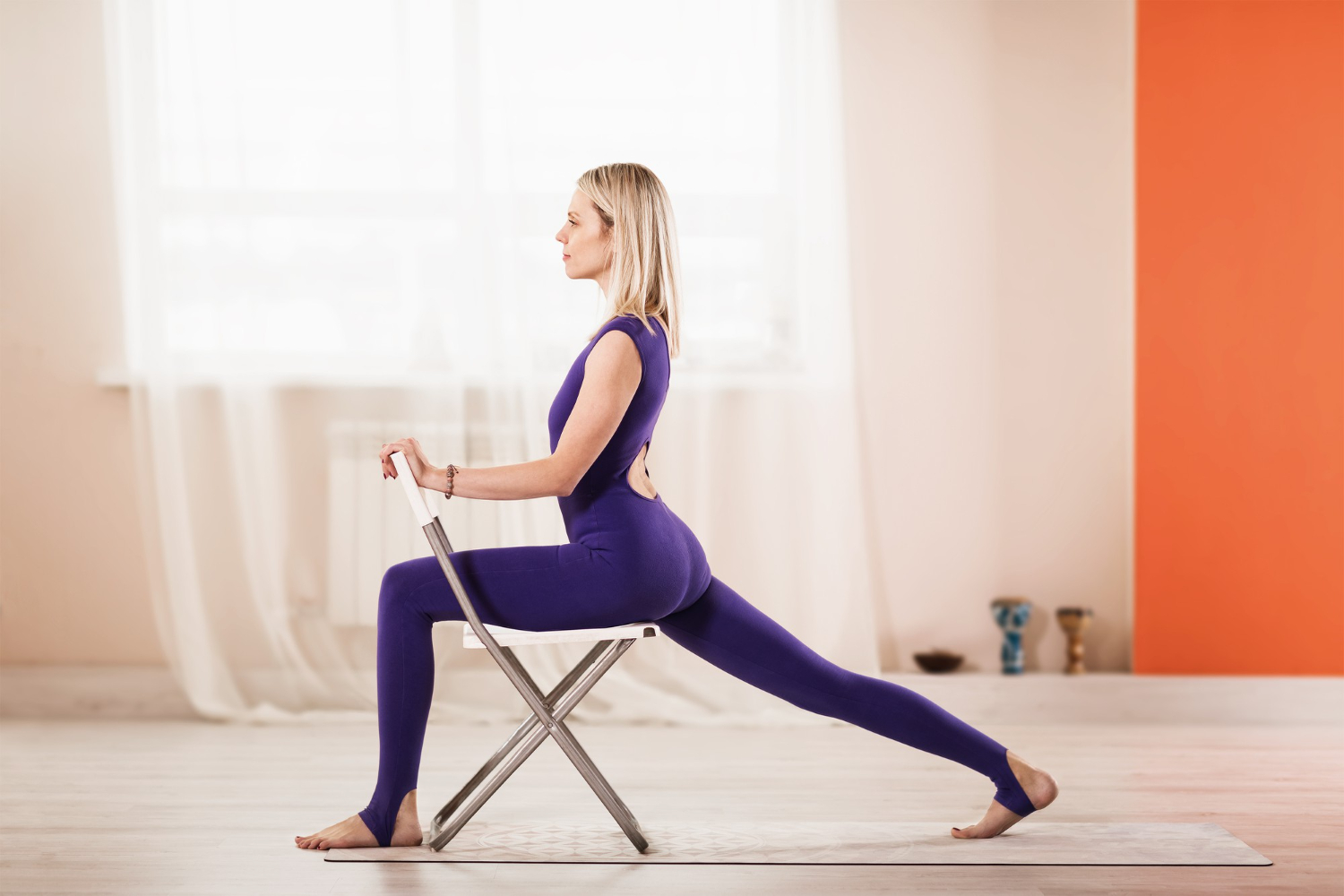
Chair yoga is undoubtedly one of the most accessible means of developing balance and flexibility. However, you must implement daily habits for long-term change.
Below, we explain how to integrate your balancing techniques throughout the day, as well as environmental modifications and realistic timelines for improvement.
Movement Snacks Throughout Day
Adding movements that test your balance and flexibility helps you implement what you practice during your sessions.
Here is a list of different movement snacks based on our poses and exercises listed above, ordered by ease of implementation:
- Chair Squats: Perform your chair squat every time you sit down or stand up. This will reinforce good habits and continue to develop balance, core, and lower body strength.
- Chair Cat Cow: Use this during the day to release tension and mobilize the spine.
- Chair Knee Lifts: Perform these when sitting at your desk or table. This is a great way to strengthen your core and hip flexors while improving circulation.
- Tree Pose: Perform single-leg standing during the day such as standing in line or at your kitchen counter. Doing this regularly will improve proprioception, resulting in better balance.
- Chair Yoga Lunge: This exercise mimics tasks such as stepping and walking up stairs. To make this a movement snack, try walking up the stairs without using the handrail and pushing off each foot evenly. This will improve balance and single leg strength.
Chair yoga represents just one approach to gentle, joint-friendly movement. Women over 40 benefit from exploring different modalities to find what works best for their bodies. Low-impact workouts like walking, swimming, and resistance training complement chair yoga beautifully, providing variety while protecting joint health.
For those seeking deeper nervous system regulation alongside flexibility work, somatic yoga offers a complementary practice. Somatic yoga for women over 40 focuses on internal sensation and stress release, making it an excellent pairing with chair-based balance training.
Environmental Modifications
Modifying your environment is an excellent way to test your balance and challenge yourself outside of your sessions. This can be done in the following ways:
- Reduce hazards by improving lighting, removing clutter, and organizing items.
- Change the furniture arrangement so that it can be used as support for balance when walking in certain rooms. This will encourage you to move more, providing you with more opportunities to test your balance.
- Position items around the house on countertops, tables, and chairs. This will provide you with more opportunities to walk around and test your balance.
Realistic Timeline for Improvements
When it comes to developing balance and flexibility, it is important to manage your expectations, as improvements and plateaus are a natural part of the process.
Everyone's timeline for improvement is different as variables such as training time, daily practice, and personal conditions vary between participants.
The key is to track your performance each session by recording your sets, repetitions, and duration, along with any other notes. This will provide you with accurate information on your performance, which not only shows you how much you have improved, but also provides you with motivation to push through during challenging times.
Chair Yoga for Flexibility and Balance: Key Takeaways
Chair yoga provides women over 40 with a safe, accessible path to rebuilding flexibility and balance two critical components of healthy aging and fall prevention.
What we covered:
- How estrogen decline and tissue stiffening reduce flexibility and balance after 40
- Why chair support makes yoga accessible while maintaining effectiveness
- Three core flexibility principles: duration over intensity, breathing into stretches, and progressive deepening
- Six chair yoga poses specifically targeting flexibility (hip flexors, hamstrings, shoulders, spine)
- How chair support builds confidence through gradual progression from full support to independent movement
- Six chair yoga poses designed to develop balance through supported standing, weight-shifting, and dynamic challenges
- A complete 25-minute integrated routine combining flexibility and balance work
- Practical daily habits including movement snacks and environmental modifications
Start with the 25-minute beginner routine twice this week, focusing on proper breathing and form rather than speed. Track your sets and duration to measure progress over the coming weeks. Consistency matters more than perfection two quality sessions per week will deliver measurable improvements within 4-6 weeks.
Chair Yoga that meets you where you are.
Get your planSources
- Chidi-Ogbolu, N. and Baar, K. (2019) 'Effect of estrogen on musculoskeletal performance and injury risk', Frontiers in Physiology, 9, 1834. doi:10.3389/fphys.2018.01834. https://www.frontiersin.org/journals/physiology/articles/10.3389/fphys.2018.01834/full
- Wicaksono U, Sadu B, Er Unja E, Prayogo D, Rachman A, Ladjar II. Health promotion through movement: Examining the correlation between lower extremity flexibility, balance, and demographic factors. J Educ Health Promot. 2025 Jul 31;14:314. doi: 10.4103/jehp.jehp_1347_24. PMID: 40917973; PMCID: PMC12413120. https://pmc.ncbi.nlm.nih.gov/articles/PMC12413120/
- Shin S. Meta-Analysis of the Effect of Yoga Practice on Physical Fitness in the Elderly. Int J Environ Res Public Health. 2021 Nov 6;18(21):11663. doi: 10.3390/ijerph182111663. PMID: 34770176; PMCID: PMC8583600. https://pmc.ncbi.nlm.nih.gov/articles/PMC8583600/
- Warneke K, Wirth K, Keiner M, Schiemann S. Improvements in Flexibility Depend on Stretching Duration. Int J Exerc Sci. 2023 Jan 1;16(4):83-94. doi: 10.70252/LBOU2008. PMID: 37113511; PMCID: PMC10124737. https://pmc.ncbi.nlm.nih.gov/articles/PMC10124737/
- Adityasiwi, G.L., Wirata, R.B., Wijanarko, F., Susanto, N.A. and Nugroho, T. (2025) 'Diaphragmatic breathing for improving lumbar flexibility: An experimental study on final-year students at STIKES Bethesda Yakkum Yogyakarta', Majalah Ilmiah Fisioterapi Indonesia, 13(1), pp. 71–76. doi:10.24843/mifi.000000620. https://www.researchgate.net/publication/396574284_Diaphragmatic_Breathing_for_Improving_Lumbar_Flexibility_An_Experimental_Study_on_Final-Year_Students_at_STIKES_Bethesda_Yakkum_Yogyakarta
- Norelli SK, Long A, Krepps JM. Relaxation Techniques. [Updated 2023 Aug 28]. In: StatPearls [Internet]. Treasure Island (FL): StatPearls Publishing; 2025 Jan-. Available from: https://www.ncbi.nlm.nih.gov/books/NBK513238/
- Valdes K, Manalang KC, Leach C. Proprioception: An evidence-based review. J Hand Ther. 2023 Oct 26:S0894-1130(23)00142-4. doi: 10.1016/j.jht.2023.09.015. Epub ahead of print. PMID: 39492292. https://pubmed.ncbi.nlm.nih.gov/39492292/
- Aman JE, Elangovan N, Yeh IL, Konczak J. The effectiveness of proprioceptive training for improving motor function: a systematic review. Front Hum Neurosci. 2015 Jan 28;8:1075. doi: 10.3389/fnhum.2014.01075. PMID: 25674059; PMCID: PMC4309156. https://pmc.ncbi.nlm.nih.gov/articles/PMC4309156/
FAQs
Is chair yoga effective for improving flexibility and balance?
Yes, chair yoga effectively improves both flexibility and balance in women over 40. Research demonstrates that yoga positively affects balance and lower body flexibility, and these benefits transfer to chair-supported variations. The chair provides stability that allows you to hold stretches longer (which research shows is the key factor in flexibility gains) while building balance confidence through progressive reduction of support.
How long before I see results from chair yoga?
Most women notice initial improvements in flexibility within 2-3 weeks of consistent practice (2-3 sessions per week). Balance improvements typically become noticeable around the 4-6 week mark. Significant measurable changes in range of motion and balance confidence usually occur within 8-12 weeks of regular practice.
Can chair yoga replace physical therapy for balance issues?
No, chair yoga should not replace physical therapy if prescribed by a healthcare provider. Chair yoga serves as an excellent complement to physical therapy or as preventive practice for those without diagnosed balance disorders. If you have significant balance impairment, fall history, or inner ear conditions, consult your physician before starting any new exercise program.
Is chair yoga safe for complete beginners with no exercise experience?
Yes, chair yoga is one of the safest entry points into exercise for complete beginners. The chair provides constant support that prevents falls and assists with proper form. Start with just the seated poses (cat cow, knee lifts, twists) for the first 1-2 weeks to build confidence before progressing to standing poses. Always keep one hand on the chair when standing until your balance improves.
How many times per week should I practice chair yoga for flexibility and balance?
Practice 2-3 times per week with at least one rest day between sessions. This frequency provides enough stimulus for flexibility and balance improvements while allowing adequate recovery. Beginners should start with twice weekly for the first month, then add a third session if desired. Daily practice is not necessary and may lead to overuse fatigue.