Chair Yoga that meets you where you are.
Get your plan
Chair Yoga that meets you where you are.
Get your plan
Chair yoga is a modified form of yoga that adapts traditional poses using a chair for support, making the practice accessible to individuals with limited mobility, balance concerns, or joint sensitivity.
Many people question whether chair yoga is legitimate, asking "Is this real yoga?", "Will I get similar benefits?", and "Can I progress from here?". The answer to all three is yes.
Chair yoga delivers the same core benefits as traditional yoga improved flexibility, increased strength, enhanced balance, and reduced stress while providing the stability needed for women over 40 who may be managing joint concerns, returning to movement after injury, or beginning their fitness journey.
In this article, we cover chair yoga fundamentals for women over 40, including safe setup practices, proper breathing and alignment techniques, eight essential beginner poses with detailed instructions, and how to create your personalized practice routine.
Why Chair Yoga Works for Women Over 40

Chair yoga is particularly effective for women over 40 because the chair provides stable support that enables confident movement while delivering measurable results. The effectiveness stems from three primary factors: accessibility without compromising benefits, joint-friendly flexibility development, and confidence building through supported practice.
Accessibility Without Sacrificing Benefits
Accessibility in chair yoga refers to the ease with which practitioners can perform movements regardless of physical limitations. The chair creates a stable foundation that makes yoga available to beginners and those with functional restrictions who cannot safely perform floor-based poses or maintain balance in traditional standing positions.
Traditional yoga offers exceptional benefits for strength, mobility, and functional movement. However, not everyone can balance on one leg or transition from standing to floor positions without assistance. The chair serves as both support structure and resistance modifier, making movements more accessible while preserving the strengthening and stretching effects.
By providing adjustable support, the chair allows practitioners to learn proper techniques, develop baseline strength, and experience yoga's benefits without the barriers that traditional practice presents. The supported positions enable full participation in poses that would otherwise be impossible.
Joint-Friendly Approach to Flexibility
Joint-friendly flexibility development refers to improving range of motion without aggravating sensitive joints or causing pain. Yoga is widely recognized for lengthening muscles and mobilizing joints through controlled stretching. For women over 40 dealing with arthritis, previous injuries, or age-related stiffness, achieving the positions necessary for flexibility gains can be challenging and sometimes painful in traditional yoga.
The chair provides crucial support that enables practitioners to safely enter stretching positions that would be too intense or unstable without assistance. This supported positioning allows effective flexibility improvement while minimizing joint stress. The ability to control depth and intensity through chair support makes progressive flexibility development possible for those with limitations.
Building Confidence Through Supported Practice
Confidence in movement refers to the mental assurance and physical self-efficacy needed to attempt new exercises and push personal boundaries. Beginners and women with limited function often lack the strength, balance, or coordination to hold poses, maintain balance, or move through full ranges of motion independently.
The chair creates stability that allows practitioners to confidently explore movements beyond their current limitations. This supported exploration builds both physical capabilities strength, flexibility, and mobility and psychological confidence. As physical abilities improve through consistent practice, mental confidence grows proportionally, creating a positive reinforcement cycle that supports long-term adherence.
Many women over 40 wonder whether chair-based exercises can truly deliver fitness results comparable to traditional workouts. Chair yoga demonstrates that modified movements with proper form and consistency produce real, measurable improvements in strength and flexibility while respecting the body's current limitations.
Women exploring chair-based movement often compare different modalities to find the best fit for their needs. Both chair yoga and wall pilates offer low-impact approaches to building strength and mobility, though they differ in technique and focus. For a detailed comparison of these complementary practices, see our guide to chair yoga vs wall pilates to determine which approach aligns with your goals.
Setting Up for Safe Chair Yoga Practice
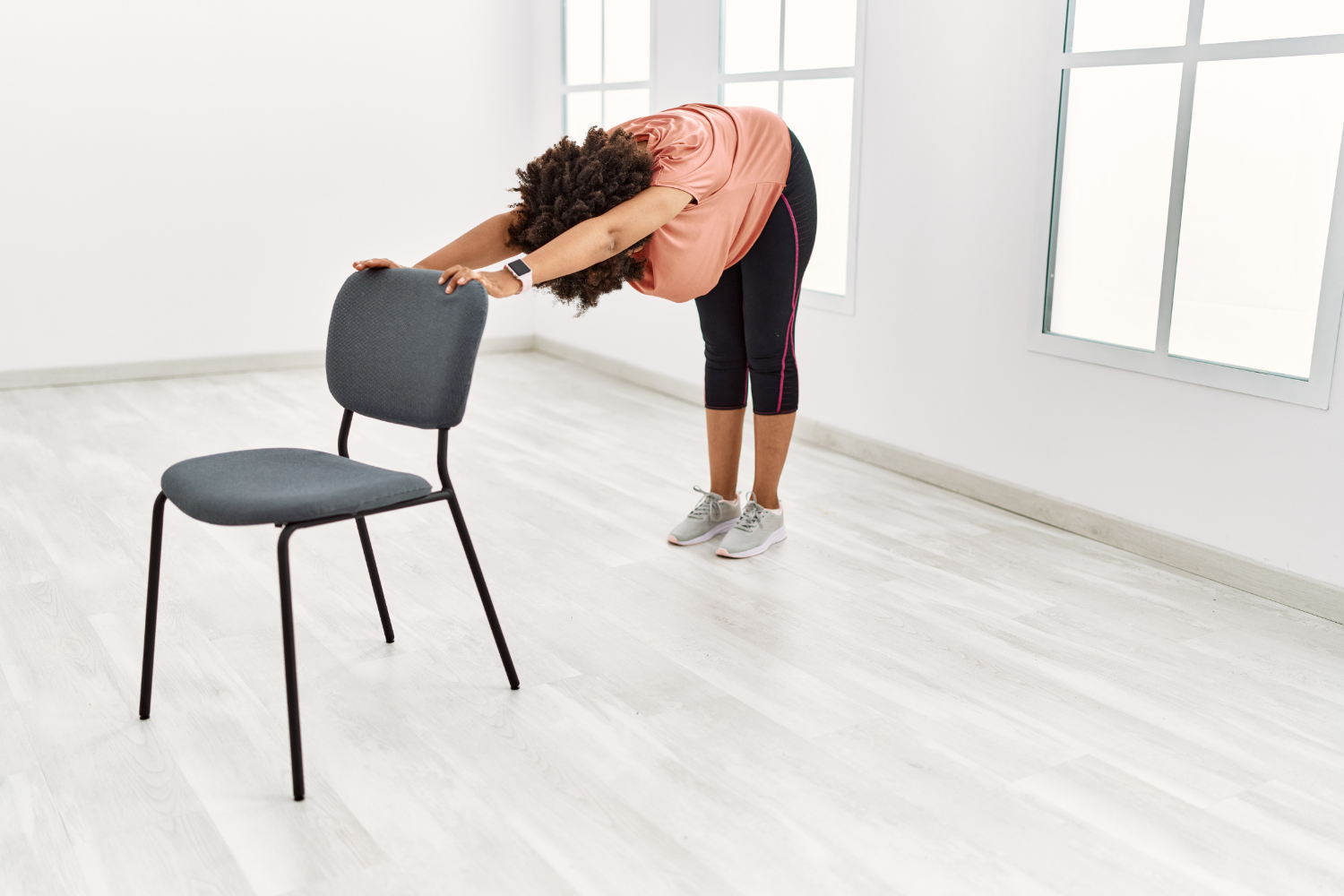
Safe chair yoga practice requires proper equipment selection and environmental preparation. Chair selection, positioning, prop usage, and practice space arrangement all contribute to injury prevention and practice effectiveness.
Choosing and Positioning Your Chair
Chair selection is the foundational decision for safe practice. The ideal chair for yoga must meet specific stability and sizing criteria to provide proper support without creating new problems.
Your chair should meet these requirements:
- Feet rest flat on the floor when seated comfortably (proper leg alignment)
- Knees form 90-degree angles with thighs parallel to floor (optimal joint positioning)
- Legs and base are even and stable with no wobble (safety)
- Rubber feet or non-slip base prevents sliding (security during movement)
- Armless design allows free arm movement (full range of motion)
- Sturdy construction supports body weight plus dynamic forces (durability)
Regarding position, place the chair's back against a wall with at least three feet of clearance on all other sides. Wall placement prevents backward shifting during poses, while surrounding space allows arm and leg movements without obstruction.
Optional Props that Enhance Practice
Props are supplementary equipment that modifies positioning or provides additional support. While not required, strategic prop use enhances comfort and enables proper form when body proportions or limitations would otherwise interfere.
If sitting down and standing up proves difficult with hips and knees at 90 degrees, place a firm cushion or folded towel on the seat. This elevation raises the hips above 90 degrees, making transitions easier and reducing knee strain during seated poses.
Additional useful props include:
- Yoga blocks for hand support in forward folds
- Straps for extending reach in stretches
- Bolsters for supported seated positions
- Small towels for joint cushioning
Each prop serves a specific purpose: modifying distance, providing support, or reducing pressure on sensitive areas.
Creating Appropriate Space
Practice space refers to the physical environment where you perform chair yoga. An optimized space minimizes distractions and creates a mental association between location and practice, supporting consistency.
Create an effective practice space by implementing these changes:
- Remove electronic distractions (phone, devices, television)
- Reduce visual clutter from surfaces
- Ensure adequate lighting without glare
- Maintain comfortable temperature (68-72°F ideal)
- Designate the area exclusively for yoga when possible
The psychological benefit of a dedicated space cannot be overstated. When you consistently practice in the same location, your mind associates that environment with focused movement, making it easier to shift into the mindful state that yoga requires.
Fundamental Chair Yoga Breathing and Alignment
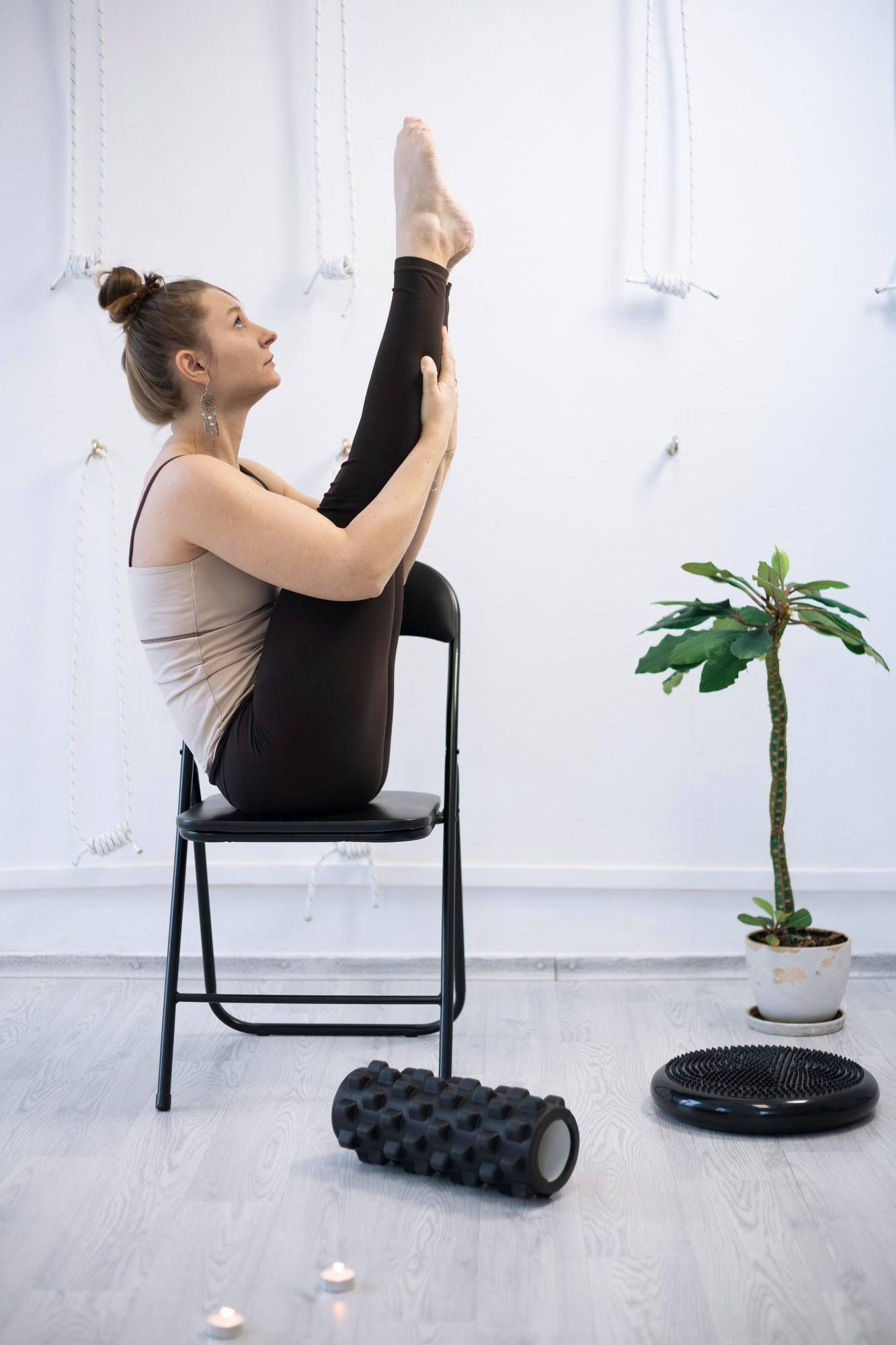
Proper breathing and alignment form the foundation of effective chair yoga practice. Before learning specific poses, you must understand seated posture fundamentals, breath awareness techniques, and core engagement principles.
Seated Posture Fundamentals
Seated posture refers to the alignment of your spine, head, and pelvis while sitting. Proper alignment distributes weight evenly, reduces strain, and enables effective movement.
Achieve correct seated posture using these cues:
- Sit toward the front half of the chair seat (allows spine to stack naturally)
- Spine straight and elongated from tailbone to crown of head
- Shoulders relaxed, drawn back and down (not hunched forward)
- Chin level with the floor (neutral neck position)
- Abdominals gently engaged (light activation, not clenching)
- Feet flat on floor, hip-width apart
This posture can be challenging initially, particularly maintaining spinal length while keeping shoulders relaxed. Like all yoga positions, consistency makes it progressively easier. Most practitioners can maintain proper seated posture for several minutes within 2-3 weeks of regular practice.
Breath Awareness and Patterns
Breath awareness refers to conscious attention to your breathing pattern, depth, and rhythm. Proper breathing techniques are central to yoga practice, influencing both nervous system state and movement quality.
Yoga emphasizes nasal breathing, which research shows engages the parasympathetic nervous system more effectively than mouth breathing. This activation promotes relaxation and reduces stress response. When correctly synchronized with movement, nasal breathing allows you to relax into poses and flow smoothly between positions.
Foundational breathing techniques for chair yoga include:
Victorious Breath (Ujjayi Breath): Gently constrict the back of your throat to create a soft ocean-like sound during both inhale and exhale. This audible breath helps maintain focus and regulates breathing pace.
Alternate Nostril Breathing (Nadi Shodhana): Sitting upright, bring your right hand to your face with thumb and ring finger positioned on either side of your nose. Close your right nostril with your thumb and inhale through the left nostril. At the top of the inhale, release your thumb, close your left nostril with your ring finger, and exhale through the right. Reverse the pattern. This balances both sides of the nervous system.
Breathing techniques are fundamental to effective yoga practice across all styles and modifications. Understanding proper breath control enhances not only chair yoga but serves as a foundation for any movement practice you may explore.
The breath-focused nature of chair yoga makes it particularly effective for stress management and nervous system regulation. Women over 40 dealing with chronic stress, sleep disruption, or accumulated tension often find that combining chair yoga's gentle movements with intentional breathwork creates profound calming effects. For women seeking deeper stress relief through movement, somatic yoga offers complementary techniques focused specifically on nervous system healing.
Bee Breath (Bhramari Breath): Inhale through the nose, then exhale while producing a humming sound similar to a bee, optionally covering your ears or eyes with your hands. The vibration creates a calming effect.
Breath of Fire (Kapalabhati): Perform forceful, rapid exhales from the nose while sharply engaging the abdominal muscles. Inhales occur passively. This energizing breath should be practiced in short intervals (20-30 seconds) with rest between rounds.
Box Breathing: Inhale for 4 counts, hold for 4 counts, exhale for 4 counts, and hold for 4 counts. This creates a square breathing pattern that promotes calmness and focus.
Begin with simple nasal breathing before progressing to specialized techniques. Master one technique before adding another.
Core Engagement While Seated
Core engagement refers to the activation of deep abdominal and back muscles that stabilize the spine and pelvis. Proper core activation creates the foundation required to perform movements safely and effectively.
When performed correctly, the combination of good posture, core activation, and coordinated breathing creates dynamic stability. This stability allows smooth transitions between poses while protecting the spine from excessive stress.
Core engagement techniques for chair yoga:
Optimal Posture Foundation: Sit upright with head, neck, and spine aligned to create a long, neutral spine. This alignment is the prerequisite for effective core activation.
Breathing Integration: Sitting upright with a proud chest, inhale deeply while gently drawing the lower ribs down and engaging your core muscles. This breath-core connection ensures continuous activation during movement.
Transverse Abdominis Activation: Sitting upright with an open chest, inhale fully, then exhale completely while drawing your belly button toward your spine. Focus on the deep pulling sensation rather than surface muscle contraction. This engages the transverse abdominis, a corset-like muscle that stabilizes the spine and maintains core rigidity during movement.
Practice core engagement for 5-10 breaths before beginning poses. This establishes the muscle activation pattern that will support your entire practice.
8 Essential Chair Yoga Poses for Beginners

Chair yoga includes numerous poses that develop strength, flexibility, and mobility. The following eight foundational poses target upper body mobility, spinal health, lower body strength, and balance. Each pose includes a description, step-by-step instructions, and key instructor cues.
Poses 1-4: Upper Body and Spine
The first four poses target the upper body with emphasis on spinal mobility and tension release.
1. Chair Cat Cow
Chair Cat Cow is a spinal mobility exercise that alternates between flexion (rounding) and extension (arching) of the spine. Performed with coordinated breathing and proper posture, this movement lengthens paraspinal muscles, reduces movement restrictions, and relieves back tension.
How To Do Chair Cat Cow
- Sit on your chair in upright position with hands resting on your thighs
- Position feet hip-width apart, flat on the floor
- Inhale and extend your spine, gently arching your back and lifting your chest (cow position)
- Exhale, flex your spine, and round your shoulders forward while drawing belly button to spine (cat position)
- Exhale again and return to the neutral upright position
- Repeat for 8-10 cycles
Instructor Cues
- Return to neutral alignment at the end of each repetition to reset head, neck, and spine positioning. This maintains proper form throughout the set.
- Synchronize breathing with movement: inhale during extension (cow), exhale during flexion (cat). This rhythm helps your body relax and increases movement range.
2. Chair Side Twists
Chair Side Twist is a rotational movement designed to improve spinal mobility in the transverse plane. The chair's stability prevents hip rotation, allowing isolated focus on spinal rotation while providing leverage to deepen the twist safely.
The chair back serves dual purposes: it blocks hip movement and provides a handle to gently increase rotation, allowing you to gauge and progressively increase your rotational range.
How To Do Chair Side Twists
- Sit on the chair with your legs positioned to the right side so your right shoulder faces the chair back
- Plant feet firmly on the floor, hip-width apart
- Exhale and rotate right 90 degrees toward the chair back, grasping the backrest with both hands
- Hold the twist for 3-5 breaths, using your hands to gently deepen the rotation with each exhale
- Inhale and return to starting position
- Perform for the designated duration or repetitions (typically 30 seconds per side), then switch sides
Instructor Cues
- Keep feet facing forward and firmly planted throughout the movement. This maximizes the rotational stretch through the spine.
- Begin with smaller rotations (45 degrees) and gradually progress toward 90 degrees as mobility improves.
3. Chair Mountain Pose (Overhead Stretch)
Chair Mountain Pose, also called the overhead stretch, is a vertical reaching movement that lengthens the sides of the torso, mobilizes the shoulder joints, and improves spinal extension. This pose enhances posture, increases rib cage mobility for deeper breathing, and improves circulation to the upper body.
How To Do Chair Mountain Pose
- Sit upright with feet firmly planted hip-width apart
- Let arms hang by your sides with palms facing away from your body
- Inhale and lift arms up and out in a wide arc until palms meet overhead
- Hold the stretched position for 2-3 seconds, continuing to breathe
- Exhale and lower arms back down in the same wide arc to the sides
- Repeat for 8-10 repetitions
Instructor Cues
- Coordinate full inhalation with upward arm movement. This maximizes the lengthening effect through the sides of your torso.
- Maintain upright posture throughout the movement. Avoid leaning backward as arms rise; focus on vertical spine lengthening instead.
4. Chair Forward Fold
Chair Forward Fold is an adaptation of the traditional yoga forward bend designed to stretch the posterior chain (back of the body). The hinging motion at the hips lengthens the hamstrings, glutes, and entire back while the supported seated position makes the pose accessible to those who cannot perform standing forward folds.
How To Do Chair Forward Fold
- Sit upright with feet placed together, arms hanging by your sides with palms facing outward
- Inhale and lift arms overhead in a wide arc until they meet above your head
- Exhale and hinge forward at the hips, reaching arms and hands toward the floor beside your feet
- Allow your upper body to relax completely in the folded position for 2-3 breaths
- Inhale and lift the torso back to upright while raising arms overhead again
- Repeat from the overhead position for 6-8 repetitions
Instructor Cues
- Coordinate breathing with movement: inhale as you reach overhead, exhale as you fold forward. This breathing pattern helps lengthen the spine and deepen the stretch during the fold.
- At the bottom of the fold, release all muscular tension and let gravity do the work. Allow your body to relax completely with each exhale.
Poses 5-8: Lower Body and Balance
The next four movements target the lower body, emphasizing strength development, balance improvement, and hip mobility. These poses address two critical concerns for women over 40: maintaining functional balance to prevent falls and preserving hip flexibility for daily activities. For more on chair yoga's effectiveness, see our guide on can you lose weight with chair yoga.
5. Chair Knee Lifts
Chair Knee Lifts are a core and hip flexor strengthening exercise. Performed from the upright seated position, each leg lifts in a slow marching pattern that requires core stabilization to maintain posture and balance.
How To Do Chair Knee Lifts
- Sit upright with feet firmly planted hip-width apart and arms by your sides
- Inhale, then exhale and engage your abdominal muscles
- Lift your right foot off the floor, raising the knee until it reaches belly button height
- Lower the right foot back to the floor with control
- Immediately lift the left foot and knee to the same height
- Alternate legs in a controlled marching pattern for the designated duration (typically 30 seconds to 1 minute)
Instructor Cues
- Concentrate on maintaining upright posture, steady breathing, and continuous core engagement throughout the exercise.
- Use short, rhythmic breaths with each lift (exhale on lift, inhale on lower). This breathing pattern helps maintain core activation.
6. Chair Pigeon Pose
Chair Pigeon Pose is a hip-opening stretch designed to release tension in the glutes and external hip rotators. This accessible variation of the traditional pigeon pose is particularly effective for women over 40 dealing with hip tightness from prolonged sitting or reduced activity.
How To Do Chair Pigeon Pose
- Sit upright with feet planted hip-width apart
- Lift your right leg and rotate it outward so the ankle turns toward the midline of your body
- Place your right ankle on your left knee
- Allow your right knee to rotate outward until your right shin approaches parallel with the floor
- Inhale to lengthen your spine, then exhale and gently hinge forward at the hips while keeping your back straight
- Hold the stretch for 5-8 breaths (30-60 seconds)
- Return to upright position and switch sides
Instructor Cues
- Maintain a straight spine from tailbone to crown of head during the forward fold. This ensures the stretch targets the glute and hip rather than rounding the back.
- To deepen the stretch, draw the heel of the lifted leg closer to your body or hinge further forward while maintaining spinal length.
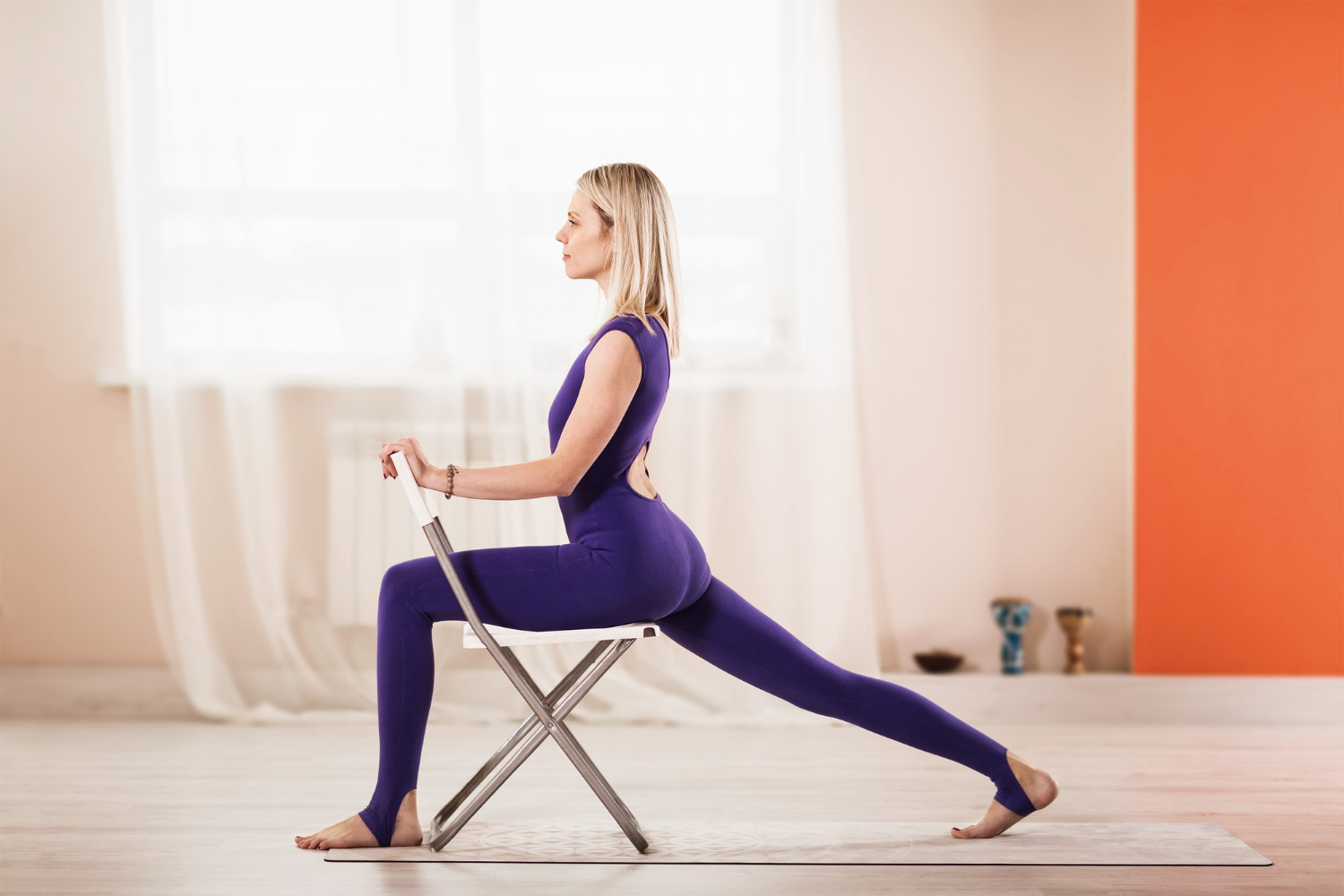
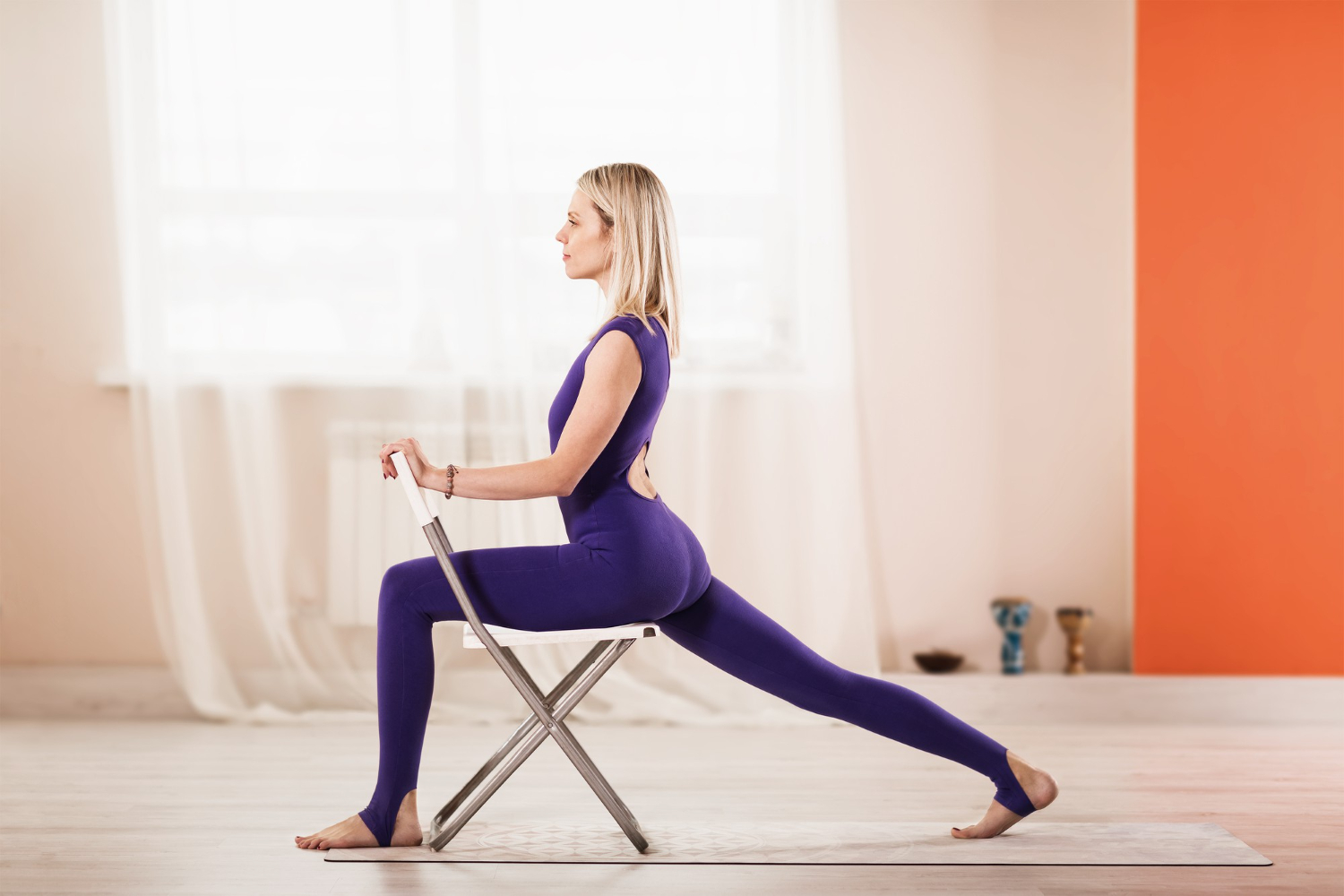
7. Chair Warrior 1 Pose
Chair Warrior 1 Pose is a seated adaptation of the traditional warrior stance that builds leg strength, improves hip flexibility, and enhances balance. The chair provides support that makes this challenging pose accessible to beginners while still delivering significant strengthening benefits.
How To Do Chair Warrior 1 Pose
- Sit on the chair with your legs positioned to the left side so your left shoulder faces the chair back
- Adjust your hips slightly to the right so your right glute is at the edge of or slightly off the chair
- Extend your right leg back and lower your right knee toward the floor until your right thigh is vertical
- Press through your right foot to straighten your right leg, creating a lunge position with the back leg extended
- Bring palms together at your chest, then press them overhead while keeping arms straight
- Hold for 5-8 breaths (30-60 seconds)
- Return to seated position and switch sides
Instructor Cues
- Focus on coordinated breathing throughout the hold. This helps deepen the hip stretch and maintain balance.
- If this is your first time, limit how far you extend the back leg (keep the back knee on the floor initially). This modification improves stability as you build strength.
8. Chair Squat
Chair Squat is a fundamental lower body strengthening exercise that builds leg and glute strength while improving balance and functional movement capacity. The chair allows practitioners to lower into a full squat depth without the risk of falling backward, making this exercise safe for those rebuilding strength.
How To Do Chair Squat
- Sit on the chair with feet spaced shoulder-width apart, firmly planted on the floor
- Straighten arms out in front so they're parallel with the floor
- Exhale and engage your core muscles
- Lean forward slightly while maintaining a straight back, then push through your feet to stand up completely
- Lean back with your hips (not your knees) and lower yourself back down to the seated position with control
- Immediately begin the next repetition (stand-sit-stand pattern)
- Perform for the designated number of repetitions (typically 8-12)
Instructor Cues
- Keep arms straight and extended throughout the entire set. This counterbalances your hips moving backward, improving stability during both the up and down phases.
- Lead the upward phase by leaning your torso forward with a straight back. This forward lean shifts your center of gravity over your feet, making it easier to stand.
- Control the lowering phase rather than dropping to the chair. Lower over a 2-3 second count to build eccentric strength.
Creating Your Chair Yoga Practice Routine
.jpeg)
Developing an effective chair yoga routine requires understanding movement sequencing principles that allow exercises to flow logically from one to the next. A well-structured sequence prepares the body progressively, maximizes benefits, and minimizes injury risk.
Sample 20-Minute Sequence
This beginner routine uses the eight poses detailed above, arranged in a sequence that follows yoga's foundational principle: mobilize and lengthen first, then strengthen.
The program focuses on lengthening and mobilizing the upper body first, followed by strengthening movements for the lower body and core, and concludes with hip flexibility work.
| Exercise | Sets | Duration/Reps | Rest Times |
|---|---|---|---|
| Chair Cat Cow | 1 set | 10 repetitions | 20 seconds |
| Chair Side Twist | 1 set | 30 seconds each side | 20 seconds |
| Chair Mountain Pose | 1 set | 10 repetitions | 20 seconds |
| Chair Forward Fold | 1 set | 8 repetitions | 20 seconds |
| Chair Squats | 2 sets | 10 repetitions | 45 seconds |
| Chair Knee Lifts | 2 sets | 30 seconds | 45 seconds |
| Chair Warrior 1 Pose | 1 set | 30 seconds each side | 45 seconds |
| Chair Pigeon Pose | 1 set | 60 seconds each side | Complete |
Total Time: Approximately 20 minutes including rest periods
How Often to Practice
Practice frequency refers to how many sessions per week you should perform to see improvements without overtraining. For beginners, 2-3 chair yoga sessions per week provides optimal results.
The movements in the program above focus on lengthening, mobilizing, and activating key muscle groups through gentle, controlled movements. This type of training is not highly fatiguing, making it suitable for frequent practice. Regular practice improves function, circulation, and stress reduction all essential for overall health in women over 40.
Many individual poses can be performed throughout your day to maintain mobility and relieve tension. Chair Pigeon Pose, Chair Mountain Pose, Chair Side Twists, and Chair Knee Lifts are all suitable for brief practice sessions during work breaks or between activities. This spontaneous practice develops proficiency and provides immediate relief from stiffness.
For women seeking comprehensive strength and flexibility development, chair yoga complements other low-impact exercise modalities particularly well. The mobility and stability gained through regular chair practice creates an excellent foundation for expanding your fitness routine.
Chair yoga serves as an ideal introduction to mindful movement for women over 40. The practice builds both physical capabilities and mental confidence through supported, progressive movements. For those ready to deepen their chair yoga practice beyond these basics, our complete chair yoga guide offers 30+ poses and advanced sequencing strategies.
Here is an example weekly schedule for the 20-minute routine:
| Mon | Tues | Wed | Thurs | Fri | Sat | Sun |
|---|---|---|---|---|---|---|
| Chair Yoga | Rest | Chair Yoga | Rest | Chair Yoga | Rest or Light Activity | Rest |
Sequencing Principles
Sequencing principles are the guidelines that determine exercise order within a yoga routine. Proper sequencing prepares tissues for more intense work, reduces injury risk, and creates a logical flow that feels natural.
A well-designed chair yoga sequence follows this pattern:
- Gentle spinal mobility (prepare the spine for all subsequent movements)
- Upper body lengthening and mobilization (release tension in shoulders, arms, back)
- Lower body strengthening (build leg and core strength)
- Intense or challenging poses (warrior poses, deeper squats)
- Hip flexibility and release (final stretching)
This sequence is evident in the 20-minute routine above. The session begins with Chair Cat Cow, Chair Side Twist, Chair Mountain Pose, and Chair Forward Fold all gentle mobilization movements performed in similar seated positions that flow naturally from one to the next.
After the body is warmed and mobilized, resistance-style exercises follow: Chair Squats, Chair Knee Lifts, and Chair Warrior 1 Pose. These movements place greater demands on muscles and cardiovascular system, requiring the foundation that warming provides.
The session concludes with Chair Pigeon Pose, a deep hip stretch that serves as both a cool-down and flexibility builder. This final pose allows heart rate to decrease while muscles are still warm and receptive to stretching.
Following this sequencing pattern in your routines will prepare your body systematically, improving performance of more intense exercises while reducing stiffness and soreness.
Modifications for Common Concerns

Women over 40 frequently manage health conditions that require exercise modifications. Understanding how to adapt chair yoga for arthritis, balance limitations, and restricted range of motion ensures safe, effective practice regardless of current ability level.
Adapting for Arthritis and Joint Pain
Arthritis adaptation refers to modifying exercises to accommodate joint inflammation, pain, and stiffness. Women over 40 commonly experience arthritis and joint pain that can make movement challenging or painful. Research has shown yoga to be effective for reducing tender and swollen joints while decreasing pain levels.
Chair yoga's supported seated position is particularly favorable for arthritis management. The stability allows practitioners to move slowly, avoid painful positions, and safely build strength and mobility without aggravating inflamed joints.
Modify your chair yoga sessions for arthritis using these strategies:
Warm-Up Thoroughly: Spend 5-10 minutes on gentle movements before beginning your routine. Warming muscles and joints establishes better mind-muscle connection, improving movement quality and decreasing pain during exercise.
Respect the 4/10 Pain Rule: On a pain scale of 0-10, working at a 4 is acceptable during rehabilitation exercise. Pain beyond 4/10 may aggravate your condition. Working to this level allows you to safely challenge your limits, which is essential for strengthening muscles and joints, without causing setbacks.
Understanding the difference between productive discomfort and harmful pain is crucial for women over 40 managing joint conditions. Gentle movement like chair yoga provides a safe pathway to rebuild strength without triggering inflammation or exacerbating existing arthritis.
Chair yoga exemplifies the principles of low-impact exercise building strength and improving function while protecting joints from excessive stress. Women managing arthritis or joint sensitivity benefit from exercises that maintain ground contact or provide continuous support throughout movements. For a comprehensive overview of low-impact exercise options beyond chair yoga, explore our guide to low-impact workouts.
Control Your Range of Motion: Limiting and controlling movement range is excellent for preventing joint aggravation. The seated position allows you to move slowly and work gradually toward a safe range of motion, improving function progressively without risking flare-ups.
Minimize Position Changes: Frequent position changes during a session may aggravate joint conditions. Perform exercises in similar positions (multiple seated poses in sequence) to decrease the stress of transitions.
Seek Professional Guidance: Consult a healthcare professional about exercise with your specific condition and work with a qualified yoga instructor who has experience with arthritis modifications. They can answer questions and provide personalized adjustments.
Balance Modifications
Balance modifications are adjustments that provide additional stability for practitioners with balance impairments or fear of falling. For women struggling with balance, chairs with armrests and strategic prop placement provide crucial support.
A chair with armrests offers hand support during Chair Squats and transitions between positions, significantly improving stability. When performing Chair Squats, lightly grip the armrests during the standing phase until strength and confidence improve.
Blocks or firm cushions placed under your feet can reduce the distance you need to stand, making the movement less challenging until leg strength develops. Alternatively, placing cushions on the chair seat elevates your hips, decreasing the depth of the squat and making standing easier.
While the seated position addresses many balance-related concerns inherently, those with significant balance challenges should:
- Practice near a wall for additional security
- Keep one hand on the chair at all times during any standing elements
- Skip or modify poses that require lifting both feet off the floor
- Work with an instructor who can provide hands-on stabilization when needed
Working with Limited Range of Motion
Range of motion adaptation refers to modifying movements for individuals who cannot achieve standard positions due to stiffness, previous injuries, or anatomical restrictions. For women with limited flexibility or mobility, chair height and movement depth can be adjusted to match current capabilities.
For those who struggle with sitting down or standing up, using a higher chair makes transitions significantly easier. Add firm cushions to the seat to raise hip height, reducing the muscular demand of the standing phase.
Movement-specific modifications based on the eight essential poses:
Chair Forward Fold: Reduce the amount of forward hinging and focus primarily on breathing and maintaining spinal alignment rather than touching the floor. Reaching toward knees or shins is perfectly acceptable.
Chair Cat Cow: Perform the movement slowly with emphasis on coordinated breathing. Flex and extend the spine only as far as your body allows without pain, even if the movement is small initially.
Chair Side Twist: Use the chair back for support but perform smaller rotations (30-45 degrees instead of 90). Gradually increase rotation as mobility improves over weeks.
Chair Squat: Elevate hips using a cushion or block to increase seated height. This reduces the depth of the squat, making both sitting and standing significantly easier until leg strength develops.
Chair Knee Lifts: Perform smaller lifts, raising the knee only 6-12 inches off the floor initially. This reduces balance challenge and decreases joint pressure while still strengthening hip flexors and core.
Progress these modifications gradually. As range of motion improves, reduce cushion height, increase movement depth, and work toward the full expression of each pose.
Progressing Your Chair Yoga Practice
Progression in chair yoga refers to systematically increasing difficulty to continue improving strength, flexibility, mobility, and balance. Without progressive challenge, improvements plateau. Understanding how to add difficulty while maintaining support, when to consider mat yoga, and how to combine chair and standing elements ensures continued development.
Adding Challenge While Staying Supported
Adding challenge while staying supported means increasing exercise difficulty without removing the safety and stability that make chair yoga effective. Progressive overload gradually increasing demand on your body is essential for ongoing improvements.
Implement these progression strategies:
Increase Sets and Repetitions: If you're performing 1 set of 8 Chair Squats, progress to 1 set of 12, then 2 sets of 10, then 2 sets of 12. This gradually increases total work volume.
Extend Hold Duration: For static poses like Chair Warrior 1 or Chair Pigeon Pose, increase hold time from 30 seconds to 45 seconds to 60 seconds over several weeks.
Decrease Rest Times: Reduce rest between exercises from 45 seconds to 30 seconds to 20 seconds. This increases intensity and improves cardiovascular conditioning.
Add Intermediate and Advanced Poses: Once the eight foundational poses feel comfortable, incorporate more challenging variations like Chair Eagle Pose, Chair Dancer Pose, or Chair Tree Pose.
Increase Range of Motion (for joint pain): If you've been limiting movement to avoid pain, gradually work toward slightly greater depth or range, respecting the 4/10 pain rule.
Reduce Support Gradually (for balance assistance): If you've been gripping armrests, progress to light fingertip contact, then hovering hands near the chair, then hands-free practice.
When to Consider Mat Transitions
Mat transition refers to moving from chair-supported practice to traditional floor-based yoga. For many women, chair yoga provides the support needed to safely and comfortably perform exercises without fall risk or joint aggravation. Over time, consistent practice builds sufficient strength and mobility to consider transitioning to mat yoga.
Consider mat transition only when you can:
- Get up and down from the floor without assistance or pain
- Maintain balance in standing positions for 30+ seconds
- Perform all eight foundational chair poses with good form
- Feel confident in your movement capabilities
Even when meeting these criteria, transition gradually within a guided session with a qualified instructor. An instructor can teach you new floor-based poses, assist with transitions between positions, and ensure proper form as you adapt to the reduced support.
Many practitioners find that a gradual transition over 2-3 months works best, starting with one mat pose per session and slowly replacing chair variations with floor versions.
Combining Chair and Standing Elements
Combining chair and standing elements means using both supported and unsupported poses within a single practice session. Transitioning to mat yoga doesn't mean abandoning chair yoga entirely. Both modalities can coexist to maintain function, support proper alignment, and continue building strength.
Begin your session with 5-10 minutes of seated chair work to gently warm up and prepare your body for more demanding standing or floor exercises. This chair-based warm-up makes the transition to the mat smoother and reduces injury risk.
Similarly, conclude mat sessions with 5 minutes of chair-based poses for a gentle cool-down that allows heart rate to decrease gradually while maintaining movement.
If you're now comfortable with both chair and mat yoga, experiment with different combinations:
- 50% chair / 50% mat (equal split)
- Chair warm-up + mat main practice + chair cool-down
- Alternate days (chair Monday/Friday, mat Wednesday)
- Use chair for balance support during standing mat poses
The flexibility to move between modalities based on how your body feels each day is one of chair yoga's greatest advantages.
Chair yoga builds an excellent mobility and stability foundation that complements resistance training. Many women over 40 find that combining chair yoga for flexibility and stress management with strength training for muscle preservation creates a comprehensive fitness approach. The improved body awareness and core stability from chair yoga enhances form during resistance exercises. For women ready to add strength work, our guide to strength training for women over 40 provides minimal-equipment approaches that pair well with chair yoga practice.
Getting Started with Chair Yoga
Chair yoga offers women over 40 a safe, equipment-minimal path to building strength, improving flexibility, and supporting overall wellness all from the comfort of home with just a sturdy chair.
What we covered:
- What makes chair yoga ideal for women over 40 (accessibility, joint-friendly approach, confidence building through support)
- Essential setup requirements (chair selection criteria, positioning guidelines, optional props, practice space optimization)
- Fundamental breathing and alignment principles (seated posture, breath awareness techniques, core engagement methods)
- Eight foundational poses with complete instructions (4 upper body/spine poses, 4 lower body/balance poses)
- Creating effective practice routines (sample 20-minute sequence, optimal practice frequency, proper sequencing principles)
- Modifications for common concerns (arthritis adaptations, balance support, limited range of motion adjustments)
- Progression strategies (adding challenge while staying supported, when to consider mat yoga, combining chair and standing elements)
Start with the 20-minute beginner sequence twice this week, focusing on proper breathing and alignment rather than depth or speed. Once these eight movements feel comfortable and your form is solid, explore progressive variations or consider working with an instructor for personalized guidance.
For those ready to expand beyond foundational poses, exploring complementary movement practices can enhance overall fitness while maintaining the gentle, joint-friendly approach that makes chair yoga effective for women over 40.
Many women find that structured guidance accelerates their progress and ensures proper technique from the beginning. Chair yoga programs designed specifically for women over 40 account for joint sensitivity, balance concerns, and realistic time constraints. A comprehensive chair yoga program provides progressive sequences, detailed form cues, and modifications tailored to your experience level.
Chair Yoga that meets you where you are.
Get your planSources
- Sinha AN, Deepak D, Gusain VS. Assessment of the effects of pranayama/alternate nostril breathing on the parasympathetic nervous system in young adults. J Clin Diagn Res. 2013 May;7(5):821-3. doi: 10.7860/JCDR/2013/4750.2948. Epub 2013 May 1. PMID: 23814719; PMCID: PMC3681046. https://pmc.ncbi.nlm.nih.gov/articles/PMC3681046/
- Haaz S, Bartlett SJ. Yoga for arthritis: a scoping review. Rheum Dis Clin North Am. 2011 Feb;37(1):33-46. doi: 10.1016/j.rdc.2010.11.001. Epub 2010 Dec 3. PMID: 21220084; PMCID: PMC3026480. https://pmc.ncbi.nlm.nih.gov/articles/PMC3026480/
FAQs
Is chair yoga effective for building strength?
Yes, chair yoga effectively builds functional strength, particularly in the core, legs, and upper body. The chair provides resistance and support that allows you to safely challenge muscles through full ranges of motion. Research shows that regular chair yoga practice (2-3 times weekly) produces measurable strength gains within 8-12 weeks, especially for women over 40 who are rebuilding baseline strength.
How long should a beginner chair yoga session last?
Beginners should start with 15-20 minute sessions and gradually extend to 30-45 minutes as stamina improves. Quality of movement matters significantly more than duration a focused 20-minute session with proper form and breathing delivers better results than a rushed 45-minute practice. Listen to your body and stop if you experience pain beyond mild muscle fatigue.
Can chair yoga help with arthritis pain?
Yes, chair yoga can significantly reduce arthritis pain and improve joint mobility. Studies show that gentle yoga practice reduces tender and swollen joints while decreasing overall pain levels in arthritis patients. The key is respecting the 4/10 pain rule, moving slowly, and working within a comfortable range of motion. The chair's support allows you to strengthen muscles around affected joints without aggravating inflammation.
Is chair yoga suitable for complete beginners with no exercise experience?
Yes, chair yoga is one of the safest and most accessible entry points into exercise for complete beginners. The chair provides stability that prevents falls and supports proper form, making injury risk extremely low. Start with the eight foundational poses presented in this article, master proper breathing and alignment, and progress gradually. Consider taking an introductory class or working with an instructor for the first few sessions to ensure proper technique.
How many times per week should I practice chair yoga to see results?
Practice chair yoga 2-3 times per week with at least one rest day between sessions for optimal results. This frequency provides enough stimulus for strength and flexibility gains while allowing adequate recovery time. Beginners should start with twice weekly and add a third session after 4-6 weeks of consistent practice. Individual poses can be performed daily during short breaks for mobility maintenance.